Origin: Austria
Date: 18th century
Material: porcelain
Technique: polychrome painting, gilding
Dimensions: height 13 cm; base 8.3 × 3.8 cm
Current Collection: The State Hermitage Museum
Inventory Number: ZF-16441
Hermitage ID: 352423
Rudanovsky Connection: Entered the Hermitage in 1919 from the collection of A. K. Rudanovsky.
An eighteenth-century Austrian porcelain figure of a child seated on a rocaille base, painted in soft colours and finished with gilding.
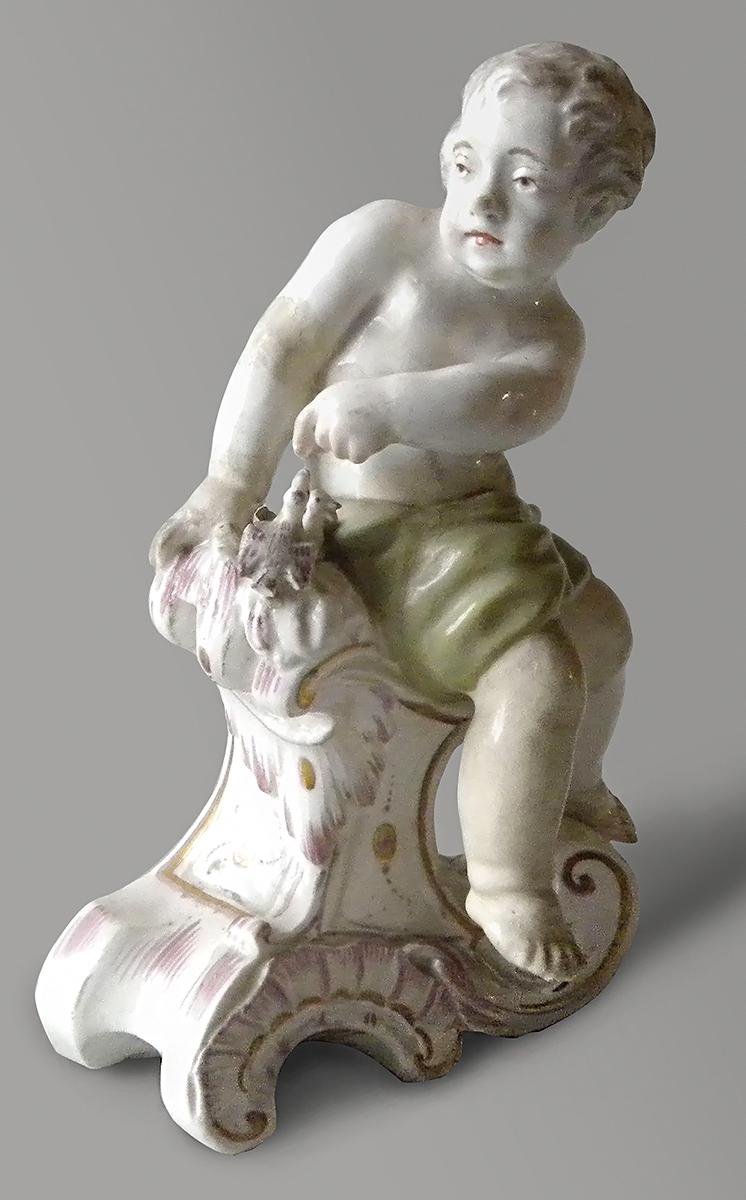
Figurine: Child Seated on a Rocaille Base. The State Hermitage Museum.
The figure entered the Hermitage in 1919 from the collection of A. K. Rudanovsky. It is not currently on permanent display.
It is a small sculpture — thirteen centimetres high — of a naked child with a green cloth around the waist, sitting on a scroll-shaped base and holding a small object in its hands.
The Object
The child sits with the body turned slightly, the head inclined, the legs crossed at the ankle.
The flesh is left in the white of the porcelain, lightly tinted; the cloth around the waist is painted a soft green; the base is white with pale pink and grey scrollwork and a gilded edge.
The surface is glossy, with the slight unevenness of hand-modelled porcelain.
The Child
The figure belongs to the long tradition of the putto.
Putti — chubby naked children — were everywhere in eighteenth-century art: on ceilings, on furniture, on porcelain. They stood for love, for innocence, for the playful side of classical mythology.
This child is not a portrait. It is a type: a soft, rounded body, a small face with a slightly parted mouth, a pose that suggests movement without effort.
Rocaille
The base is a rocaille — a scroll of shell-like, asymmetrical forms.
Rocaille is the ornamental vocabulary of the Rococo: curves that turn back on themselves, shells, rocks and foliage, arranged without symmetry. It was the dominant style of the 1730s to 1760s, and it shaped the bases of countless porcelain figures.
The base here is not a neutral plinth. It is part of the sculpture, a piece of ornament that supports and frames the child.
Austrian Porcelain
The figure is recorded as Austrian, without a factory attribution.
In the eighteenth century, Austria had several porcelain manufactories, of which Vienna was the most important. The Vienna factory, founded in 1718, produced figures, table services and decorative objects in a style influenced by Meissen and by French models.
The figure’s soft colours and rocaille base are consistent with Austrian production of the mid-eighteenth century.
Polychrome
The painting is restrained.
The flesh is almost unpainted, relying on the porcelain’s own warm white; the cloth is a single soft green; the base is touched with pink and grey. Only the gilding adds a metallic note.
This restraint is characteristic of good porcelain figures. The modelling carries the expression, and the colour supports it without competing.
The Base
The base is unusually specific.
It is recorded as 8.3 by 3.8 centimetres, a long, narrow plinth of scrollwork. Such bases were often designed to fit a figure into a group, a clock case or a table centrepiece.
The shape suggests that the figure may have been part of a larger composition, now dispersed.
Function
What was the figure for?
Porcelain figures were made for tables, cabinets and dessert displays. They stood among the dishes, or on a mantelpiece, or in a glass case, and they were admired as small sculptures.
This child, with its rocaille base, was probably one of a group — a season, a trade, a mythological scene — or a decorative figure in its own right.
The Model
The figure was made from a mould.
Porcelain figures were modelled in wax or clay, then reproduced in plaster moulds and cast in porcelain. The moulds allowed the factory to produce many versions of the same figure, with variations in painting.
The crispness of the modelling on this figure suggests a good mould and a careful cast.
The Hands
The child’s hands are the most expressive part of the figure.
They are clasped in front of the body, holding a small object that is difficult to identify — perhaps a flower, perhaps a bird. The gesture is gentle and slightly hesitant, and it gives the figure its character.
Modelling hands in porcelain is difficult: they are small, thin and prone to warping in the kiln. The security of the hands here is a sign of a skilled modeller.
The Green Cloth
The green cloth around the waist is the only strong colour on the figure.
It is painted in a soft, slightly greyish green, with folds indicated by darker lines. The colour is muted, in keeping with the pale flesh and the white base.
The cloth also solves a practical problem: it covers the junction between the body and the base, and it gives the figure a classical, putto-like drapery.
The Gilding
The gilding is confined to the edge of the base.
It is a thin line of gold, applied to the scrolls and the rim of the rocaille, and it catches the light without overwhelming the figure. Gilding of this kind was common on Austrian and German porcelain figures of the period.
The restraint of the gilding is part of the figure’s charm: it is a detail, not a display.
Small Sculpture
Porcelain figures are small sculptures.
They are modelled in the round, fired, painted and glazed, and they are meant to be seen from several angles. Unlike a painting, they occupy space and cast shadows, and their effect depends on the light.
This child is a good example: it changes as the viewer moves around it, and its expression shifts with the angle of the head.
The Rococo Figure
The figure belongs to the great age of the Rococo porcelain figure.
In the 1740s and 1750s, factories across Europe produced figures of shepherds, children, trades and mythological characters, designed for the dessert table and the cabinet. They were the small talk of the decorative arts.
This child, with its rocaille base and soft colours, is a late example of that tradition, and it preserves its charm intact.
The Base and the Group
The base is the key to the figure’s lost context.
Its long, narrow shape and its scrollwork suggest that it was designed to sit beside something — another figure, a clock, a vase — on a table centrepiece. The composition may have been a group of children, each on a similar base, arranged around a central object.
Without the group, the child sits alone, and its pose seems slightly incomplete. The base remembers what the figure has lost.
Provenance
The figure carries the inventory number ZF-16441 and entered the Hermitage in 1919 from the collection of A. K. Rudanovsky.
In the Hermitage
The figure is preserved in the State Hermitage Museum in Saint Petersburg and is not on permanent display.
It is a small object, but it carries the whole vocabulary of the Rococo: the putto, the rocaille, the soft colours, the gilded edge. Held in the hand, it is a piece of the eighteenth century at its most charming, and a reminder that porcelain could be as intimate as a drawing, and as fragile as a daydream.
It has survived two centuries of handling, and it still sits quietly on its scroll, waiting to be looked at.