Organization: Meissen Porcelain Manufactory
School: Meissen
Origin: Germany, Meissen
Date: circa 1735–1738
Complex: Service with a Yellow Lion
Material: porcelain
Technique: overglaze painting with gilding
Dimensions: height 6 cm; diameter 4.3 cm
Current Collection: The State Hermitage Museum
Inventory Number: ZF-16759
Hermitage ID: 354348
Rudanovsky Connection: Entered the Hermitage in 1919 from the collection of A. K. Rudanovsky.
A small Meissen flask of about 1735–1738 from the «Yellow Lion» service, painted with a tiger and bamboo.
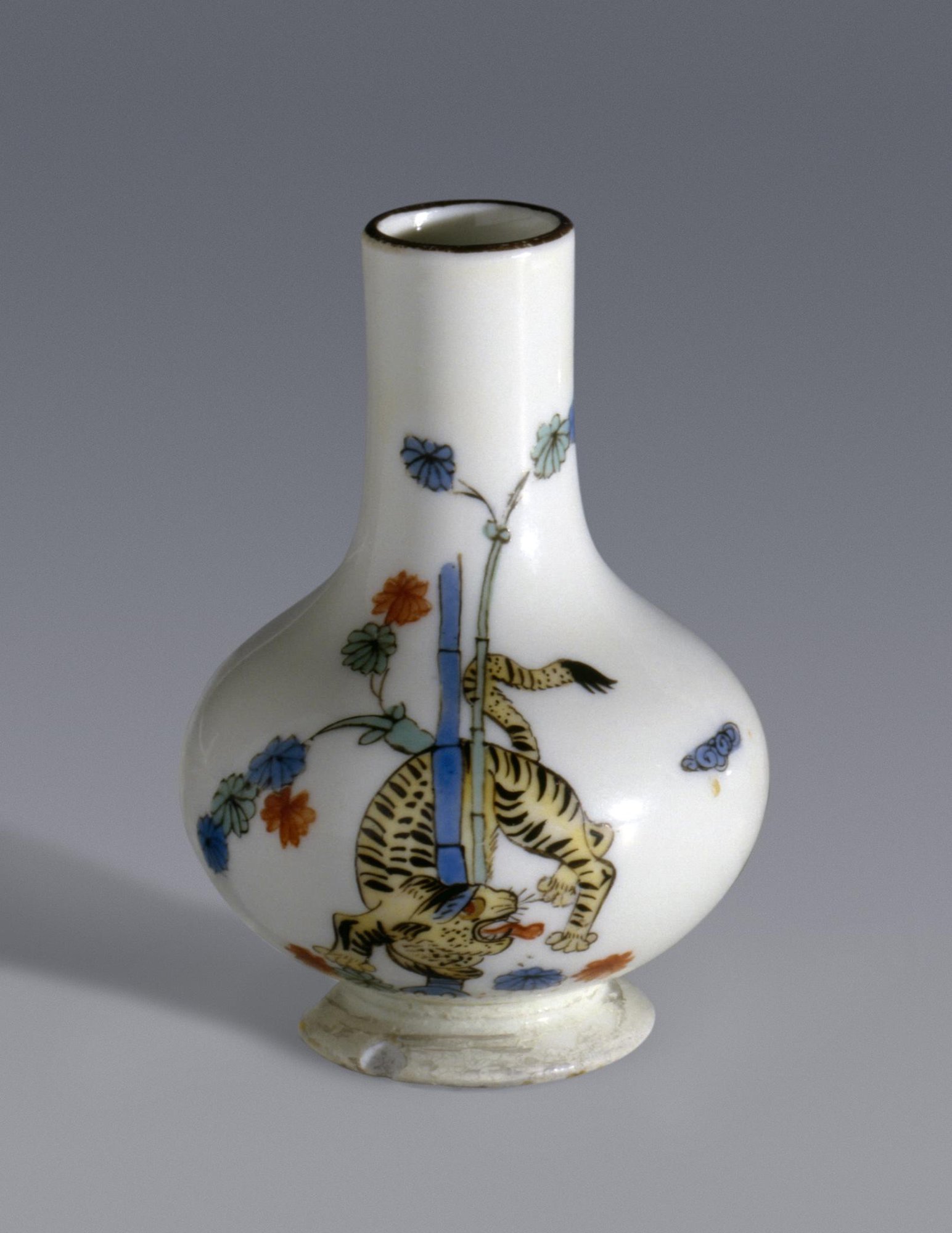
Flask (ZF-16759). The State Hermitage Museum.
The flask entered the Hermitage from the collections of Prince Dolgorukov, Fersen, A. K. Rudanovsky, Oliv and Gorchakov, Shuvalova, Baron Alexander Stieglitz, and the Leningrad Art Treasures Department. It is on display in the Winter Palace, in room 305.
It is a small flask — six centimetres high — with a white ground, a narrow neck and a scene of a tiger among flowers.
The Object
The flask has a bulbous body, a narrow neck and a flared foot.
Its surface is white, and it is painted with a tiger, bamboo and flowering branches. The neck is bare, with a brown band at the rim, and the body is covered with the scene.
The flask is small and round, and it fits in the palm of a hand.
The Flask
The flask is a small vessel.
It held liquids — water, wine or liqueur — and it was part of a service. Flasks of this shape were common in the eighteenth century, and they were used on the table or carried in a case.
Its narrow neck and bulbous body are designed for pouring, and its small size makes it a personal object.
The Tiger
The tiger is the flask’s subject.
It is painted in yellow and black, with stripes, and it crouches on the ground, its head turned. Its tail curls up, and its body is compact.
The tiger is the emblem of the «Yellow Lion» service, and it appears on every piece in a slightly different pose.
The Bamboo
A bamboo stem rises behind the tiger.
It is painted in blue, with joints and leaves, and it gives the composition its vertical line. Bamboo is a symbol of resilience in Asian art, and it is a common motif in Kakiemon porcelain.
The blue bamboo contrasts with the yellow tiger, and it frames the animal.
The Flowers
The flowers are painted in orange and blue.
They grow from the bamboo and from the ground, and they fill the empty spaces. They are stylised, with simple petals and leaves.
Flowers of this kind are a Kakiemon convention: they give the composition its rhythm and its colour.
The Service
The flask belongs to the «Yellow Lion» service.
The service was produced at Meissen in the 1720s and 1730s, and it included plates, dishes, tureens and flasks, all decorated with the tiger and dragon pattern. It was one of the factory’s most successful services.
The flask is one of its smallest pieces, and it carries the service’s name.
The Date
The flask is dated to about 1735–1738.
The date places it in the later phase of the service, when the factory was producing large quantities of the pattern for the courts of Europe. The painting is confident and refined.
The flask is therefore a mature work of the Meissen workshop, and it shows the Kakiemon style at its height.
The Condition
The flask is in fair condition.
Its foot is chipped, and the brown band at the rim is worn. The painting is still clear, and the surface is glossy.
The damage is part of the object’s history: a small flask, used and carried, and it has survived almost three hundred years.
The Shape
The flask is pear-shaped.
Its body is round and low, its neck is narrow, and its foot is flared. The shape is classical, and it is designed for pouring.
Flasks of this kind were common in the eighteenth century, and they were used for water, wine and liqueur.
The Foot
The flask stands on a flared foot.
It is white, with a brown edge, and it is chipped in places. The foot gives the flask stability, and it is the part that touches the table.
Foot rings of this kind are a feature of Meissen flasks of the period, and their wear is a sign of use.
The White
The white ground is the flask’s space.
It is the colour of the porcelain, glazed and smooth, and it gives the painting its emptiness. The white of the flask is warm, and it makes the tiger and the flowers stand out.
In the Kakiemon style, white is a material: it is the sky, the air and the paper of the picture.
The Hall
The flask is displayed in the Winter Palace, in room 305.
It stands in a case among other porcelain, and it is seen in a controlled light. Its small size makes it an object for close looking.
The room and the flask belong together: a nineteenth-century interior and an eighteenth-century flask.
The Restitution
The flask’s record lists several collections.
The names — Dolgorukov, Fersen, Rudanovsky, Oliv, Gorchakov, Shuvalova, Stieglitz — record the flask’s passage through the great collections of imperial Russia, and its later transfer to the Hermitage.
The list is a document of Russian collecting, and it gives the flask a history beyond its making.
The Glaze
The flask is glazed.
The glaze is clear and glossy, and it covers the whole surface. It protects the painting, and it gives the porcelain its depth.
The glaze has a slight crazing in places, and it catches the light.
The Neck’s Band
The neck is banded in brown.
It is a thin brown line at the rim, painted around the opening, and it frames the neck. Brown bands were common in Meissen’s Kakiemon-style wares, and they imitated the iron-brown rims of Japanese porcelain.
The band is worn, and it records the flask’s use.
The Tiger’s Pose
The tiger crouches.
Its body is low, its legs bent, its head turned back over its shoulder. It is a pose of rest or of readiness, and it gives the animal its energy.
The pose is painted with a few decisive strokes, and it is one of the finest passages on the flask.
Provenance
The flask carries the inventory number ZF-16759. It entered the Hermitage from the collections of Prince Dolgorukov, Fersen, A. K. Rudanovsky, Oliv and Gorchakov, Shuvalova, Baron Alexander Stieglitz, and the Leningrad Art Treasures Department.
The long list of owners records the flask’s passage through several of the great collections of imperial Russia.
In the Hermitage
The flask is on display in the Winter Palace, in room 305.
It is a small, fine object, and it preserves a scene: a tiger, a bamboo and a few flowers, painted on a white flask.
It is a small flask, and it has carried its tiger and its bamboo through almost three hundred years, from a German workshop to a Russian palace.
It is still a flask, and the tiger is still crouching, and the bamboo is still blue. And it is still, in its small way, a picture of patience and of the East as Europe imagined it. It is, in the end, a very small monument.