Artist: Augustin-Christian Ritt (1765–1799)
Origin: Russia
Date: 1798
Material: ivory
Technique: watercolour and gouache, gilding (frame)
Dimensions: diameter 5.7 cm
Current Collection: The State Hermitage Museum
Inventory Number: ORm-2211
Hermitage ID: 202641
Rudanovsky Connection: Entered the Hermitage in 1919 from the collection of A. K. Rudanovsky.
A miniature portrait on ivory, barely six centimetres across, painted in 1798 by Augustin-Christian Ritt and set in a frame bordered with woven hair.
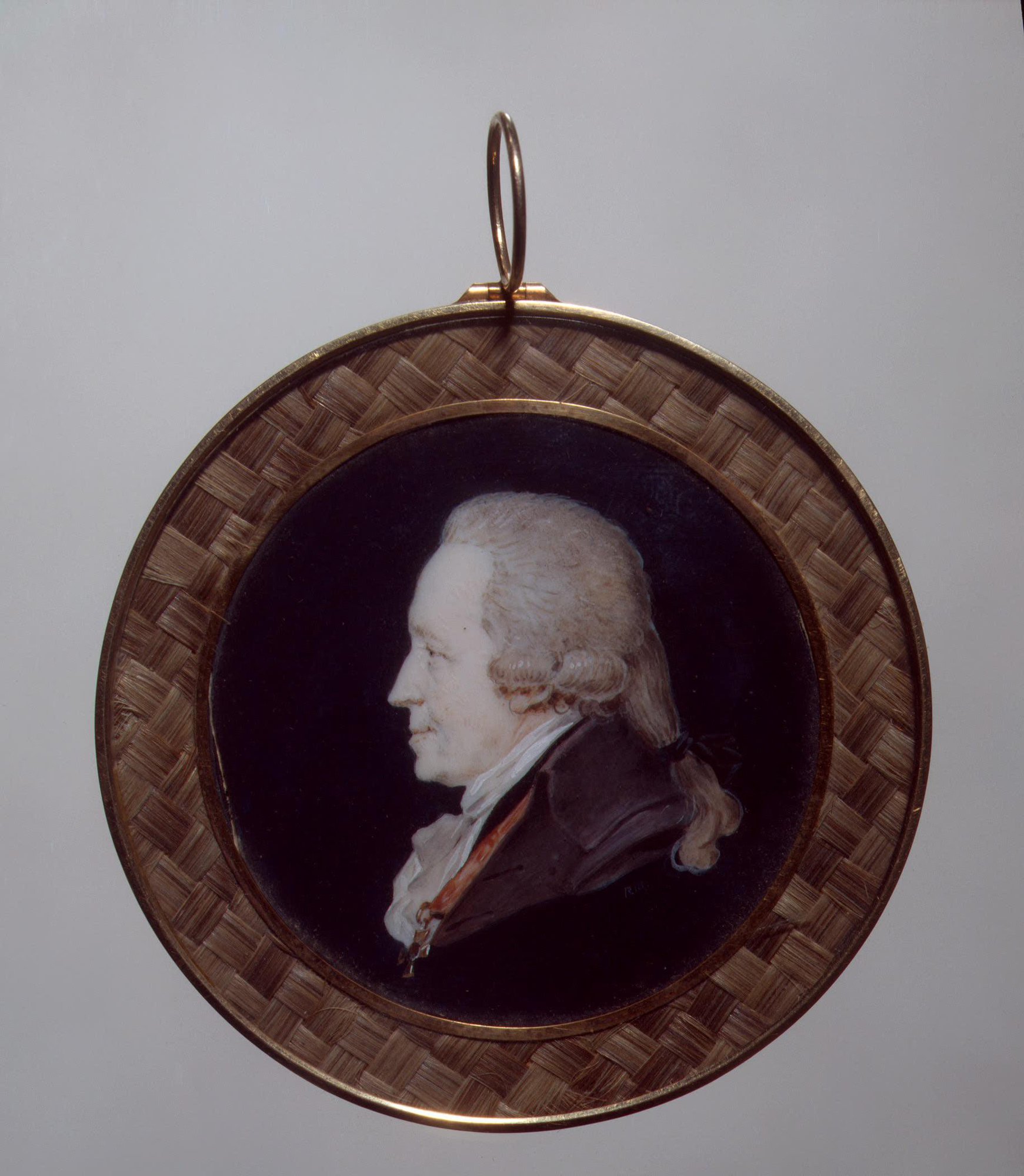
Miniature: Portrait of K.K. Labensky (?). The State Hermitage Museum.
The portrait shows a man in profile, facing left, against a dark background. He wears a powdered wig with a queue, a dark coat and a white cravat; a touch of red at the collar suggests a uniform or a ribbon. The painting is enclosed in an oval gilt mount, and that mount is set into a broad, round frame of plaited brown hair.
The miniature comes from the collection of A. K. Rudanovsky and is not currently on permanent display.
The Object
The scale is the first fact to be grasped. The painted surface is less than six centimetres in diameter, smaller than a watch dial, and the whole portrait has been made for the hand rather than the wall.
The head is shown in strict profile, a format that eliminates the distractions of a full-face likeness and concentrates attention on the line of the brow, nose and chin. The powdered hair is built up in soft, granular strokes; the coat is a dark mass without detail; the cravat catches the light. The background is nearly black, which makes the pale face and hair stand out with the clarity of a cameo.
Around the painting runs a narrow gilt mount, and beyond it a wide border of woven hair, worked in a diagonal plait. The outer frame is round; the inner opening is oval. The contrast between the two geometries is deliberate and gives the object the character of a piece of jewellery rather than a picture.
Portrait Miniatures
The miniature is a distinct genre with its own history, technique and social function.
It emerged in the sixteenth century, grew out of the illuminated manuscript and the portrait medal, and reached its height in the eighteenth century, when every fashionable person might own a dozen. Miniatures were worn as pendants, brooches and rings; they were set into snuff boxes and lockets; they were exchanged between lovers, friends and family members.
Their function was intimacy. A miniature could be carried, hidden, kissed, sent by post. It made an absent person present at a scale that allowed physical closeness, and it was valued precisely for that.
The genre declined in the middle of the nineteenth century, when photography offered a cheaper and more exact likeness. But in 1798, the date of this portrait, the miniature was still the most personal form of portraiture available.
Painting on Ivory
Ivory had replaced vellum as the preferred support for miniatures in the early eighteenth century, and it changed the look of the genre.
The material is translucent. Light passes through the thin sheet, strikes the back and returns through the paint, giving the colours a peculiar luminosity that no opaque ground can produce. Painters learned to exploit this: they left areas of bare ivory to serve as the lights of the flesh, and they built shadows with thin washes rather than thick pigment.
Watercolour does not adhere easily to ivory, and the surface had to be prepared and lightly abraded. The painter worked with a fine brush, often with stippling rather than continuous strokes, and every correction was difficult. A miniature is therefore an object of patience: a portrait of a face the size of a thumbnail, made with a technique that allows almost no revision.
Augustin-Christian Ritt
Augustin-Christian Ritt was born in 1765 and died in 1799, at thirty-four. He worked in Russia during the last decade of the eighteenth century, at the moment when St Petersburg was one of the great centres of European miniature painting.
His career was short, and his surviving work is correspondingly rare. What remains shows a painter trained in the European tradition of the miniature — precise, delicate, attentive to the modelling of the face — working for a Russian clientele that had adopted the portrait miniature as an essential part of polite life.
The date of this portrait, 1798, places it in the reign of Paul I, a period of short-lived uniforms, strict court ceremonial and a renewed interest in the image of the sovereign and his servants.
The Sitter
The Hermitage record identifies the sitter as K. K. Labensky, but adds a question mark. The identification is traditional rather than certain.
What can be said with confidence is what the portrait itself shows: a man of the late eighteenth century, in a powdered wig with a queue, wearing a dark coat and a white cravat, with a red detail at the neck that may belong to a uniform or to an order ribbon.
The profile format flatters him. It gives the face a classical line and removes the asymmetry that a frontal view would reveal. This was the standard rhetoric of the profile miniature: not deception, but a convention of dignity.
The Profile Portrait
The profile has a long history in European portraiture. It comes from the medal and the coin, and it carries the authority of those forms: a profile is an emblem as much as a likeness.
In the eighteenth century the profile became fashionable again, partly through the influence of neoclassicism and partly through the vogue for silhouettes. A profile miniature is a hybrid object — a portrait, a medal and a silhouette at once.
For the painter, the profile is a test of drawing. There is no second eye to balance the face and no frontal symmetry to hide behind; the whole likeness rests on the line from the forehead to the chin. Ritt’s sitter survives that test: the nose, the mouth and the soft fold of the chin are described with a few economical strokes.
The Frame and the Keepsake
The frame is not a later addition to be ignored. The broad border of woven hair is part of the object’s meaning.
Hairwork was one of the most widespread forms of sentimental jewellery in the late eighteenth and early nineteenth centuries. Hair was incorruptible, intimate and personal; it could be plaited, woven and set under glass to preserve the memory of a person, living or dead. A portrait framed in hair is therefore a double portrait: the face in paint, the body in the material of the frame.
Such objects were kept in drawers, worn at the throat, or placed on a desk. They were not meant for a gallery wall. Their scale and their privacy are the conditions of their effect.
Provenance
The miniature comes from the collection of A. K. Rudanovsky and carries the inventory number ORm-2211.
Small portraits were among the most personal objects in a nineteenth-century collection. They were bought, inherited and kept in cabinets rather than hung in state rooms, and they preserve a kind of intimacy that larger paintings rarely possess.
In the Hermitage
The miniature is preserved in the State Hermitage Museum in Saint Petersburg and is not on permanent display.
It is an object that requires a different kind of looking. At arm’s length it is a dark little disc with a pale face; under a glass, in good light, it becomes a fully modelled portrait, with the texture of the wig, the shine of the cravat and the faint colour of the lips.
That change of scale — from object to portrait — is the essential experience of the miniature, and it is what makes this small painting, made in 1798 by a young artist who died the following year, still capable of holding attention.