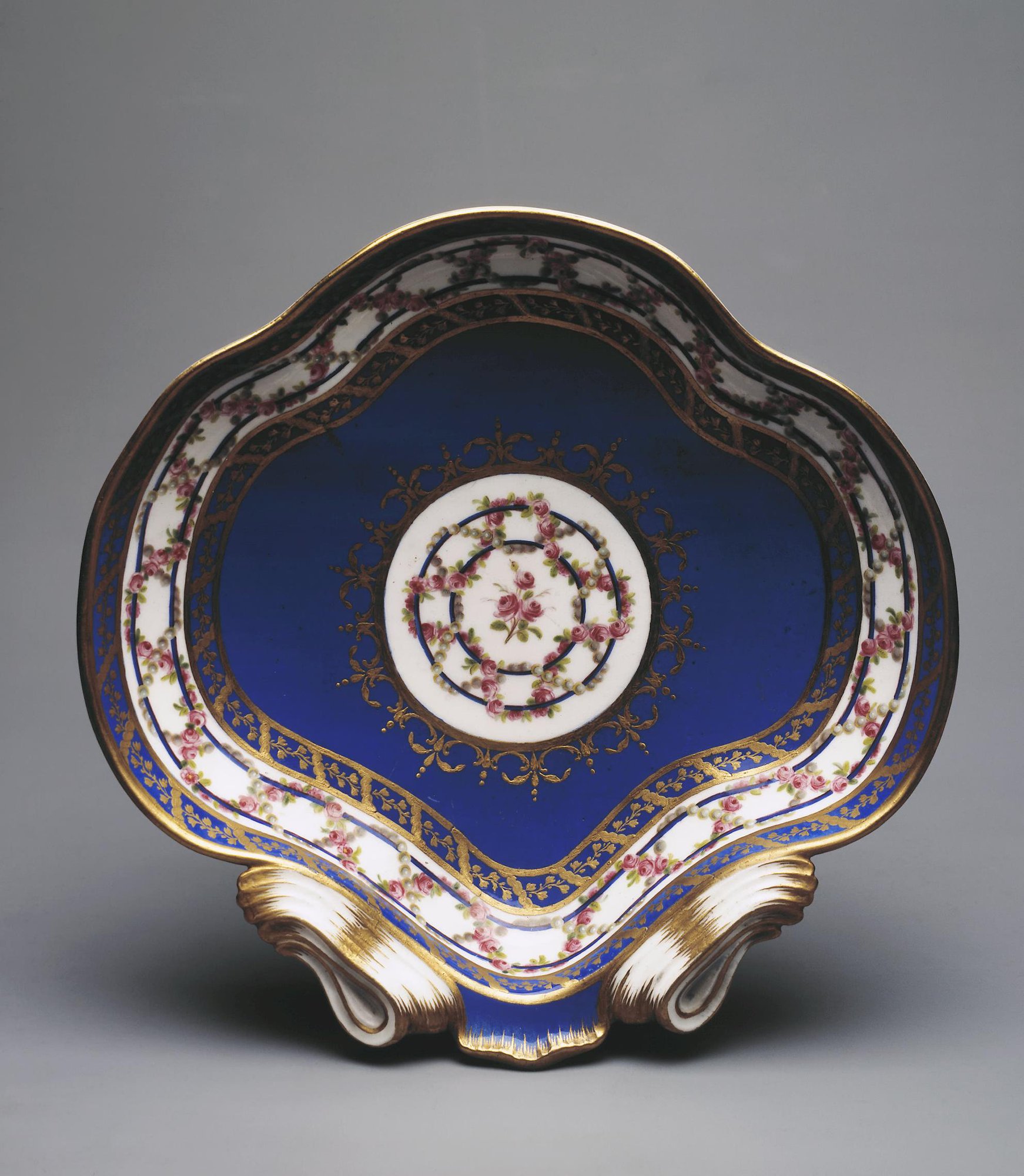
Organization: Sèvres Porcelain Manufactory
Origin: France
Date: 1788
Complex: Blue Service
Material: soft-paste porcelain
Dimensions: height 20.7 cm; diameter 19.3 cm
Current Collection: The State Hermitage Museum
Inventory Number: ZF-16262
Hermitage ID: 352362
Rudanovsky Connection: Entered the Hermitage in 1919 from the collection of A. K. Rudanovsky.
A covered Sèvres bowl of 1788 for serving ice cream, its blue body banded with garlands of roses and its lid crowned with a loop handle.
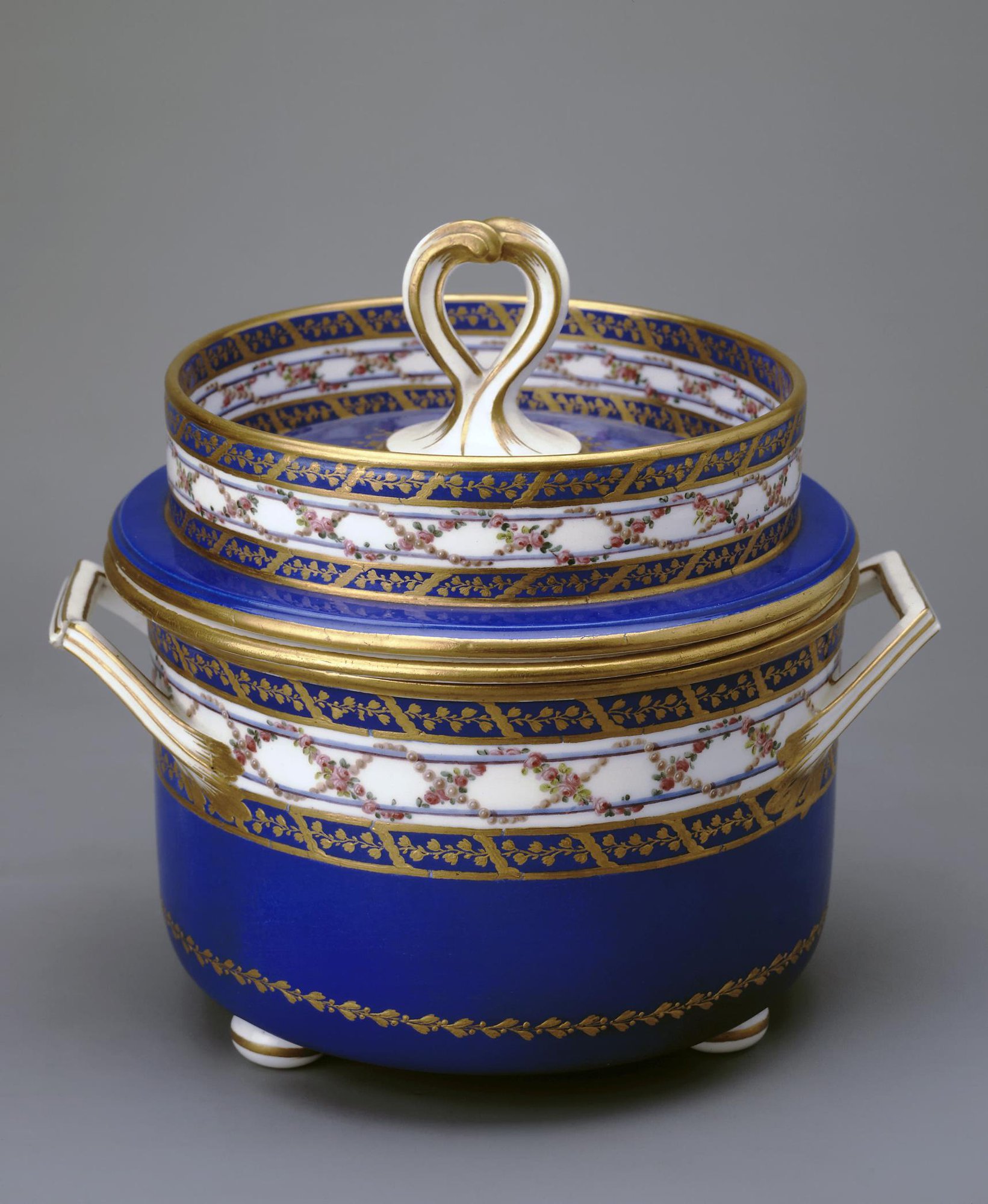
Ice-Cream Bowl. The State Hermitage Museum.
The bowl entered the Hermitage in 1919 from the collection of A. K. Rudanovsky. It is not currently on permanent display.
It is a tall, cylindrical vessel with a domed lid, two angular handles and a loop finial — a small tureen made for ice cream.
The Object
The bowl has a straight-sided body and a domed lid.
The lower part is deep cobalt blue; above, a white band carries a garland of roses and leaves, framed by blue lines and gold. Another blue band runs around the lid, with the same garland, and the lid is crowned by a white loop handle, doubled like a ribbon.
The handles are angular, painted with gold, and the foot is small and gilded.
Ice Cream
Ice cream was a luxury of the eighteenth-century table.
It was made with ice and salt, served at dessert in small cups or in larger bowls, and it was one of the most fashionable treats of the period. A covered bowl like this one kept the ice cream cold and protected it from the air.
The shape — a small tureen — suggests that the bowl was brought to the table and served by the host or a servant.
The Lid
The lid is a dome with a loop handle.
It fits into the rim of the bowl and keeps the contents cold. Its blue band and garland match the body, so that the object reads as a single form when closed.
The lid turns a bowl into a vessel: it protects, conceals and completes the object.
The Loop
The loop handle is the lid’s most distinctive detail.
It is a white ribbon of porcelain, folded into a double loop, and it stands up like a small sculpture. It is both a handle and an ornament, and it gives the lid its focal point.
Loop handles of this kind are characteristic of Sèvres in the 1780s, and they appear on tureens, bowls and compotiers.
The Blue Service
The bowl belongs to the Blue Service of 1788.
The service included cups, plates, trays, bowls and a monteith, all decorated with the same blue ground, white band and rose garland. The ice-cream bowl is one of its most ambitious pieces.
The service was a luxury commission, and it would have been used for dessert and wine.
The Garland
The garland of roses runs around the white bands of the body and the lid.
It is continuous, with roses, buds and leaves, and it is framed by blue lines and gold. The flowers are painted in soft pinks and greens, and they contrast with the deep blue.
The garland gives the object its elegance and its lightness, and it connects it to the rest of the service.
The Handles
The handles are angular and painted with gold.
They are set at the sides of the body and curve outward, allowing the bowl to be lifted. Their geometric shape contrasts with the round body and the loop of the lid.
Handles of this kind are a feature of Sèvres vessels of the 1780s, and they give the object its neoclassical character.
The Shape
The bowl is cylindrical, with a slight taper and a small foot.
Its straight sides give it a modern, almost architectural look, and its lid continues the line upward, so that the object reads as a single column when closed.
The shape is a departure from the rounder forms of the earlier eighteenth century, and it reflects the neoclassical taste of the 1780s.
The Foot
The foot is small and gilded.
It raises the body from the table, gives it stability and provides a base for the blue ground. The foot is also a place for the gold band that frames the base.
A small foot under a tall body is a classical proportion: it makes the object look lighter than it is.
The Ice
Ice cream in the eighteenth century was made by hand.
The mixture was placed in a bucket of ice and salt and stirred until it froze. It was a labour-intensive process, and it was reserved for special occasions and wealthy households.
A covered bowl kept the ice cream cold and protected it from the air, and it allowed the dessert to be brought to the table in style.
The Table
The bowl was made for a table.
It stood among cups, plates and compotiers, all decorated in the same blue and gold, and it was opened at the moment of serving. Its loop handle and its lid made it a small ceremony in itself.
That table is gone, but the bowl still carries its logic: a vessel designed for a festive dessert.
The Collector
The bowl came to the Hermitage with the Rudanovsky collection.
Rudanovsky collected Sèvres porcelain alongside paintings, drawings, glass and miniatures, and the Blue Service is one of the most important groups in his collection.
The bowl is therefore a double document: of the Sèvres factory in 1788 and of a nineteenth-century Russian collector’s taste.
The Blue Ground
The blue ground is the bowl’s dominant colour.
It is applied as a wash over the glaze, fired and polished, and it covers the lower part of the body and a band on the lid. The colour is deep and even, with a slight variation that comes from hand application.
Blue was the most expensive colour in the Sèvres palette, and its use here signals the quality of the service.
The Lid’s Band
The lid carries the same decoration as the body.
A blue band, a white garland, gold lines: the pattern continues across the lid, so that the closed object reads as a single design. This continuity is what makes the bowl look whole when the lid is on.
The lid’s band is also a technical achievement: painting a curved dome evenly is more difficult than painting a flat side.
The Closed Form
When the lid is on, the bowl becomes a single object.
The dome of the lid continues the cylinder of the body, the loop rises from the top, and the blue bands align. The closed form is a small tower of porcelain, with a ribbon on top.
This transformation is the point of the object: a vessel that is also a sculpture when closed, and a bowl when open.
Provenance
The bowl carries the inventory number ZF-16262 and entered the Hermitage in 1919 from the collection of A. K. Rudanovsky.
In the Hermitage
The bowl is preserved in the State Hermitage Museum in Saint Petersburg and is not on permanent display.
It is a small, elegant object, and it shows how a practical vessel — a bowl for ice cream — could be designed as a piece of architecture, with a dome, a loop and a garland of roses.