
Organization: Sèvres Porcelain Manufactory
Origin: France
Date: 1788
Complex: Blue Service
Material: soft-paste porcelain
Dimensions: height 6.4 cm
Current Collection: The State Hermitage Museum
Inventory Number: ZF-16269
Hermitage ID: 352369
Rudanovsky Connection: Entered the Hermitage in 1919 from the collection of A. K. Rudanovsky.
An ice-cream cup from the Sèvres «Blue Service» of 1788, its lower body in deep cobalt blue and its white band hung with garlands of roses.
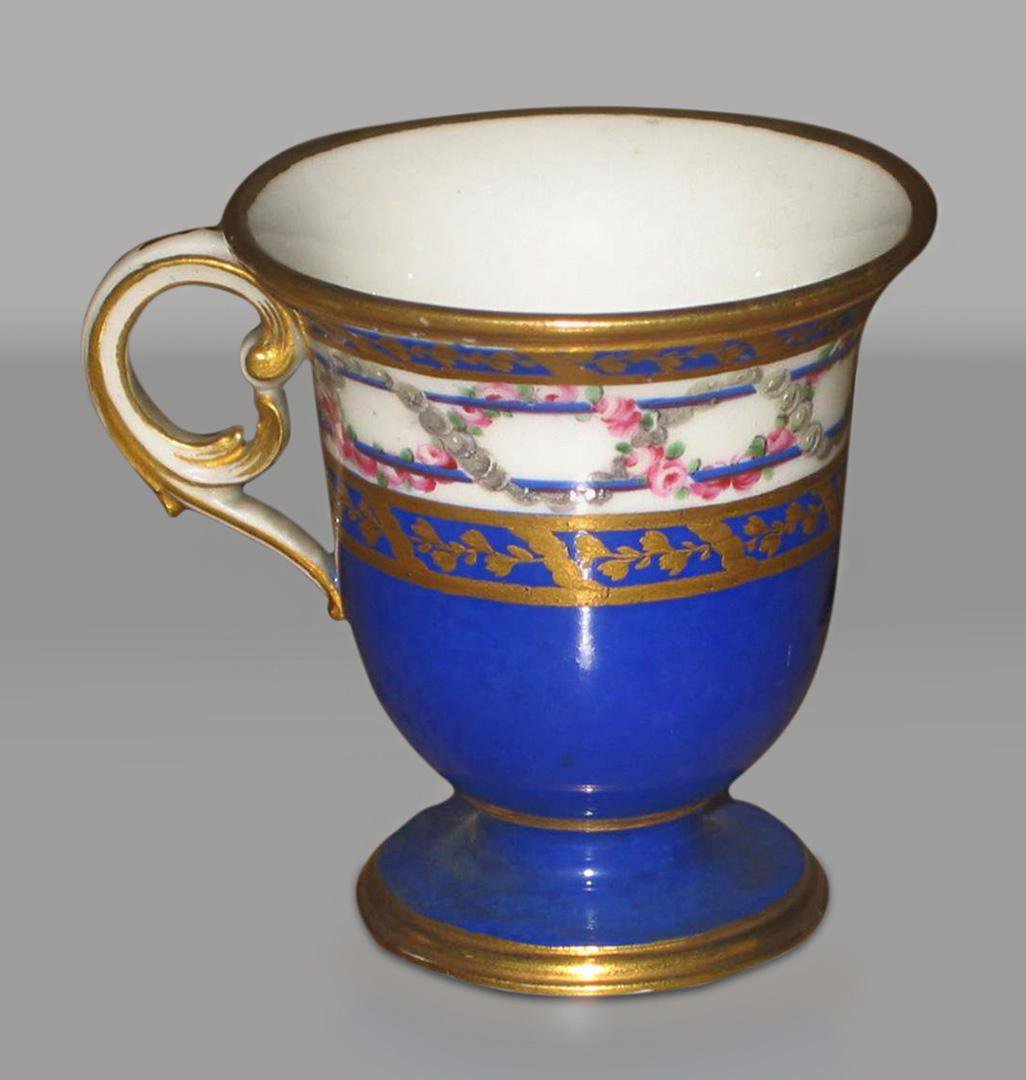
Ice-Cream Cup, Blue Service (ZF-16269). The State Hermitage Museum.
The cup entered the Hermitage in 1919 from the collection of A. K. Rudanovsky. It is not currently on permanent display.
It is small — a little over six centimetres high — and it fits easily into the palm of the hand. It was made to hold ice cream at a fashionable table in the last years of the ancien régime.
The Object
The cup has a rounded body that flares at the rim and narrows to a small foot.
The lower half is covered in a deep, even blue; the upper half is white, decorated with a garland of pink roses and green leaves, framed by blue lines. Gold bands separate the blue and white zones, and the rim, the foot and the handle are gilded.
The handle is a scroll, attached to the side with a small leaf-shaped terminal.
Ice Cream
Ice cream was a luxury of the eighteenth century.
It was made in the kitchens of the wealthy, using ice from ice houses and salt to freeze the mixture, and it was served at dessert in small cups like this one. The fashion spread from Italy and France across Europe, and it became one of the signs of a sophisticated table.
A cup for ice cream had to be small, thick enough to insulate the hand, and handsome enough to appear at dessert.
The Cup Shape
The shape of the cup is designed for its contents.
The rounded body holds a small portion; the flared rim allows the spoon to reach the bottom; the foot raises the cup from the saucer and gives it stability. The handle, though small, allows the cup to be held without warming the ice.
The proportions are carefully calculated: the cup is wider than it is tall, so that the ice can be eaten with a spoon rather than drunk.
The Blue Service
The cup belongs to a service known as the «Blue Service».
The name describes the ground colour: a deep cobalt blue, applied to the lower part of each piece and combined with white bands, gold and flowers. The service included cups, saucers, plates, bowls and trays, all decorated in the same scheme.
A service of this kind was a major commission, and it would have been used for dessert, coffee and tea.
Sèvres in 1788
In 1788, Sèvres was still the leading porcelain manufactory in Europe.
It was a royal enterprise, protected by the crown and patronised by the court, and it produced some of the finest porcelain of the century. Its painters, gilders and sculptors were among the most skilled in France.
The year 1788 was also the last year before the Revolution, which would disrupt the factory’s finances and its clientele.
Soft Paste
The cup is made of soft-paste porcelain, the material Sèvres had used since its foundation.
Soft paste is made from a mixture of clay and glassy materials, fired at a lower temperature than hard paste. It is more translucent and more delicate, and it allows a wider range of colours, but it is also more fragile and more difficult to fire.
The soft paste gives the cup its warm, slightly creamy white and its fine, glassy surface.
The Handle
The handle is a small but significant element.
It is a scroll, modelled and applied to the body, then gilded. Its shape echoes the scrolls and volutes of neoclassical ornament, and it gives the cup a sculptural detail that the simple body lacks.
The handle also has a practical function: it allows the cup to be held without touching the bowl, which is important when the bowl is cold.
The Colours
The colours of the cup are blue, white and gold, with the pink and green of the garland.
The blue is the dominant note: a deep, saturated cobalt that contrasts with the white band and sets off the gold. The flowers add a softer, more natural accent.
The combination is characteristic of Sèvres in the 1780s: rich grounds, gold bands, and delicate floral decoration in reserved panels.
Dessert
Dessert was the most theatrical course of the eighteenth-century dinner.
After the roasts and the vegetables, the table was cleared and re-laid with fruit, sweets, biscuits, compotes and ices. The porcelain was changed, and the dessert service — often the most decorative in the house — was brought out.
An ice-cream cup belongs to that moment. It was part of a set of small objects designed to make the end of the meal memorable.
The Saucer
The cup would have had a saucer.
The saucer caught the spoon, protected the cloth and completed the design. Cups and saucers were made as pairs, and their decoration was coordinated.
Many cups in museum collections have lost their saucers, and the pair is often separated. This cup is recorded alone, but its shape and decoration assume a saucer beneath it.
Sèvres and the Court
Sèvres was a royal manufactory, and its fortunes were tied to the court.
The kings of France patronised the factory, commissioned services and gave porcelain as diplomatic gifts. The court’s taste shaped the factory’s production, and the factory’s products in turn shaped the taste of Europe.
A cup from a service of 1788 belongs to that world of royal patronage, even if the client was not the king himself.
Small Objects
Small objects carry large histories.
A cup of six centimetres can tell us about materials, techniques, trade, fashion and daily life. It can be dated, attributed and traced through collections, and it can open a window onto a world that no longer exists.
This cup is small enough to hold in one hand, and it contains a whole eighteenth-century table.
The Rudanovsky Cup
The cup came to the Hermitage with the Rudanovsky collection.
Rudanovsky’s collection included a large group of Sèvres porcelain, and this cup is one of several pieces from the Blue Service. The collection was formed in the nineteenth century, when Sèvres was already a historic taste, and it reflects the prestige that French porcelain retained in Russia.
The cup is therefore a double document: of the 1780s, when it was made, and of the nineteenth century, when it was collected.
Provenance
The cup carries the inventory number ZF-16269 and entered the Hermitage in 1919 from the collection of A. K. Rudanovsky.
In the Hermitage
The cup is preserved in the State Hermitage Museum in Saint Petersburg and is not on permanent display.
It is one of several cups from the same service in the collection, and it allows us to imagine a dessert table of the 1780s: white cloth, blue and gold porcelain, and small cups of ice cream in the candlelight. It is a small cup, but it has travelled a long way, from a Paris workshop to a Russian collection and then to a museum store.
