Organization: Sèvres Porcelain Manufactory
Origin: France
Date: 1788
Complex: Blue Service
Material: soft-paste porcelain
Dimensions: height 6.4 cm
Current Collection: The State Hermitage Museum
Inventory Number: ZF-16270
Hermitage ID: 352370
Rudanovsky Connection: Entered the Hermitage in 1919 from the collection of A. K. Rudanovsky.
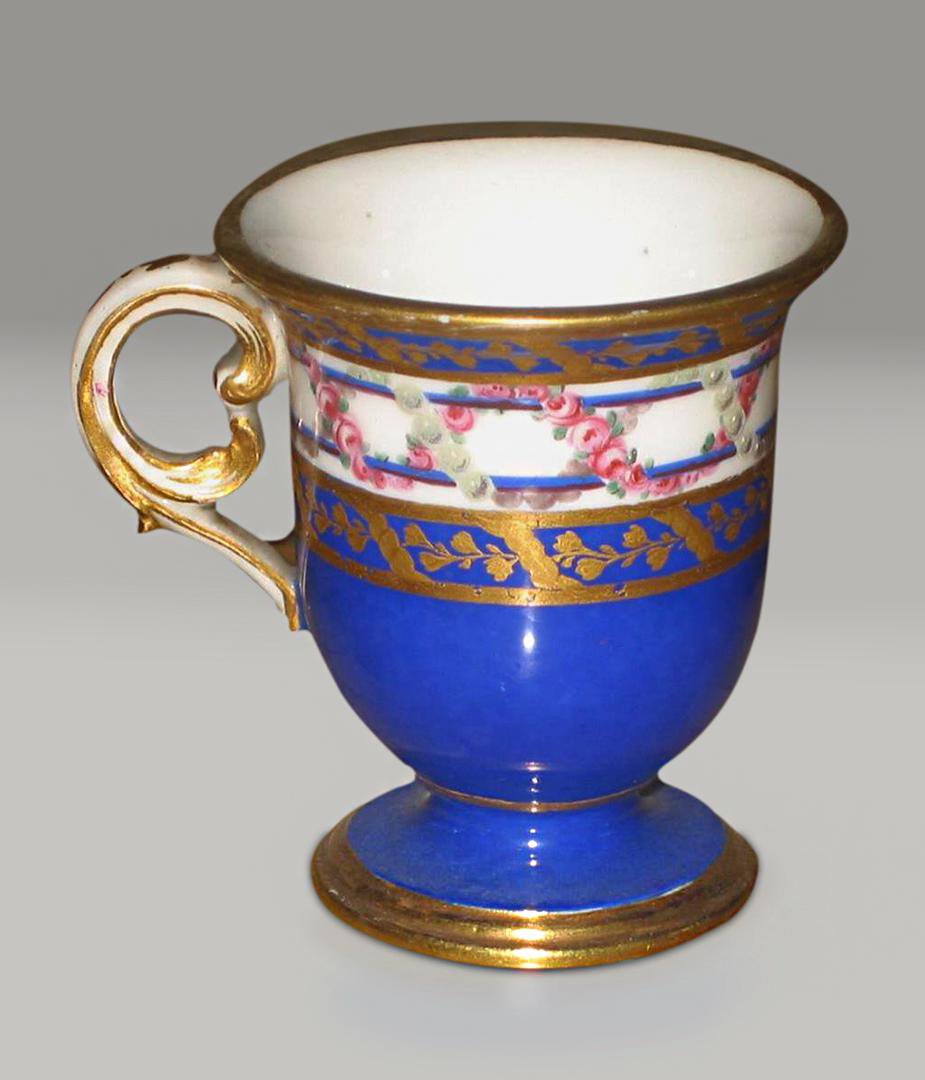
An ice-cream cup from the Sèvres «Blue Service» of 1788, where a deep cobalt ground meets white porcelain, gold bands and a garland of roses.

Ice-Cream Cup, Blue Service (ZF-16270). The State Hermitage Museum.
The cup entered the Hermitage in 1919 from the collection of A. K. Rudanovsky. It is not currently on permanent display.
It belongs to the same service as three other cups in the collection, and it shares their design: a blue lower body, a white band with flowers, gold rims and a gilt scroll handle.
The Object
The cup is small and rounded, with a flared rim and a low foot.
The lower two-thirds of the body are covered in a saturated cobalt blue, so deep that it looks almost black in shadow. Above it, a white band is framed by blue lines and decorated with a garland of pink roses and green leaves.
Gold bands run along the rim, the foot and the junction between blue and white, and the handle is fully gilded.
The Blue Ground
The blue ground is the defining feature of the service.
It is applied as a wash over the glaze, then fired, so that the colour fuses with the surface and becomes part of the porcelain. The result is a deep, even blue with a slightly glossy finish.
Blue grounds were among the most expensive decorations at Sèvres. They required a large amount of pigment, careful application and a controlled firing, and they were reserved for the finest pieces.
Cobalt
The colour comes from cobalt oxide.
Cobalt had been used in ceramics since antiquity, and in the eighteenth century it was the standard source of blue on porcelain. Its strength and stability made it ideal for grounds, and its depth could be varied by changing the concentration.
The blue of this cup is at the richer end of the range: a dark, saturated tone that contrasts strongly with the white band and the gold.
Gold
The gold is applied in bands and lines.
Each band is painted with a preparation of powdered gold, fired and burnished, so that it shines against the blue and white. The gilding is especially effective on the rim, where it frames the cup and catches the light.
Gold was the final stage of decoration, and it was usually done by a specialist gilder rather than by the painter. The quality of the burnish on this cup is high.
The Frame
The design is organised by frames.
A gold band separates the blue ground from the white band; blue lines frame the garland; another gold band separates the white from the foot. These frames give the cup a clear structure and guide the eye around it.
The effect is architectural: the cup is divided into zones, each with its own colour and ornament, like the storeys of a small building.
The Garland
The garland of roses is the only naturalistic element in the design.
It runs around the white band in a continuous line, with pink roses, buds and green leaves. The flowers are painted in a light, delicate style, with soft modelling and fine detail.
The garland softens the geometry of the blue and gold and gives the cup a note of informality that balances its formal structure.
The Blue Service
The service is known as the «Blue Service» for obvious reasons.
Its pieces share the same blue ground, white band, gold bands and floral garland. The service included cups, saucers, plates and trays, and it would have been used for dessert and coffee.
The survival of several cups in the Hermitage allows us to see how the design worked across a set: each piece repeated the scheme, with adjustments for its shape and size.
The Cup in a Set
A cup is never alone in a service.
It is one of a set, made to be used with saucers, plates and other pieces. The design of the cup is therefore part of a larger system, in which each object repeats and varies the same motifs.
This cup is one unit of that system, and it can only be fully understood in relation to the others.
The Blue of Sèvres
Sèvres was famous for its blue grounds.
The factory produced several shades, from the pale turquoise of the 1750s to the deep cobalt of the 1780s. Each required a different pigment concentration and a different firing, and each had its own character.
The blue of this cup is at the dark end of the range. It is closer to the colour of lapis lazuli than to the sky, and it gives the cup a gravity that the flowers alone would not.
Gilding Technique
Gilding porcelain is a delicate operation.
The gold is ground to a powder, mixed with a flux and painted onto the glazed surface. The piece is then fired at a low temperature, so that the gold fuses to the glaze, and burnished with a hard tool to bring up the shine.
The process is repeated for each band and line. On this cup, the gold bands are broad and even, which suggests a skilled gilder.
The White Band
The white band is not simply undecorated porcelain.
It is a reserved zone, left unpainted so that the garland can be read against a neutral ground. The white is the colour of the porcelain itself, and it provides the light that the blue and the gold reflect.
In the design of the cup, the white band is the stage on which the flowers perform.
A Cup in the Hand
The scale of the cup is part of its charm.
At six centimetres, it sits comfortably in the palm and can be examined at close range. The decoration is designed for that distance: the flowers are small, the gold lines fine, the blue deep.
It is an object made for intimacy as much as for display.
The Cup and the Light
The cup was designed for candlelight.
In an eighteenth-century dining room, light came from candles and from the fire, and it moved and flickered. A surface of blue, white and gold was made to catch that light: the gold would flash, the blue would deepen, the white would glow.
Under electric light in a museum, the cup looks different — flatter, cooler, more uniform. The original conditions of its beauty are lost, and can only be imagined.
Provenance
The cup carries the inventory number ZF-16270 and entered the Hermitage in 1919 from the collection of A. K. Rudanovsky.
In the Hermitage
The cup is preserved in the State Hermitage Museum in Saint Petersburg and is not on permanent display.
It is a small object, but it carries the full vocabulary of the service: blue, white, gold and flowers, combined in a design that is both rich and restrained. Under any light, it remains a beautiful thing, and a reminder that colour is a form of memory, and that memory is often made of very small, very ordinary things.