Organization: Sèvres Porcelain Manufactory
Origin: France
Date: 1788
Complex: Blue Service
Material: soft-paste porcelain
Dimensions: height 6.4 cm
Current Collection: The State Hermitage Museum
Inventory Number: ZF-16272
Hermitage ID: 352372
Rudanovsky Connection: Entered the Hermitage in 1919 from the collection of A. K. Rudanovsky.
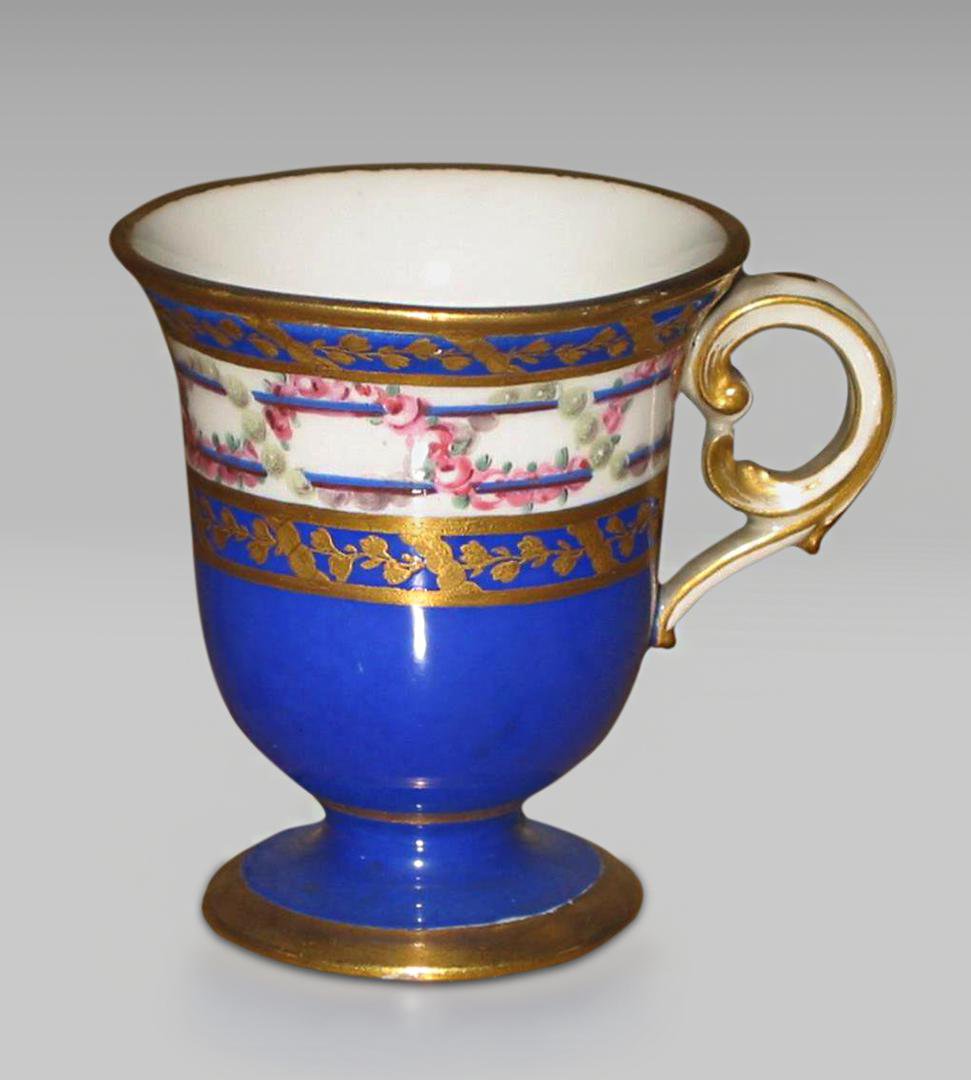
An ice-cream cup of 1788, its white band encircled by a garland of roses within borders of blue and gold.
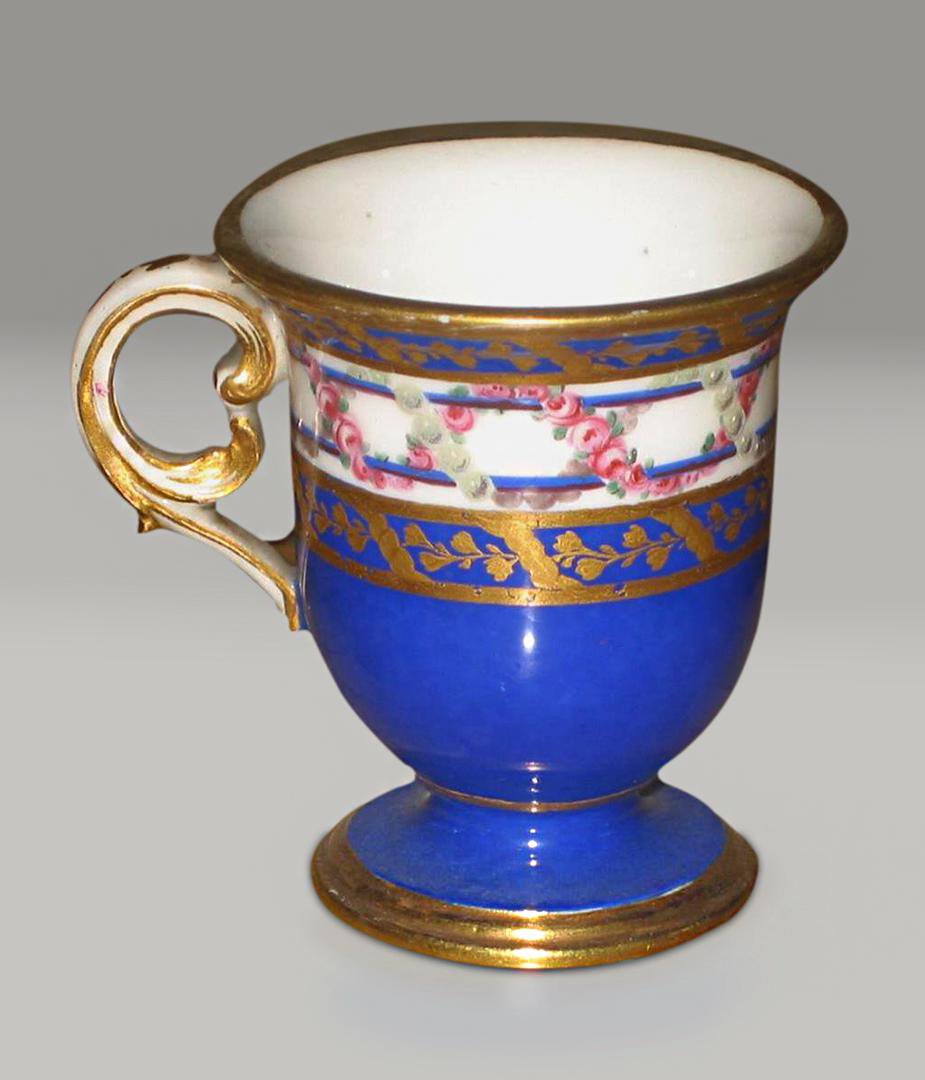
Ice-Cream Cup, Blue Service (ZF-16272). The State Hermitage Museum.
The cup entered the Hermitage in 1919 from the collection of A. K. Rudanovsky. It is not currently on permanent display.
It is one of four cups from the same service in the collection, and it carries the same decoration: cobalt blue below, white above, roses and gold all around.
The Object
The cup has a rounded body, a flared rim and a low foot, with a gilt scroll handle.
The lower part is blue; the upper part is white, framed by blue lines and gold bands. In the white band, a garland of roses runs around the cup, with pink flowers, green leaves and a few grey-green shadows.
The gold is worn at the rim, where the cup was handled, and the blue is scratched in places.
The Garland
The garland is the liveliest element of the design.
It is a continuous ribbon of flowers, painted in a naturalistic style: roses in several stages of opening, from tight buds to full blooms, with leaves and stems.
The garland is not a botanical study. It is a decorative convention, repeated on every piece of the service, and it gives the cup its connection with the natural world that eighteenth-century ornament loved.
Roses
The rose was the most popular flower in eighteenth-century decorative art.
It appears in textiles, porcelain, furniture and painting, and it carries a range of associations: love, beauty, transience. In a porcelain service, the rose was also a sign of luxury: it required a skilled painter to render the petals and the shading.
The roses on this cup are painted in pink and crimson, with darker centres and lighter outer petals, and they are set among green leaves that curl around the white band.
The Vocabulary
The decoration is built from a small vocabulary of motifs.
Blue ground, white band, gold bands, blue lines, roses and leaves: these elements are combined and repeated to create a design that is both simple and rich.
This economy of means is characteristic of Sèvres in the 1780s. The factory had perfected a language of ornament that could be adapted to any shape, and the Blue Service is an example of that language in use.
The Painter
The painter of the garland is not named in the record.
Sèvres painters usually left a mark on the underside of the piece, but the mark on this cup is not recorded in the available documentation. The flowers are painted with skill, but the hand cannot be identified with certainty.
Attribution in porcelain is often a matter of style rather than signature: the way a petal is turned, the tone of a leaf, the thickness of a line.
The Four Cups
The Hermitage has four cups from the same service.
They are nearly identical, and their survival together is a small stroke of luck. Services were often dispersed, and individual pieces were separated from their fellows; here, four cups have stayed in the same collection.
Seen together, they show the consistency of the factory’s production and the small variations that hand-painting introduced.
The Blue Service
The Blue Service was a major commission of 1788.
It included cups, saucers, plates and trays, all decorated with the same scheme. The service was probably made for a wealthy client, and it would have been used for dessert, coffee and tea.
The exact identity of the client is not known, but the quality of the pieces suggests a court or aristocratic household.
The Cup in Use
The cup was made to be used.
It held ice cream at dessert, and it was small enough to be held in the hand while the guest talked and ate. The decoration was designed to be seen at close range, in candlelight, on a white tablecloth.
That context is lost, but the cup still carries it: the blue, the gold and the roses are the colours of a festive table.
The Border Lines
The thin blue lines are the skeleton of the design.
They frame the white band, separate the garland from the gold, and give the decoration its structure. Without them, the flowers would float and the gold would lose its edge.
Lines of this kind were painted with a fine brush and a steady hand. They are the simplest part of the decoration and, in a way, the most demanding: a wavy line is immediately visible.
Painting Flowers
Painting flowers on porcelain requires a particular technique.
The painter worked with enamel colours mixed with oil, applied in thin layers and fired at a low temperature. The colours had to be built up gradually, and each firing could alter them.
The roses on this cup are painted with a few strokes each: a base colour, a darker centre, a lighter edge. At close range, the brushwork is visible and lively.
The Gold Lines
The gold lines are applied last.
They are painted with a preparation of gold powder, fired and burnished, and they sit slightly raised on the surface. On this cup, the gold catches the light and frames the flowers.
Gold lines are vulnerable: they wear with handling and can be rubbed away entirely. Their survival here is a sign of careful use.
The Service’s Repertoire
The Blue Service repeats a small repertoire of motifs.
Blue ground, white band, garland, gold bands and blue lines: these elements appear on every piece, arranged according to its shape. The result is a family of objects that are recognisably related without being identical.
This is how a service works: not by repeating a single design, but by repeating a system of design.
The Garland’s Source
The garland was probably taken from a pattern book.
Sèvres kept a library of designs — flowers, borders, trophies, figures — which the painters copied and adapted. A garland of roses could be reused across services, with variations in colour and arrangement.
This economy of design is one of the reasons why Sèvres production was so consistent. The factory did not invent every decoration from scratch; it worked within a repertoire, and the skill lay in the execution.
Provenance
The cup carries the inventory number ZF-16272 and entered the Hermitage in 1919 from the collection of A. K. Rudanovsky.
In the Hermitage
The cup is preserved in the State Hermitage Museum in Saint Petersburg and is not on permanent display.
It is a small object, but it contains a complete decorative system: ground, band, garland, frame. The same system appears on every piece of the service, and it is what makes the service a work of art rather than a set of dishes.
The cup is, in this sense, a miniature of the whole: a fragment that carries the design of a table, and a table that carries the taste of an age, in blue and gold and pale pink roses, in the warm candlelight.