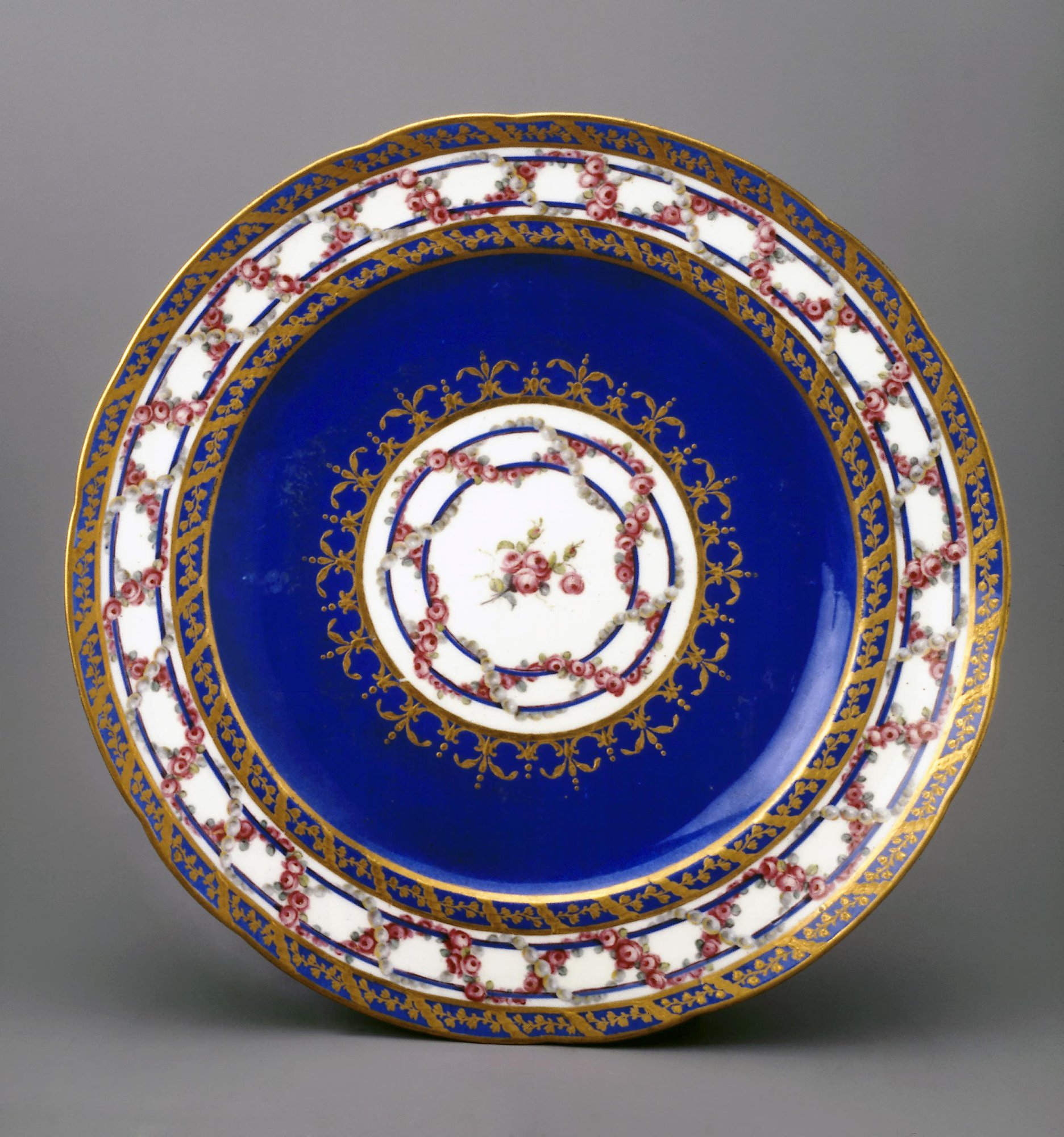
Organization: Sèvres Porcelain Manufactory
Origin: France
Date: 1788
Complex: Blue Service
Material: soft-paste porcelain
Dimensions: height 6.4 cm
Current Collection: The State Hermitage Museum
Inventory Number: ZF-16271
Hermitage ID: 352371
Rudanovsky Connection: Entered the Hermitage in 1919 from the collection of A. K. Rudanovsky.
A small Sèvres cup of 1788 for serving ice cream, its blue body banded with gold and painted with a garland of roses.
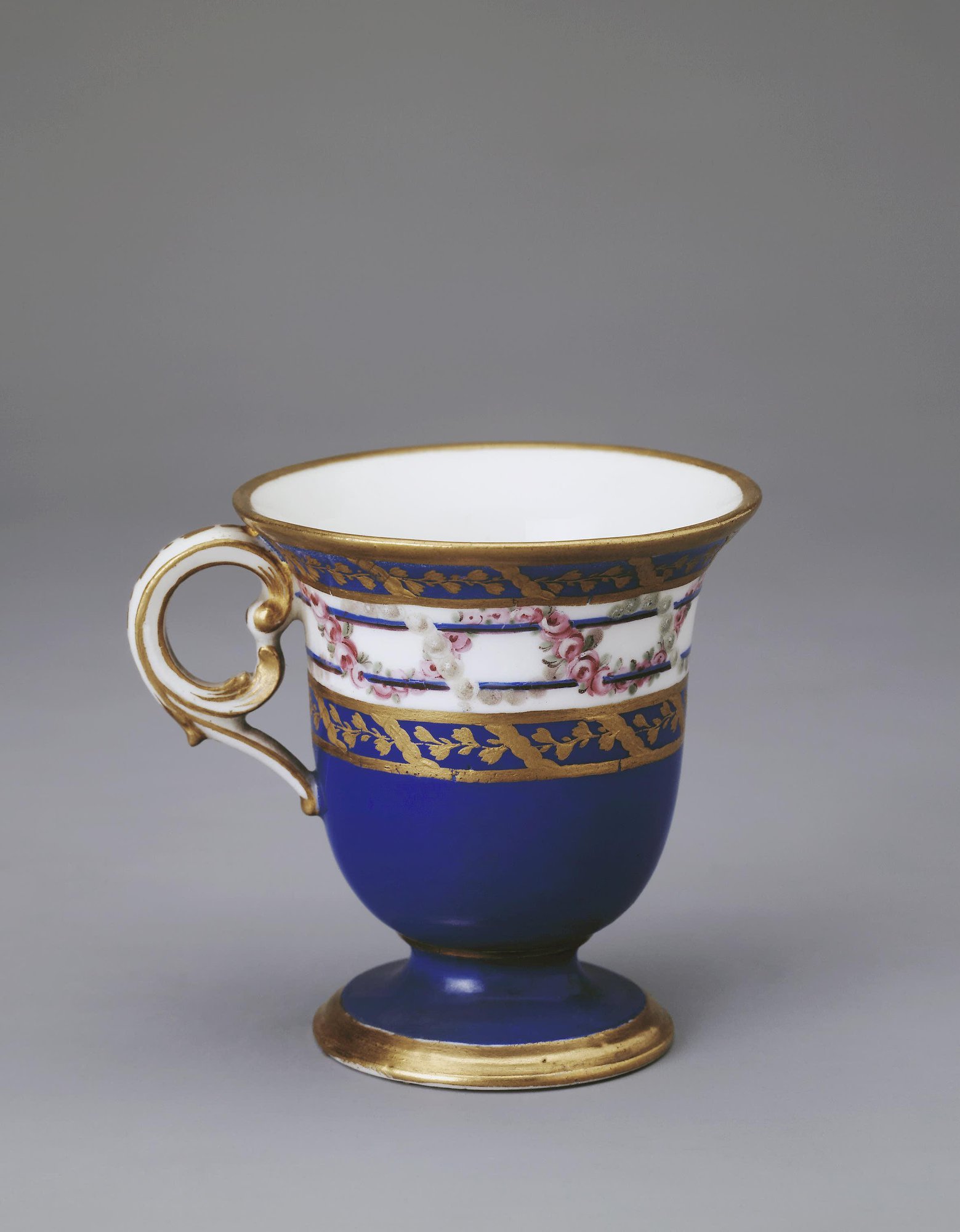
Ice-Cream Cup, Blue Service (ZF-16271). The State Hermitage Museum.
The cup entered the Hermitage in 1919 from the collection of A. K. Rudanovsky. It is not currently on permanent display.
It is a small cup — 6.4 centimetres high — with a flared rim, a loop handle and a spreading foot, painted in the blue and gold of the Blue Service.
The Object
The cup has a rounded body, a flared rim and a small foot.
Its decoration is arranged in horizontal bands: a gold band at the rim, a blue band with gold foliage, a white band with a garland of roses, another blue band with gold, and a blue base with a gilded foot.
The interior is white, and the handle is white with a gold scroll.
The Cup
A cup for ice cream is a specific object.
It is small, wider than a coffee cup and shallower than a tea cup, and it is designed to hold a portion of ice cream or sorbet at the dessert table. The flared rim makes it easy to eat from, and the handle keeps the fingers from the cold.
Cups of this kind were made in sets, and they were served on a matching tray.
Ice Cream
Ice cream was a luxury of the eighteenth-century table.
It was made by hand, with ice and salt, and it was served at dessert in small cups or in larger bowls. It was one of the most fashionable treats of the period, and it required a staff, equipment and time.
A cup like this one belonged to the most refined level of the dessert service: a small vessel, made for a single portion of a rare pleasure.
The Handle
The handle is a loop with a scroll.
It is white, painted with gold, and it curls out from the body in a simple, elegant shape. The scroll at the top and bottom of the handle is a Rococo detail, and it gives the cup a delicate, almost calligraphic line.
The handle is also practical: it allows the cup to be lifted when the fingers would otherwise touch the cold porcelain.
The Foot
The cup stands on a spreading foot.
It is blue, with a gilded edge, and it raises the body from the table. The foot is small and neat, and it gives the cup a stable, slightly elevated stance.
A foot of this kind is a feature of Sèvres cups of the 1780s, and it turns a simple vessel into a small piece of architecture.
The Blue Service
The cup belongs to the Blue Service of 1788.
The service included cups, plates, trays, bowls and compotiers, all decorated with the same blue ground, white bands and rose garlands. The ice-cream cup is one of its smallest pieces.
The service was a luxury commission, and it would have been used for dessert and tea.
The Bands
The decoration is built in bands.
Each band has its own colour and its own pattern: gold, blue with gold foliage, white with roses, blue again. The bands run around the cup like rings, and they give it a clear, legible structure.
This banded decoration is characteristic of the service, and it allows the cups, plates and bowls to match while remaining distinct in shape.
The Roses
The garland of roses is the cup’s only figurative decoration.
It runs around the white band in a continuous line of small pink roses and green leaves, painted with a fine brush. The flowers are simple and precise, and they soften the geometry of the bands.
Roses are the signature of the Blue Service, and they appear on every piece, from the smallest cup to the largest tureen.
The Interior
The inside of the cup is plain white.
This is a deliberate choice: the white interior shows the colour of the ice cream, and it provides a clean surface for the eye. The decoration is all on the outside, where it belongs.
The contrast between the busy exterior and the plain interior is one of the pleasures of the cup.
The Scale
At 6.4 centimetres, the cup is small.
It fits in the palm of a hand, and it holds a single portion. Its smallness is part of its character: it is an object made for one person, one moment and one pleasure.
Small objects demand close attention, and this cup rewards it: the bands, the roses and the gold are all painted with care.
The Service
The cup belongs to a service, and a service is a system.
Every piece is designed to match every other piece, and the cup is one unit in a large set. It was made with a tray, and it was used with plates, bowls and compotiers of the same pattern.
The service is the unit of design: not the single cup, but the whole table.
The Table
The cup was made for a table.
It stood on a tray, among other cups, at the dessert course, and it was filled with ice cream. Its blue and gold would have caught the candlelight, and its roses would have repeated across the table.
That table is gone, but the cup still carries its logic: a small vessel for a festive dessert.
The Collector
The cup came to the Hermitage with the Rudanovsky collection.
Rudanovsky collected Sèvres porcelain alongside paintings, drawings, glass and miniatures, and the Blue Service is one of the most important groups in his collection.
The cup is therefore a double document: of the Sèvres factory in 1788 and of a nineteenth-century Russian collector’s taste.
The Banded Decoration
The bands are the cup’s structure.
Each band is a different width and a different pattern, and together they cover the body from rim to foot. The eye reads them as a series of rings, and the rings give the cup its rhythm.
This banded system is one of the reasons the service can be scaled from a cup to a tureen: the pattern adapts to any height, and the object remains recognisable.
Provenance
The cup carries the inventory number ZF-16271 and entered the Hermitage in 1919 from the collection of A. K. Rudanovsky.
In the Hermitage
The cup is preserved in the State Hermitage Museum in Saint Petersburg and is not on permanent display.
It is a small, elegant object, and it shows how a vessel for a single portion of ice cream could be made with the same care as a tureen — blue, gold and roses, in the space of a hand.
It is also a small lesson in proportion: on a cup, a few bands and a few roses are enough to make a complete world, and to make it hold together.
It is small, and it is enough. It has survived two centuries of handling, and it still holds the light.