Organization: Sèvres Porcelain Manufactory
Origin: France
Date: 1788
Complex: Blue Service
Material: soft-paste porcelain
Dimensions: height 6.4 cm
Current Collection: The State Hermitage Museum
Inventory Number: ZF-16273
Hermitage ID: 352373
Rudanovsky Connection: Entered the Hermitage in 1919 from the collection of A. K. Rudanovsky.
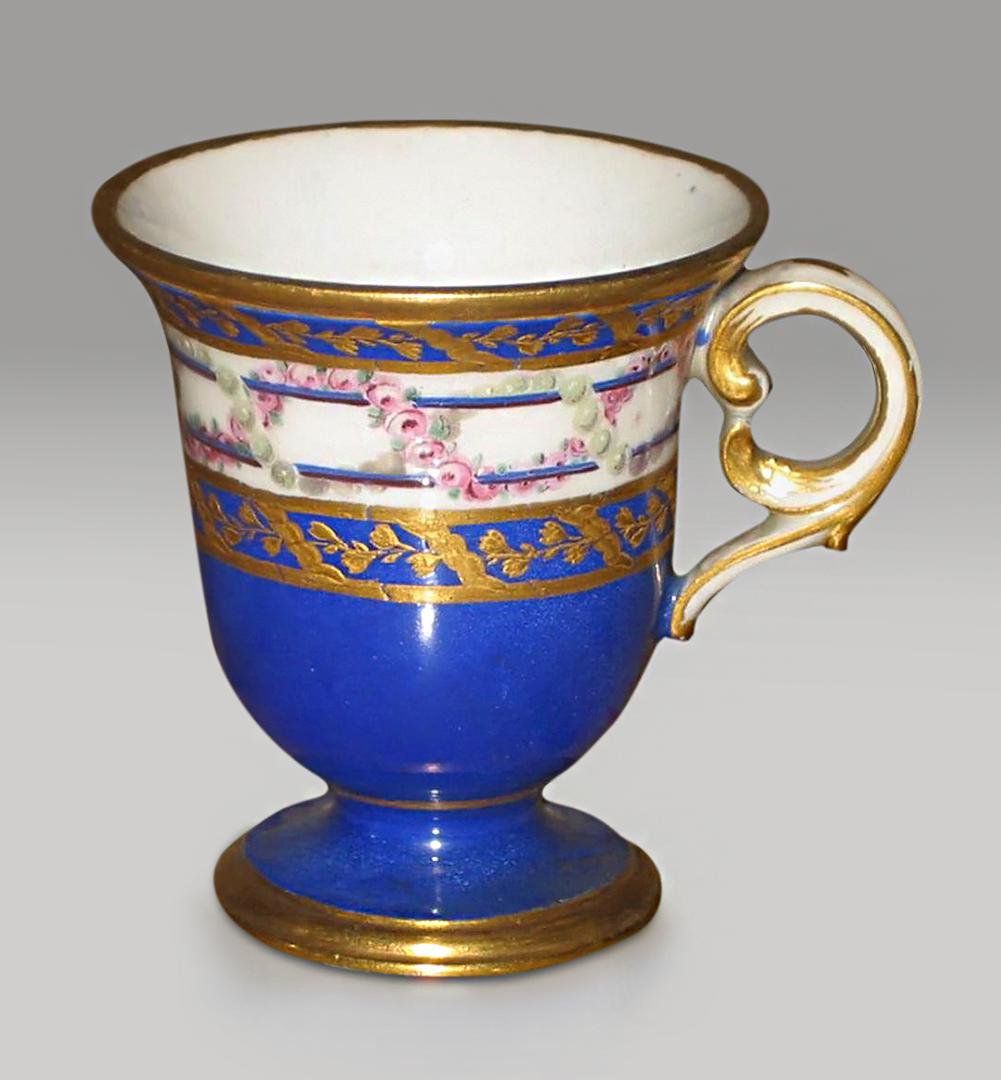
An ice-cream cup from the Sèvres «Blue Service» of 1788, made of soft-paste porcelain and decorated in blue, white and gold.
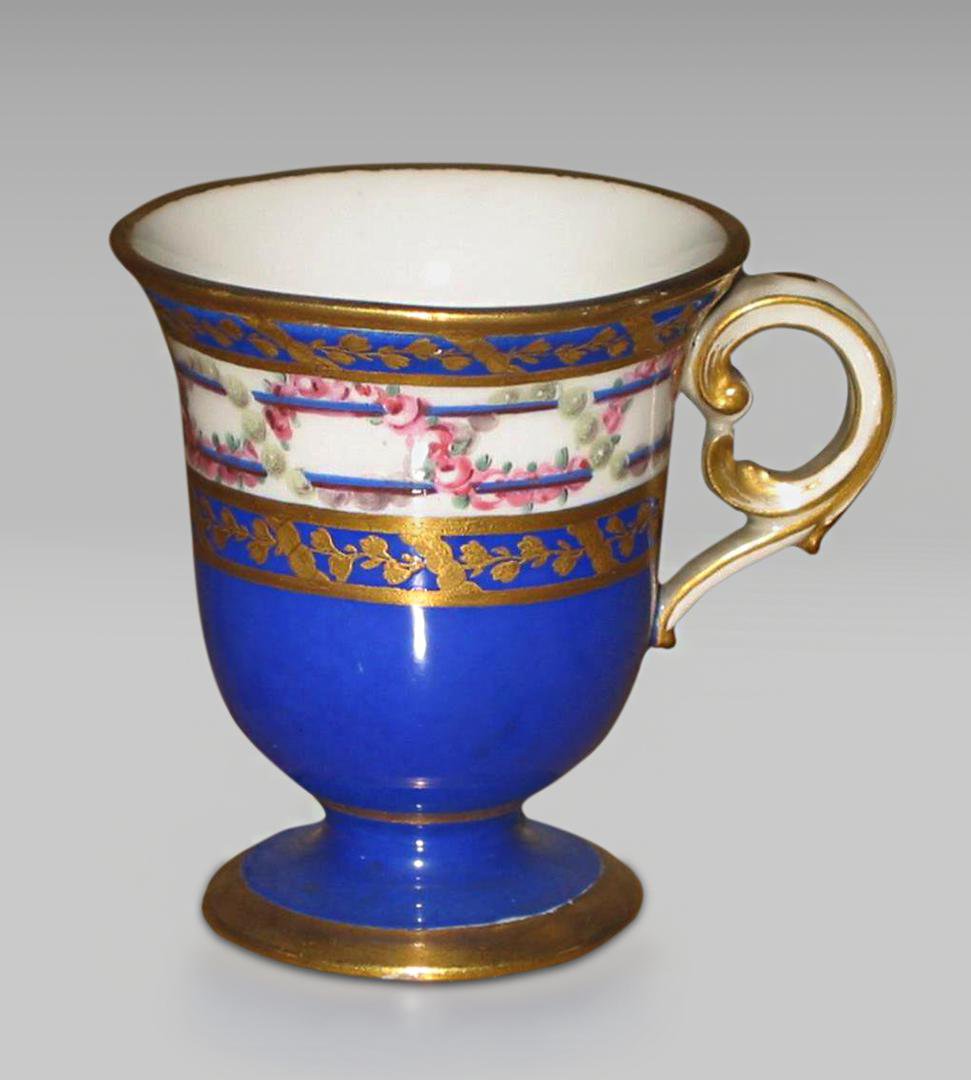
Ice-Cream Cup, Blue Service (ZF-16273). The State Hermitage Museum.
The cup entered the Hermitage in 1919 from the collection of A. K. Rudanovsky. It is not currently on permanent display.
It is the fourth cup from the same service in the collection, and it shares their design: a cobalt-blue lower body, a white band with a rose garland, gold bands and a gilt scroll handle.
The Object
The cup is small, rounded and light in the hand.
Its body is covered, below, with a deep blue ground; above, a white band carries a garland of roses and leaves, framed by blue lines and gold. The rim, the foot and the handle are gilded.
The surface is glossy, with the soft, slightly creamy white typical of Sèvres soft paste.
Soft Paste
Soft-paste porcelain is the material of the eighteenth-century French factory.
It is made from a mixture of clay and glass frit, fired at a relatively low temperature. The result is a body that is softer, more translucent and more fragile than hard paste, with a warm white colour and a glassy surface.
Soft paste was difficult to work: it sagged in the kiln, cracked easily and limited the size of the pieces. But it allowed a brilliance of colour that hard paste could not match.
The Kiln
Firing soft paste was a gamble.
The pieces were fired several times: first the body, then the glaze, then the painted decoration, then the gilding. Each firing could ruin the work of the previous one, and the failure rate was high.
A cup like this one, with a large blue ground and gold bands, required several firings and a great deal of skill. Its survival is a testament to the quality of the Sèvres workshop.
The Service
The cup belongs to the Blue Service, a large dessert and coffee service of 1788.
The service included cups, saucers, plates, trays and bowls, all decorated in the same scheme. It was a luxury commission, and it would have been used on special occasions.
The service is now dispersed, but the Hermitage’s cups allow us to see its design and to imagine its table.
The Blue Service
The name of the service describes its dominant colour.
The blue ground is applied to the lower part of each piece, creating a strong horizontal band of colour that runs around the table. The white band above, with its garland, provides contrast and lightness.
The scheme is simple and effective: blue below, white above, gold at the edges. It can be adapted to any shape, from a cup to a large tray.
The Foot
The foot of the cup is small and slightly flared.
It raises the body above the saucer, gives stability and provides a place for the gold band that frames the base. The foot is also the part that takes the most wear, and on this cup the gilding is rubbed.
The shape of the foot is characteristic of Sèvres cups of the period: a short stem, a disc, a gilded edge.
Wear
The cup shows signs of use.
The gilding on the rim is worn, the blue ground is scratched, and there are small chips and marks on the surface. These are the traces of a long life at table.
In a museum, wear is documentation. It tells us that the object was used, handled and washed, and it connects the cup to the people who drank from it.
The Cup and the Saucer
A cup is only half an object without its saucer.
The saucer caught the spoon, protected the table and completed the design. Many cups in museum collections have lost their saucers, and the pair is often separated.
This cup is recorded alone, but it was made as part of a pair, and its design assumes a saucer beneath it.
The White Body
Soft-paste porcelain has a distinctive colour.
It is not the cold white of hard paste but a warm, slightly creamy white, with a depth that comes from the glassy components in the body. The surface is smooth and slightly soft to the eye.
This warmth is one of the reasons why Sèvres soft paste was so admired. It made the colours glow and gave the porcelain a human, almost edible quality.
The Gilder
Gilding was a separate trade within the factory.
The gilder worked after the painter, applying gold bands and lines to the fired decoration. He had his own tools, his own materials and his own mark, and he was paid separately for his work.
On a cup like this one, the gilder’s contribution is as important as the painter’s: the gold frames the design and gives it its richness.
The Cupboard
A service lived in a cupboard.
It was brought out for special occasions, washed, dried and put away again. The cupboard protected the porcelain from light, dust and breakage, and it preserved the service for the next generation.
Many services survived because they were used rarely. This cup, with its relatively light wear, may have spent much of its life in a cupboard.
Four Cups
The four cups in the Hermitage are a small group within a large service.
They share a design, a date and a material, and they have survived together for more than two centuries. Their presence allows the museum to show the service as a set rather than as isolated objects.
In a collection of thousands of objects, four cups are a modest thing. But they are enough to reconstruct a table.
The Service’s Survival
The survival of the Blue Service is a small miracle.
Large services were used, washed, broken and replaced; most of them disappeared within a generation or two. The pieces that remain are the ones that were cared for, stored away or collected.
The Hermitage cups are evidence of that care. They were kept, catalogued and preserved, and they now allow us to see a service that would otherwise be known only from inventories.
Provenance
The cup carries the inventory number ZF-16273 and entered the Hermitage in 1919 from the collection of A. K. Rudanovsky.
In the Hermitage
The cup is preserved in the State Hermitage Museum in Saint Petersburg and is not on permanent display.
It is a small object, but it carries the whole history of Sèvres soft paste: the difficulty of the material, the skill of the painters and gilders, and the luxury of a dessert table in the last years of the eighteenth century.
A single cup can seem a slight thing beside a painting, but it holds its own kind of evidence — of clay, fire, colour and the hands that made it, and of a table where people once sat and ate ice cream while the candles burned down and the conversation turned slowly to other things.
It is a modest object, and a stubborn one: it has outlived everyone who used it.