Organization: Sèvres Porcelain Manufactory
Origin: France
Date: 1788
Complex: Blue Service
Material: soft-paste porcelain
Dimensions: height 6.4 cm
Current Collection: The State Hermitage Museum
Inventory Number: ZF-16274
Hermitage ID: 352374
Rudanovsky Connection: Entered the Hermitage in 1919 from the collection of A. K. Rudanovsky.
The fifth ice-cream cup from the Sèvres «Blue Service» of 1788 — one of a group of identical cups that survived together.
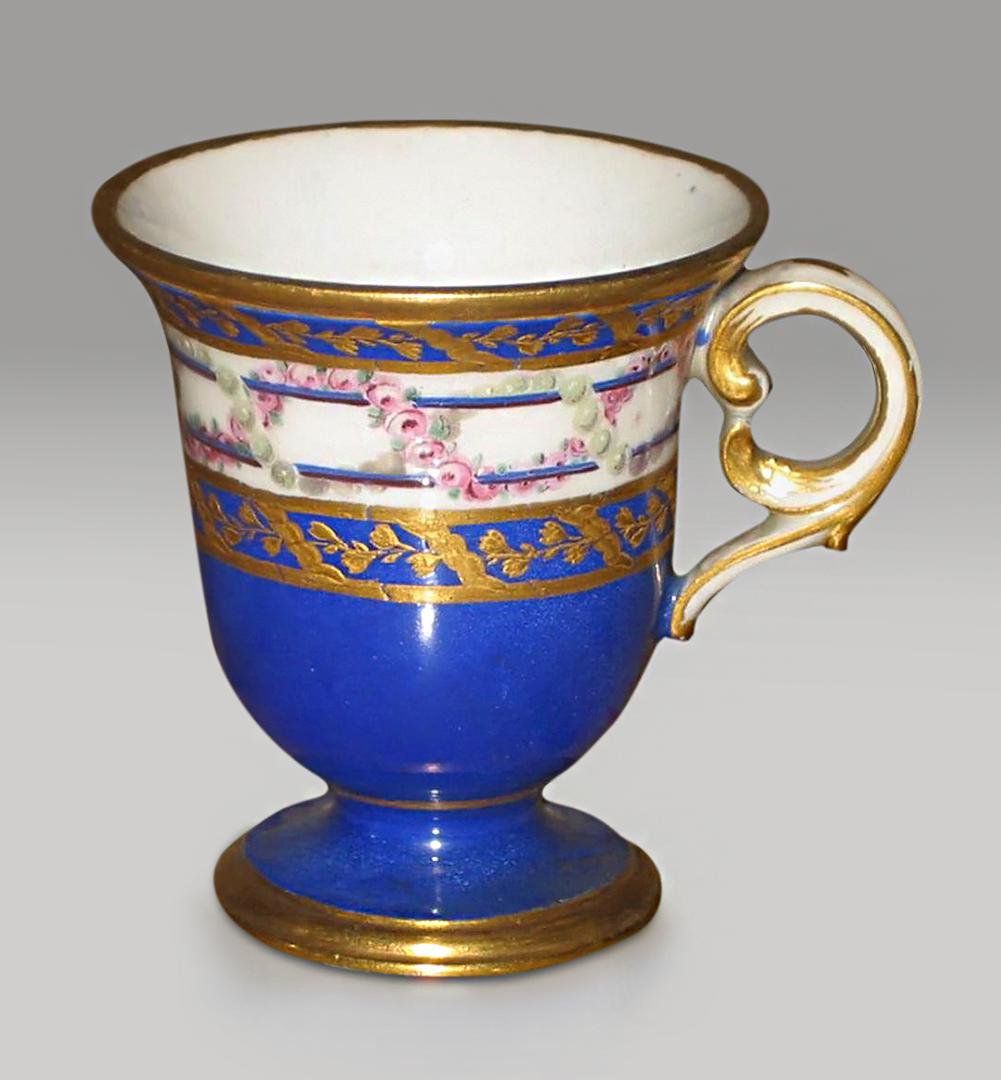
Ice-Cream Cup, Blue Service (ZF-16274). The State Hermitage Museum.
The cup entered the Hermitage in 1919 from the collection of A. K. Rudanovsky. It is not currently on permanent display.
It is the fifth cup of the same design in the collection, and its interest lies less in itself than in the group: five survivors from a service that once counted dozens of pieces.
The Object
The cup is small and rounded, with a flared rim and a low foot.
Its lower body is deep cobalt blue; above it, a white band carries a garland of pink roses and green leaves, framed by blue lines. Gold bands separate the zones, and the rim, foot and handle are gilded.
The handle is a scroll with a leaf terminal, applied to the body and gilded.
Five Cups
Five cups from the same service survive in the Hermitage.
They are almost identical: same size, same decoration, same handle. Only the small variations of hand-painting distinguish them — a petal turned differently, a line drawn a little thinner.
Five cups are a small sample of a service that would have included many dozens of pieces. Their survival is a matter of chance, but it is enough to reconstruct the design.
The Unit and the Series
A cup is a unit of a series.
In a service, the cup is repeated many times, and its design must work at the scale of the table: a dozen cups, each the same, arranged around the cloth. The repetition is the point.
The cup therefore has a double identity: as an individual object, with its own wear and its own marks, and as a unit of a set, defined by its conformity.
The Painter’s Absence
The painter of these cups is not recorded.
Unlike the plates of the service, which carry the marks of named painters, the cups are anonymous. Their decoration is competent but generic: a garland of roses, a gold band, a blue ground.
Anonymity is common in the production of services. The named painters worked on the show pieces; the cups were decorated by assistants or by painters whose marks were not recorded.
The Blue Service
The service is named for its blue ground.
The colour covers the lower part of each piece and gives the service its identity. The white band above, with its garland, is the constant counterpoint, and the gold provides the frame.
The design is simple enough to be repeated across dozens of pieces, and rich enough to make a table look magnificent.
Sèvres in 1788
The year 1788 was a difficult one for France.
The state was in financial crisis, the harvest had failed, and the country was moving toward revolution. Sèvres, as a royal manufactory, was dependent on the crown and on aristocratic clients.
The Blue Service belongs to the last years of the old order. Within a year, the world for which it was made would begin to disappear.
Soft Paste
The cup is made of soft-paste porcelain.
Soft paste was Sèvres’s traditional material: a mixture of clay and glass, fired at a lower temperature and prized for its warm white and its brilliant colours.
By 1788, the factory was also making hard paste, but soft paste remained the material of its finest decorated pieces. The cup’s slight translucency and creamy surface are the signature of the older technique.
The Cup and the Table
The cup was one of many objects on a dessert table.
It stood on a saucer, beside plates, dishes and trays, all decorated in the same blue and gold. The table was a composition, and the cup was a small element in it.
Seen alone, the cup is a pretty object; seen in its context, it is a piece of a social ritual.
The Handle
The handle is a small sculpture.
It is formed as a scroll, with a leaf-shaped terminal where it joins the body, and it is gilded over the white porcelain. The curve is designed for the fingers: a thumb on top, the index below.
The handle also protects the hand from the cold of the cup, and it gives the small object a distinct silhouette.
The Colour Blue
The blue of the cup is the colour of the service.
It is a deep cobalt, applied as a ground and fired, and it covers the lower half of the body and the foot. Against the white band and the gold, it reads as a solid, almost architectural element.
Blue was the most expensive colour in the Sèvres palette, and its use here signals the quality of the service.
What Five Cups Tell
Five cups are a small sample, but they tell a lot.
They show the consistency of the factory’s production, the small variations of hand-painting and the way a design was repeated across a set. They also show how a service was used: cups were made in numbers, because a table needed many.
Without the five, the service would be known only from plates and trays. With them, it becomes a table.
The Foot
The foot of the cup is small and slightly flared.
It lifts the body from the saucer, gives stability and carries a gold band around its edge. The foot is also the part that takes the most wear, and on this cup the gilding is rubbed.
The shape of the foot — a short stem, a disc, a gilded rim — is characteristic of Sèvres cups of the 1780s.
The Service’s Repertoire
The cup repeats the motifs of the service.
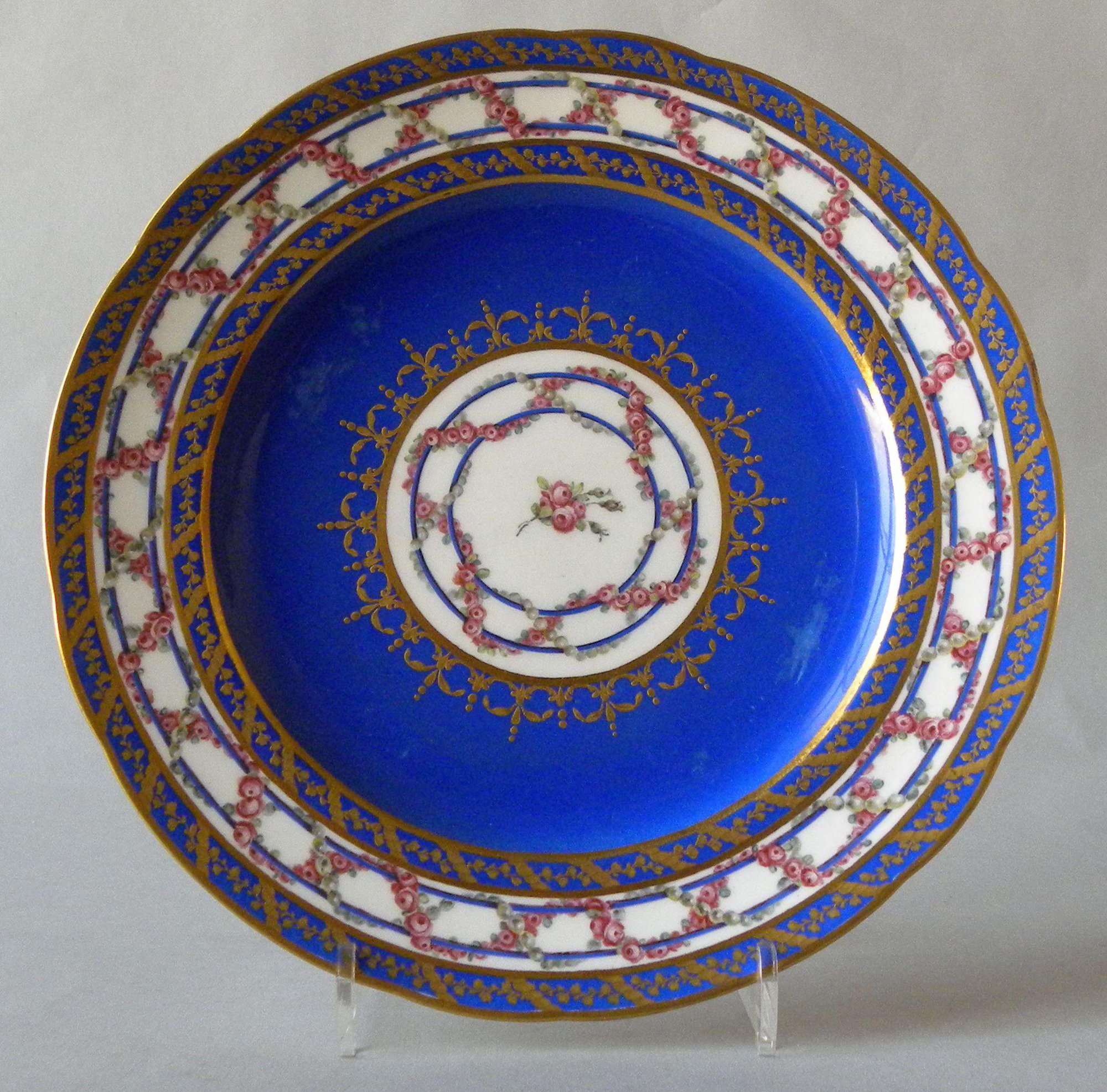
Blue ground, white band, garland of roses, gold bands, blue lines: these elements appear on every piece, from the smallest cup to the largest tray. The repertoire is small, and its repetition is what makes the service coherent.
A cup is therefore a lesson in how a design system works: a few elements, combined with variations, can furnish an entire table.
A Cup in the Collection
The cup is one of thousands of Sèvres objects in the Hermitage.
Its interest is not its rarity but its place in a group: five cups, several plates, trays and bowls, all from the same service. Together they allow the museum to show a table rather than a single object, and to reconstruct the visual world of a dessert service.
That is the quiet value of such pieces: they are not masterpieces, but they are evidence of a whole.
Provenance
The cup carries the inventory number ZF-16274 and entered the Hermitage in 1919 from the collection of A. K. Rudanovsky.
In the Hermitage
The cup is preserved in the State Hermitage Museum in Saint Petersburg and is not on permanent display.
It is one of five cups that allow the museum to show the Blue Service as a set, and it reminds us that the history of porcelain is also a history of repetition — of objects made in numbers, to be used together.