Artist: Geneviève Taillandier (painter)
Organization: Sèvres Porcelain Manufactory
Origin: France
Date: 1788
Complex: Blue Service
Material: soft-paste porcelain
Dimensions: diameter 24.2 cm
Current Collection: The State Hermitage Museum
Inventory Number: ZF-16278
Hermitage ID: 352378
Rudanovsky Connection: Entered the Hermitage in 1919 from the collection of A. K. Rudanovsky.
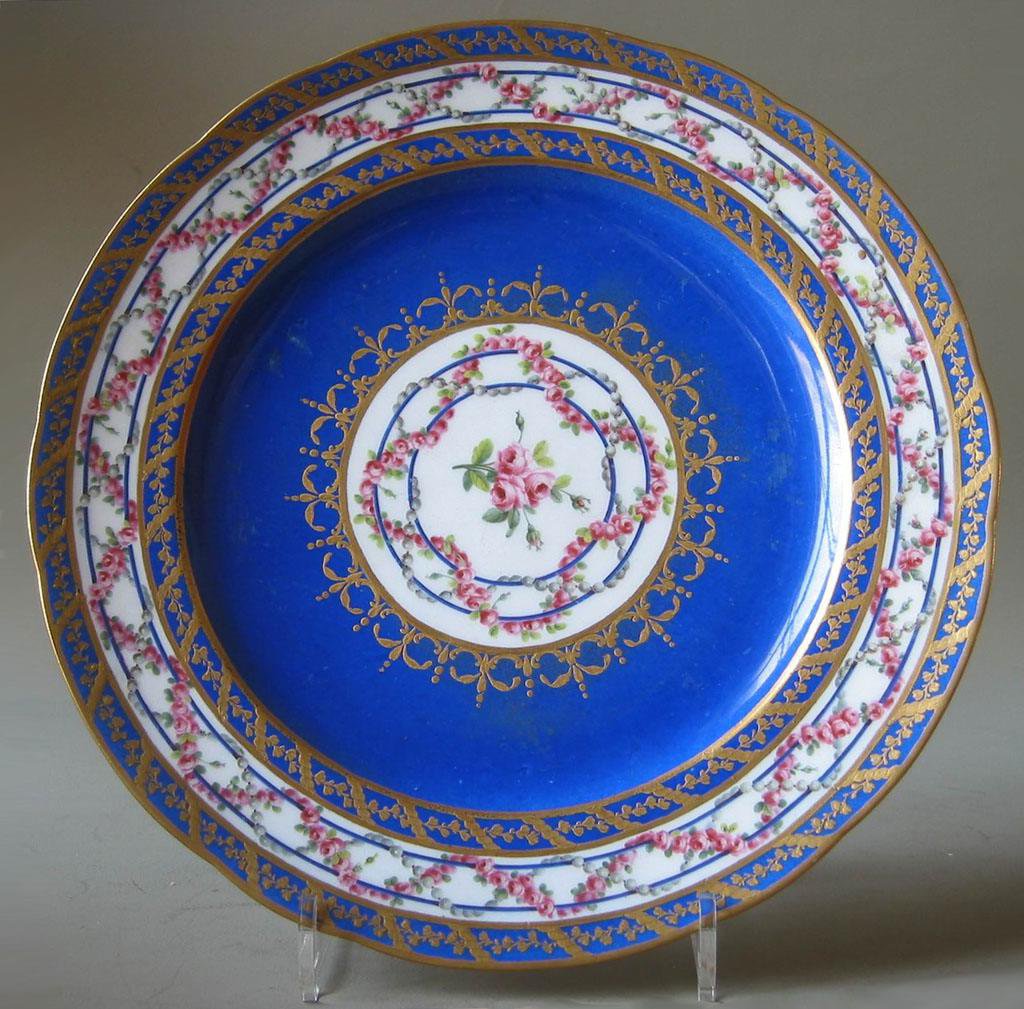
A Sèvres plate of 1788 from the «Blue Service», its blue rim and well framing a white centre with a spray of roses, painted by Geneviève Taillandier.
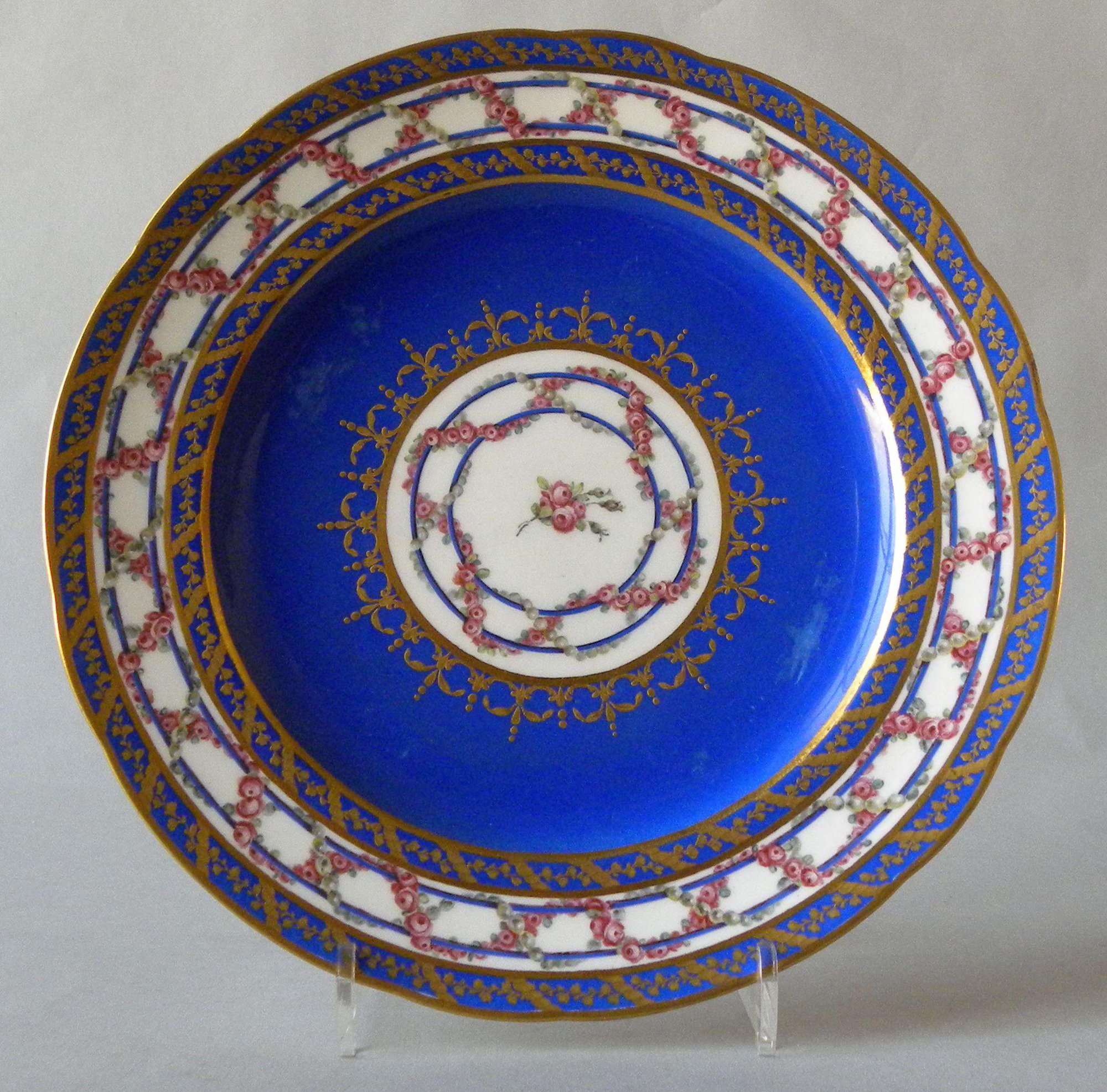
Plate, Blue Service (ZF-16278). The State Hermitage Museum.
The plate entered the Hermitage in 1919 from the collection of A. K. Rudanovsky. It is not currently on permanent display.
It is a dinner plate, 24 centimetres across, and it carries the full decoration of the service: a blue ground, a white band with a garland of roses, gold borders and a central medallion.
The Object
The plate has a wide, slightly wavy rim and a shallow well.
The rim is blue, decorated with gold garlands and scrolls. Inside it, a white band carries a continuous garland of pink roses and green leaves, framed by blue lines. A gold band separates the rim from the well, which is blue, and in the centre a gold foliate circle frames a white medallion with a small spray of roses.
The blue is deep and even; the gold is bright; the roses are painted in soft pinks and greens.
The Plate
The plate is the most basic object of the table.
It is the surface on which food is served, and it is also the largest continuous area of decoration in a service. The design of a plate must work at the scale of the whole table, where a dozen plates are seen together.
This plate is designed to be part of that pattern: the blue rim and the white centre create a strong graphic rhythm when the plates are arranged around a cloth.
Geneviève Taillandier
The plate is attributed to Geneviève Taillandier, a painter at Sèvres.
Her name is recorded among the painters who worked on the service, and the mark on the underside of the plate would have identified her work to the factory.
Women painters were employed at Sèvres, especially for flowers, and Taillandier belongs to that group. Her work on this plate is delicate and precise: the roses in the central medallion are painted with a fine brush and a light touch.
The Rim
The rim is the most decorated part of the plate.
It is blue, with gold garlands that run around the edge in a continuous pattern. The gold is applied over the blue and fired, so that it sits on the surface like a drawing.
The rim is also the part most exposed to wear: it is lifted, stacked and knocked against other plates. On this plate, the gilding is rubbed in places, and the blue is scratched.
The Well
The well of the plate is blue and plain.
It is a wide band between the rim and the central medallion, and its function is to frame the centre. The blue gives it depth, and the gold band above and below separates it from the white areas.
The well is the part of the plate that holds the food, and its colour is a bold choice: most plates of the period have white wells. The blue makes the plate a decorative object as much as a useful one.
The Centre
The centre of the plate is a white medallion with a spray of roses.
It is framed by a delicate gold circle of leaves and scrolls, which separates it from the blue well. The roses are painted in pinks and greens, with a few buds and leaves, and they form a small, centred composition.
The medallion is the focal point of the plate, and it is where the painter’s hand is most visible.
The Blue
The blue of the plate is the same deep cobalt as the cups of the service.
It is applied as a ground over the glaze, fired and polished, and it covers the rim and the well. The colour is intense and slightly uneven, as hand-applied grounds always are.
Blue grounds were expensive and difficult, and they were used only on the finest services. This plate is therefore a luxury object, made for a table that wanted to impress.
The Gold
The gold on the plate is applied in several ways.
There are broad gold bands, fine gold lines, and a delicate gold circle of leaves around the medallion. Each required a different brush and a different firing, and each is vulnerable to wear.
The gold gives the plate its richness and its sparkle, and it contrasts with the blue in a way that is both strong and harmonious.
The Plate’s Size
At 24.2 centimetres, the plate is a dinner plate.
It is large enough to hold a portion of meat or fish, and it is designed to be seen at the scale of a table setting. Smaller plates of the service would have been used for dessert or bread.
The size also gives the decoration room: the blue rim, the white band and the medallion all have space to breathe.
The Edge
The edge of the plate is slightly wavy, following the curve of the rim.
This scalloped outline softens the circle and connects the plate to the organic vocabulary of the service. It also makes the plate more difficult to make: the wavy edge must be formed by hand and fired without warping.
The edge is the part that chips, and this plate shows small losses along the rim.
The Service’s Plates
A dinner service included many plates.
There were plates of different sizes for different courses, and they were made in dozens. The Blue Service would have had a large number, and the surviving examples are only a fraction of the original production.
Each plate carries the same design, adapted to its size, and together they create the rhythm of the table.
The Underside
The underside of the plate is as informative as the front.
There the foot ring, the factory mark, the date letter and the painter’s mark are found. The foot ring shows how the plate was fired and finished; the marks show when and by whom it was decorated.
The underside is the plate’s archive, hidden from the table but essential to its history.
A Plate and Its Double
This plate has close relatives in the collection.
Several plates from the same service survive, and they are almost identical: same size, same rim, same garland, same medallion. Only the marks on the underside, and the small variations of the painting, distinguish them.
Seen together, the plates show the consistency of the factory and the individuality of the painter. Seen alone, this one is a complete statement of the service’s design.
Provenance
The plate carries the inventory number ZF-16278 and entered the Hermitage in 1919 from the collection of A. K. Rudanovsky.
In the Hermitage
The plate is preserved in the State Hermitage Museum in Saint Petersburg and is not on permanent display.
It is one of several plates from the same service in the collection, and it allows us to see how the design worked at the scale of a dinner plate: a blue frame, a white centre, and a spray of roses in the middle.