Artist: Hendrick Verschuring (1627–1690)
Origin: Holland
Date: 1680
Material: canvas
Technique: oil
Dimensions: 64.5 × 77.5 cm
Current Collection: The State Hermitage Museum
Inventory Number: GE-6414
Hermitage ID: 42307
Rudanovsky Connection: Entered the Hermitage in 1919 from the collection of A. K. Rudanovsky.
A Dutch painting of 1680 showing a troupe of Italian comedians performing on a makeshift stage in a crowded square.
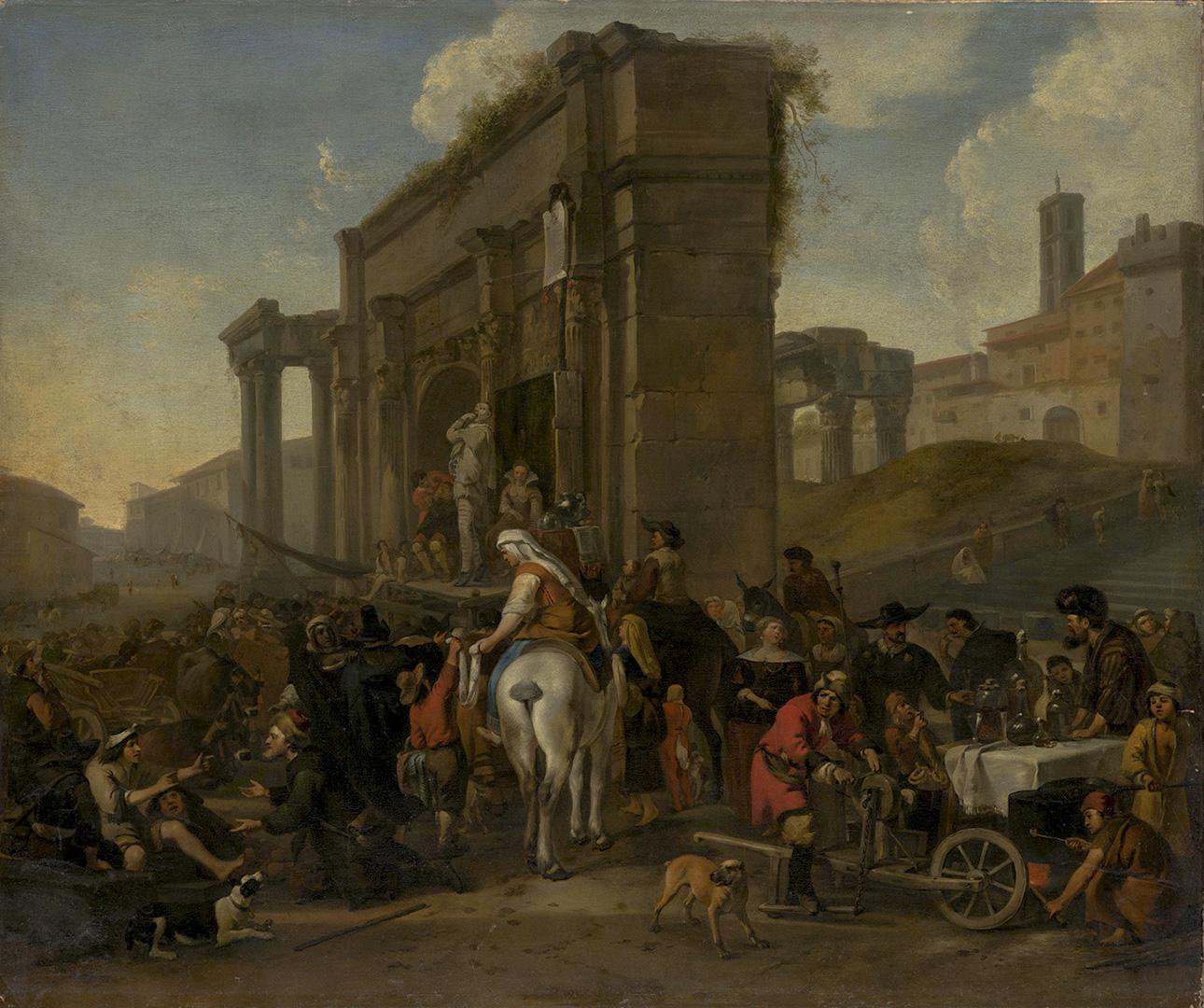
Italian Comedians in the Square. The State Hermitage Museum.
The painting entered the Hermitage in 1919 from the collection of A. K. Rudanovsky. It is not currently on permanent display.
It is a busy scene: a stage in front of a ruined Roman arch, spectators crowded around, a woman on a white horse, a table with a man sitting, and dogs in the foreground.
The Object
The painting is a horizontal canvas, 64.5 by 77.5 centimetres.
Its composition is built around the ruined arch, which dominates the left and centre. In front of it stands a wooden platform, with actors on it and a crowd around; to the right, a table with a seated figure, a cart, a donkey and a horse.
The colours are warm and earthy: browns, ochres, greys and muted blues, with a few touches of red and white.
The Comedy
The subject is the commedia dell’arte.
The commedia was an Italian form of improvised theatre, with stock characters — Harlequin, Pantalone, Columbina — and a repertoire of comic scenes. It was enormously popular in the seventeenth century, and it travelled across Europe.
The actors on the platform are performing a scene, and the crowd is watching: the painting captures the moment of performance, with its gestures, its costumes and its noise.
The Stage
The stage is a makeshift platform.
It is built of wood, raised above the ground, and covered with a canopy or a backdrop. The actors stand on it, and one of them is elevated on a small ladder or step, declaiming to the crowd.
The stage is a temporary structure, set up in a public square for a few days, and the painting records both its improvised quality and its theatrical magic.
The Crowd
The crowd is the painting’s real subject.
Dozens of figures fill the foreground and the middle ground: men in hats and cloaks, women with baskets, children, a dog. They are watching, talking, laughing, moving.
The crowd is painted in quick, lively strokes, and each figure has a gesture or a role. It is a portrait of a public — the audience that made the commedia possible.
The Ruins
The setting is ancient Rome, or a European city with Roman ruins.
The arch is monumental, with columns, a cornice and a crumbling attic, and it is overgrown with grass. It gives the scene a grand, slightly melancholic backdrop: the ruins of antiquity, and the busy life of the present.
Ruins were a favourite motif of seventeenth-century art, and they allowed the painter to combine architecture, landscape and figures in a single composition.
The White Horse
A woman on a white horse stands near the centre.
She is dressed in dark clothes, and her horse is painted in bright white, catching the light. She is a spectator too, but her elevated position makes her part of the spectacle.
The white horse is the painting’s brightest note, and it draws the eye across the composition.
Verschuring
Hendrick Verschuring (1627–1690) was a Dutch painter from Gorinchem.
He was a pupil of Jan Both, and he travelled to Italy, where he painted landscapes, town views and scenes of Italian life. His work is characterised by warm light, careful composition and lively figures.
This painting belongs to his Italianate manner: a scene of Italian popular life, painted for a Dutch market that loved images of the South.
Italy
For Dutch painters, Italy was a dream as much as a place.
It was the land of antiquity, of warm light, of music and of the commedia. Painters who travelled there brought back sketches, memories and a repertoire of motifs, which they reused for decades.
This painting is a product of that dream: an Italian square, peopled with actors, spectators and ruins, painted by a Dutchman who knew the country and its theatre.
1680
The date 1680 places the painting late in Verschuring’s career.
By then, the commedia had been popular in Europe for more than a century, and the taste for Italianate scenes was well established in Holland. The painting is a late example of a tradition that had begun in the 1620s.
It is also a record of a performance: a moment of theatre, captured in paint.
The Square
The square is the painting’s stage.
It is a public space, paved and open, with the arch at its centre and buildings on both sides. The square is where the theatre happens, and it is also where the crowd gathers, trades and gossips.
In seventeenth-century Italy, the piazza was the heart of urban life, and the commedia was one of its most popular entertainments.
The Table
A table with a seated man stands at the right.
It is covered with a white cloth, and the man sits behind it, with a jug and glasses — perhaps a refreshment stall, or a gambling table. He watches the performance, and his table is a small stage of its own.
The table is a detail that gives the painting its everyday texture: the theatre is surrounded by commerce, food and drink.
The Figures
The painting is full of figures.
There are the actors on the platform, the woman on the white horse, the man at the table, the crowd around the stage, a dog in the foreground, a cart with a wheel. Each figure has a role, and each is painted with a quick, decisive stroke.
The figures are what make the painting alive: they turn a scene into a crowd.
The Colour
The colour is warm and earthy.
Browns, ochres and greys dominate, with touches of red, white and blue. The light is golden, as if the scene were taking place in the late afternoon, and the shadows are soft.
The palette is characteristic of Italianate Dutch painting, where the warm light of the South was as important as the subject.
The Dogs
Two dogs appear in the foreground.
One lies at the left, white with dark patches, watching the crowd; another stands near the centre, alert, its head turned. They are ordinary dogs in a public square, and they are painted with as much care as the people.
The dogs give the scene its everyday scale: the theatre is a spectacle, but the square is also a place where animals sleep and wander.
Provenance
The painting carries the inventory number GE-6414 and entered the Hermitage in 1919 from the collection of A. K. Rudanovsky.
In the Hermitage
The painting is preserved in the State Hermitage Museum in Saint Petersburg and is not on permanent display.
It is a lively, crowded image, and it preserves a world that has vanished: the improvised stage in the square, the actors, the crowd and the ruins — a theatre of the seventeenth century, in paint.
It is also a picture of an audience: without the crowd, there would be no comedy at all, and no square to perform it in.