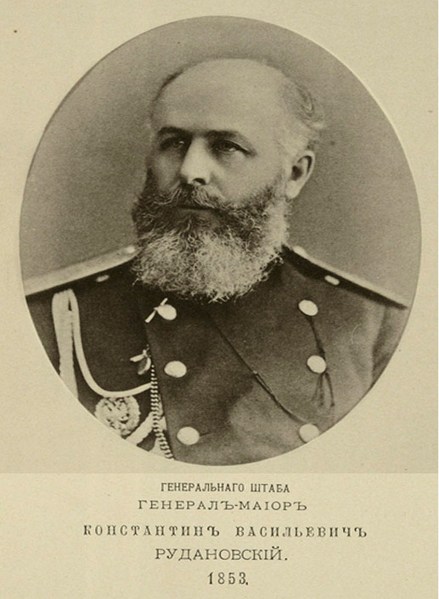
Konstantin Vasilyevich Rudanovsky
Konstantin Vasilyevich Rudanovsky (12 May 1834–1899) was a Russian general, art collector and a representative of the Rudanovsky family whose life became closely connected with France and the European art world of the nineteenth century.
Born in the Russian Empire, Rudanovsky pursued a military education in Saint Petersburg. According to biographical records, he graduated from the First Cadet Corps and later studied at the Nikolaev Academy of the General Staff. His military career eventually brought him to Paris, where he served during the reign of Emperor Nicholas I.
Paris and the Art World
Rudanovsky’s years in France extended his interests far beyond military service. He developed a strong passion for European art and became involved in collecting and dealing in works that could find buyers among Russian collectors.
France and Italy were particularly important to his activities. He sought paintings, jewellery and other valuable objects in Western Europe and helped bring them into Russian collecting circles.
One story preserved in accounts of his life describes Rudanovsky acquiring a large portrait of Emperor Nicholas I and subsequently selling the work to the emperor himself.
His position in Paris also brought him into contact with influential figures in French and Russian society. Among them was Charles de Morny, the French statesman and diplomat who served as ambassador to Russia.
Charles de Morny and Sophia Trubetskaya
De Morny was married to Sophia Sergeyevna Trubetskaya, and the couple became associated with Rudanovsky during his years in France. Historical accounts connected with the family describe them as occasional buyers of works of art and jewellery handled by Rudanovsky.
These relationships placed him within a network in which diplomacy, aristocratic society and the European art market frequently intersected.
Rudanovsky gradually established a reputation among art dealers in Paris. The historical narrative surrounding his collecting activities also associates his name with the celebrated Sancy Diamond, one of the most famous historic diamonds in Europe.
The Sancy Diamond
The Sancy has a history stretching across European royal and aristocratic collections and changed ownership numerous times over the centuries.
Accounts concerning Konstantin Rudanovsky state that his involvement in a transaction concerning the Sancy contributed significantly to his reputation among Parisian dealers.
The diamond itself would eventually become part of the collection of the Louvre, where it remains one of the best-known historic jewels associated with the French Crown.
A Russian Cultural Presence in France
The original Rudanovsky family account also connects Konstantin and Sophia Trubetskaya through discussions about establishing a cultural centre or gallery in France — a place where Russian culture and Rudanovsky’s collection could be presented to a European audience.
Sophia is remembered in this account as expressing the desire to create “an island of Russian culture in France.”
The story subsequently became intertwined with Deauville, the Normandy seaside resort whose development was closely associated with Charles de Morny during the nineteenth century.
Deauville later became an important meeting place for European high society and developed particularly strong cultural connections with Russia. By the early twentieth century, Russian artists and performers had become part of the cultural life associated with the resort.
In 1912, years after Rudanovsky’s death, Deauville also witnessed performances during the celebrated era of Sergei Diaghilev and the Ballets Russes.
Connections with the Imperial Family
Rudanovsky’s connections extended into the Romanov world.
Biographical material identifies him as a mentor of Grand Duke Konstantin Konstantinovich of Russia, a grandson of Emperor Nicholas I, as well as Grand Duke Peter Nikolaevich of Russia.
These connections place Rudanovsky within the broader network of military officers, aristocrats, collectors and cultural figures surrounding the Imperial family during the second half of the nineteenth century.
The Next Generation
Konstantin Vasilyevich Rudanovsky died in Paris in 1899.
His interest in art and collecting did not disappear with his death. His son, Arkadiy Konstantinovich Rudanovsky, became an art collector in his own right, continuing a tradition that would become an important part of the history of the Rudanovsky family.
Works associated with later generations of the family would eventually enter museum collections, including the State Hermitage Museum.
Konstantin Rudanovsky’s story therefore occupies an important place in the family history: at the intersection of Imperial Russia, nineteenth-century Paris, military service, private collecting and the international movement of art.
His life also illustrates the increasingly international character of Russian collecting during the nineteenth century — a world in which artworks, collectors, dealers, diplomats and aristocratic families moved between Saint Petersburg, Paris and other European cultural centres.