Artist: Bernard-Édouard Swebach (1800–1870)
Origin: France
Date: 19th century
Material: paper
Technique: pen, brush and ink
Dimensions: 13.5 × 19.5 cm
Current Collection: The State Hermitage Museum
Inventory Number: OR-27457
Hermitage ID: 358414
Rudanovsky Connection: Entered the Hermitage in 1922 from the collection of A. K. Rudanovsky.
An ink drawing of a rider in oriental costume, his scimitar raised, riding across a landscape with palms and a classical ruin.
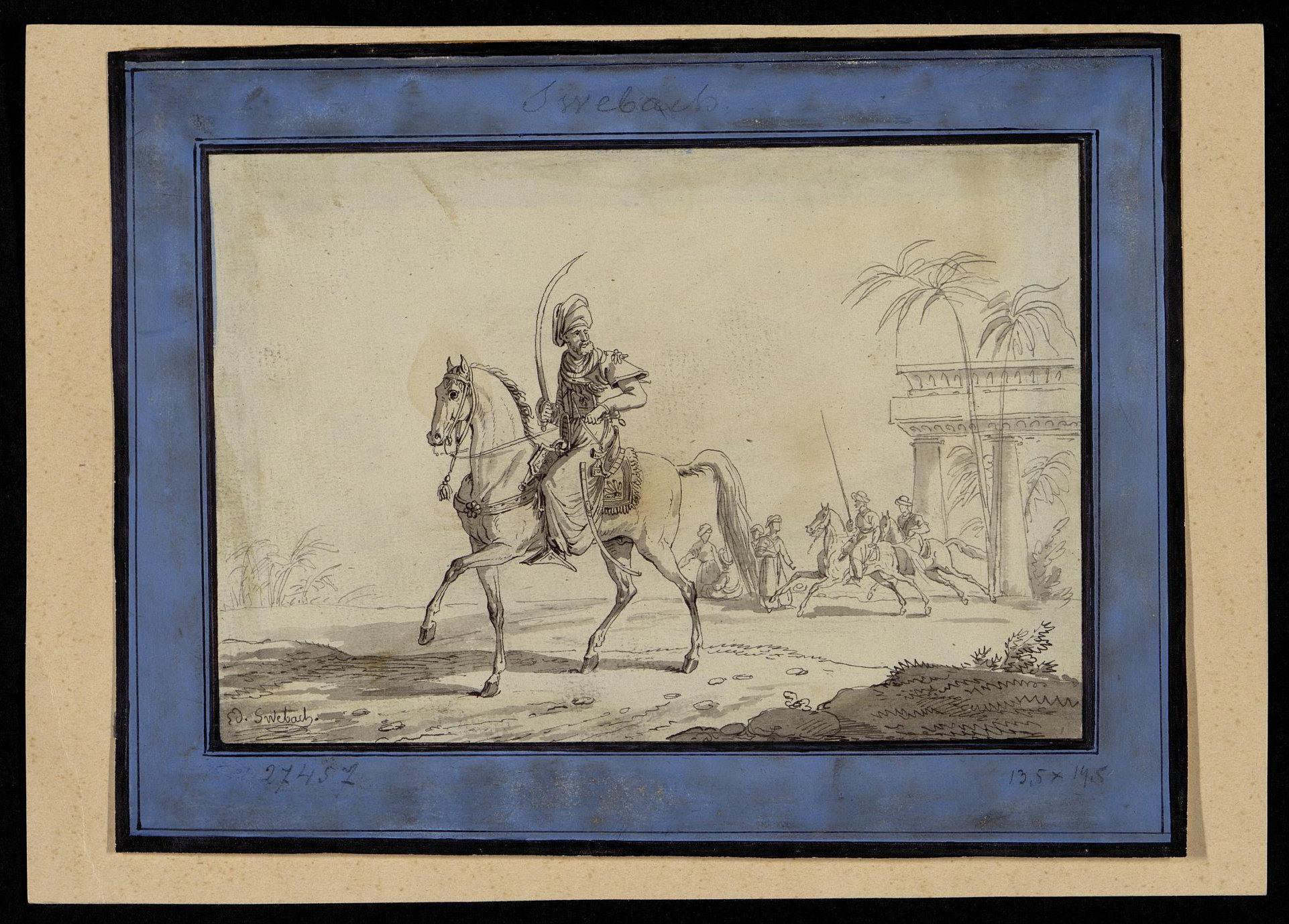
Rider in Oriental Costume. The State Hermitage Museum.
The drawing entered the Hermitage in 1922 from the collection of A. K. Rudanovsky. It is not currently on permanent display.
It is a small sheet, mounted in a blue paper frame, with the artist’s name written at the top and a signature at the lower left.
The Object
The drawing is in pen and ink, with washes of grey and brown.
The rider dominates the centre: a man in a turban and a long robe, seated on a horse that steps forward with its right foreleg raised. He holds a curved sabre above his head, and the reins in his other hand.
Behind him, to the right, are palm trees and a ruin with columns; further back, other riders and figures. The background is lightly washed, and the sky is left almost empty.
The Rider
The rider is the focus of the composition.
He is dressed in oriental costume: a turban, a long robe, wide trousers and pointed shoes. The costume is generic — a European idea of the East rather than a specific national dress — and it belongs to the fashion for orientalism that swept Europe in the eighteenth and nineteenth centuries.
His pose is theatrical: the raised sabre, the turn of the head, the horse rearing slightly. It is an image of power and movement, designed to catch the eye.
Orientalism
Orientalism was one of the great themes of nineteenth-century European art.
Painters and draughtsmen imagined the East as a place of colour, violence and sensuality: horsemen, harems, bazaars, deserts. The images were rarely based on direct observation, and they often repeated the same motifs — turbans, sabres, palm trees, ruins.
This drawing belongs to that tradition. It is not a record of a real place but a fantasy of the East, composed from familiar elements.
The Horse
The horse is drawn with care.
Its head is small and alert, its neck arched, its legs slender. The artist has studied the animal’s anatomy and movement, and the result is a horse that looks as if it could move.
Swebach was known for his equestrian subjects, and his drawings of horses are among his most admired works. The horse here is not a generic symbol but a specific animal, observed and understood.
The Setting
The setting is a mixture of East and West.
Palm trees suggest a hot climate; the ruin with columns suggests antiquity; the open ground suggests a desert or a plain. The elements are combined to create a picturesque scene rather than a coherent geography.
This mixture is characteristic of orientalist imagery: the East is assembled from whatever motifs seem exotic, without regard for accuracy.
Ink
The drawing is made with pen and brush.
The pen provides the outlines and the fine details; the brush provides the washes that model the forms and suggest the light. The combination allows both precision and atmosphere.
Ink is an unforgiving medium: a mistake cannot be erased, only covered or incorporated. The confidence of the drawing suggests an experienced hand.
The Mount
The drawing is mounted in a blue paper frame.
The mount is part of the object: it frames the image, protects the sheet and carries inscriptions. At the top, the name «Swebach» is written in ink; at the lower left, the signature «D. Swebach»; at the bottom, the dimensions.
Mounts of this kind were common in the nineteenth century, when drawings were kept in albums or portfolios.
The Signature
The signature is a small but important detail.
«D. Swebach» — the initial may refer to a member of the Swebach family, several of whom were artists. Bernard-Édouard Swebach was the son of Jacques-François Swebach, and the family workshop produced military and equestrian scenes.
The signature connects the drawing to that workshop and to the tradition of French military art.
Military Art
The Swebach family were specialists in military and equestrian subjects.
Bernard-Édouard’s father, Jacques-François Swebach, painted battles, parades and cavalry scenes, and his son continued the tradition. Their work belongs to the great age of military painting, when Napoleon’s campaigns made soldiers and horses the heroes of European art.
This drawing, with its horseman and its sabre, is a small example of that tradition. It is not a battle scene, but it has the same ingredients: a horse, a rider, a weapon and a pose of command.
The Blue Mount
The drawing is mounted in a blue paper frame.
The mount is more than a support: it is part of the object’s presentation. It isolates the image, protects the sheet and carries the inscriptions that identify the artist and the subject.
In the nineteenth century, drawings were often mounted in this way, in albums or portfolios, and the mount was chosen to complement the drawing. The blue here sets off the greys and browns of the ink.
Drawing as Reportage
Orientalist drawings often presented themselves as reportage — images of places and peoples observed at first hand.
In reality, most were composed in the studio from prints, costumes and earlier paintings. The artist assembled a scene that looked authentic without necessarily having travelled.
This drawing is a good example of that paradox: a convincing image of an oriental rider, made in France, from a repertoire of familiar motifs.
The Signature and the Family
The signature «D. Swebach» is a small clue to the drawing’s origin.
The Swebach family produced several artists, and the initial may refer to one of them — perhaps a son or a relative of Bernard-Édouard. The family workshop was known for military and equestrian scenes, and the drawing fits that repertoire.
The attribution in the museum record is to Bernard-Édouard, and the style is consistent with his work: confident, lively and preoccupied with horses.
The Scimitar
The sabre in the rider’s hand is the drawing’s most dramatic gesture.
It curves above his head, catching the light on its blade, and it turns the rider from a traveller into a warrior. The weapon is an oriental type — a scimitar rather than a European sabre — and it reinforces the exotic character of the scene.
The gesture is also a compositional device: the raised arm and the curved blade lead the eye upward, giving the figure energy and height.
Provenance
The drawing carries the inventory number OR-27457 and entered the Hermitage in 1922 from the collection of A. K. Rudanovsky.
In the Hermitage
The drawing is preserved in the State Hermitage Museum in Saint Petersburg and is not on permanent display.
It is a small, energetic sheet, and it captures a particular nineteenth-century fantasy: the East as a theatre of horsemanship, colour and violence, drawn in ink on a piece of paper.
It is a small sheet, but it has the energy of a battle painting and the confidence of a family trade, after all.