Artist: Zygmunt Vogel (1764–1826)
Date: 1794
Material: paper
Technique: watercolour
Dimensions: 42 × 58 cm
Current Collection: The State Hermitage Museum
Inventory Number: OR-27283
Hermitage ID: 358095
Rudanovsky Connection: Entered the Hermitage in 1922 from the collection of A. K. Rudanovsky.
A watercolour view of the Myślewicki Palace in Łazienki, painted by Zygmunt Vogel in 1794.
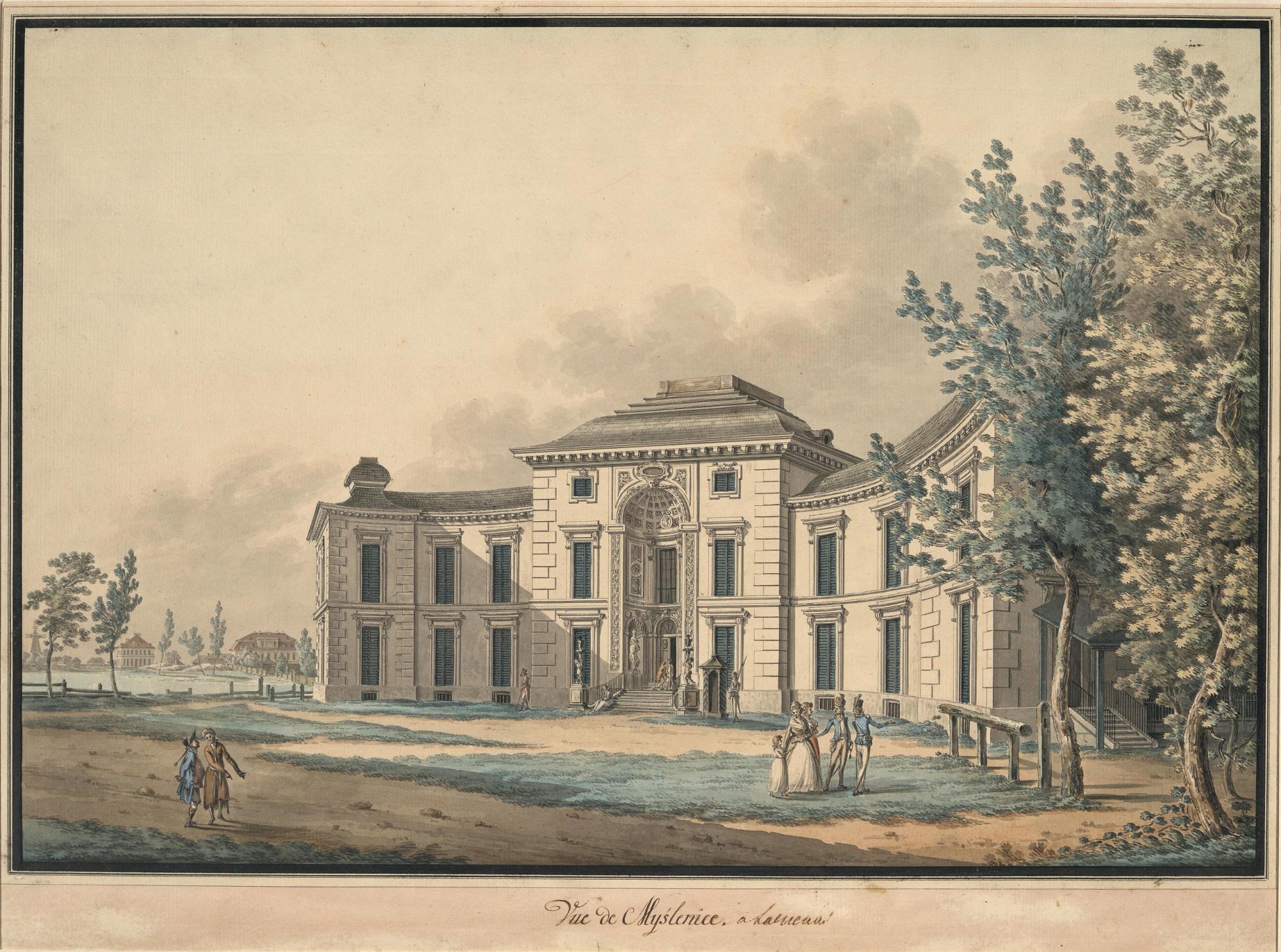
Lazienki. Myślewicki Palace. The State Hermitage Museum.
The watercolour entered the Hermitage in 1922 from the collection of A. K. Rudanovsky. It is not currently on permanent display.
It shows a low, elegant palace with curving wings, standing on open ground among trees, with a few figures in the foreground and a cloudy sky above.
The Object
The drawing is a horizontal sheet, framed by a dark border and mounted on a larger support.
The palace occupies the centre of the composition, seen from an angle that reveals both the entrance front and one wing. The foreground is a broad, sandy area with patches of grass; the background is a line of trees and a pale sky.
Below the image, on the mount, an inscription in French identifies the subject: Vue de Myślenice, à Varsovie.
The Myślewicki Palace
The Myślewicki Palace is one of the pavilions of the Łazienki estate in Warsaw.
It was built in the 1770s for King Stanisław August Poniatowski, and it takes its name from the village of Myślewice, which once stood nearby. It was intended as a residence for members of the royal family and for distinguished guests.
The palace is smaller and more intimate than the Palace on the Isle, and its architecture is correspondingly lighter: a central block with a recessed entrance, flanked by curved wings that embrace the courtyard.
Merlini
The architect was Domenico Merlini, the Italian-born designer who worked for the king for decades.
Merlini was responsible for much of the Łazienki ensemble: the Palace on the Isle, the White House, the Myślewicki Palace and the landscaping of the park. His style is neoclassical, but softened by a taste for curves, niches and picturesque effects.
The Myślewicki Palace shows his hand clearly: the curved wings, the arched entrance and the careful proportions are all characteristic of his work.
The Façade
The façade in the drawing is rendered with care.
The central block has a large arched niche, framed by pilasters, with a sculptural group or a relief above the entrance. The wings curve forward, their windows regularly spaced, their roofline low and horizontal.
The building is pale — cream or light grey — against the darker trees and the sandy ground. The watercolour captures the softness of the light and the slight irregularity of the architecture.
The Watercolour
Vogel’s technique is visible throughout.
The washes are transparent and layered: a pale blue-grey for the sky, a warm ochre for the ground, a cooler grey for the shadows. The architecture is drawn with a fine pen and brush, and the details — windows, pilasters, the sculptural group — are indicated rather than described.
The result is a drawing that is both topographical and atmospheric: it records the building accurately, but it also conveys the mood of a summer day.
The Figures
The figures in the foreground are staffage.
On the right, a group of women and men stand talking, with a child and a small dog. On the left, two men walk away from the viewer. Near the entrance, a servant or a guard stands at the door.
The figures give scale to the building and life to the scene. They also suggest the social use of the palace: a place where people met, walked and talked in the grounds.
The Inscription
The inscription reads Vue de Myślenice, à Varsovie — «View of Myślenice, in Warsaw».
The name is a variant of Myślewicki, and the French form is typical of the period, when French was the language of the Polish court and of the international market for views.
The inscription, like the drawing, is a record: it tells us what the image represents and where it was made, and it preserves the eighteenth-century name of the place.
1794
Like its companion, this watercolour is dated 1794, the year of the Kościuszko Uprising and the final partition of Poland.
The palace it shows was a royal residence, built by the last king of Poland. In the year of the drawing, the world that had produced it was collapsing, and the calm of the image is shadowed by that knowledge.
The Courtyard
The palace is built around a courtyard.
The curved wings embrace the space in front of the entrance, creating a shallow forecourt that opens toward the park. This is a baroque device — the cour d’honneur — adapted to a small neoclassical building.
In the watercolour, the courtyard is visible as a sandy area with patches of grass, crossed by the shadows of the trees. The curve of the wings gives the building a welcoming, almost theatrical presence.
The Palace in Use
The Myślewicki Palace was built to be lived in.
It housed members of the royal family and distinguished guests, and it was used for receptions, dinners and summer stays. Its rooms were decorated with paintings, mirrors and furniture, and its windows looked out over the park.
The watercolour shows the palace as a setting for social life: figures stand in the courtyard, a guard waits at the door, and the building is ready to receive.
Polish Watercolour
Watercolour was a young medium in Poland in the late eighteenth century.
It was taught at the royal court and practised by artists who travelled in Italy and France. Vogel was one of its first masters, and his views of Warsaw and its surroundings helped to establish the medium in Poland.
His work is topographical in purpose but romantic in feeling: the soft washes and the cloudy skies give the places he records an atmosphere that a simple survey would not.
The Name
The name of the palace is a small puzzle.
The building is called Myślewicki, after the village of Myślewice that once stood nearby. The inscription on the drawing calls it Myślenice, a variant or a mistake, and the French form fixes the name as it was understood in the eighteenth century.
Names of this kind are fragile. They change with languages, with owners and with fashion, and the drawing preserves one version of the name alongside one version of the building.
Provenance
The watercolour carries the inventory number OR-27283. It entered the Hermitage in 1922 from the collection of A. K. Rudanovsky.
In the Hermitage
The watercolour is preserved in the State Hermitage Museum in Saint Petersburg and is not on permanent display.
It is one of a pair with the view of the Palace on the Isle, and together the two drawings record the Łazienki of Stanisław August: a garden of pavilions, water and trees, painted in the last years of the Polish-Lithuanian Commonwealth.
Together they preserve a landscape that has changed beyond recognition, and a moment that vanished almost as soon as it was drawn.
The palace still stands in Warsaw, but the world that built it does not, and the drawing has become the more vivid of the two — a window onto a summer that ended in catastrophe.