Origin: France, Paris
Date: last quarter of the 18th – early 19th century
Material: porcelain
Technique: gilding, polychrome painting, gold painting
Dimensions: height 37.3 cm; diameter 24.8 cm
Current Collection: The State Hermitage Museum
Inventory Number: ZF-15187
Hermitage ID: 330098
Rudanovsky Connection: Entered the Hermitage in 1919 from the collection of A. K. Rudanovsky.
A large Paris porcelain vase with a gilded ground and a painted scene of a woman with a lyre, made in the last years of the eighteenth century or the first of the nineteenth.
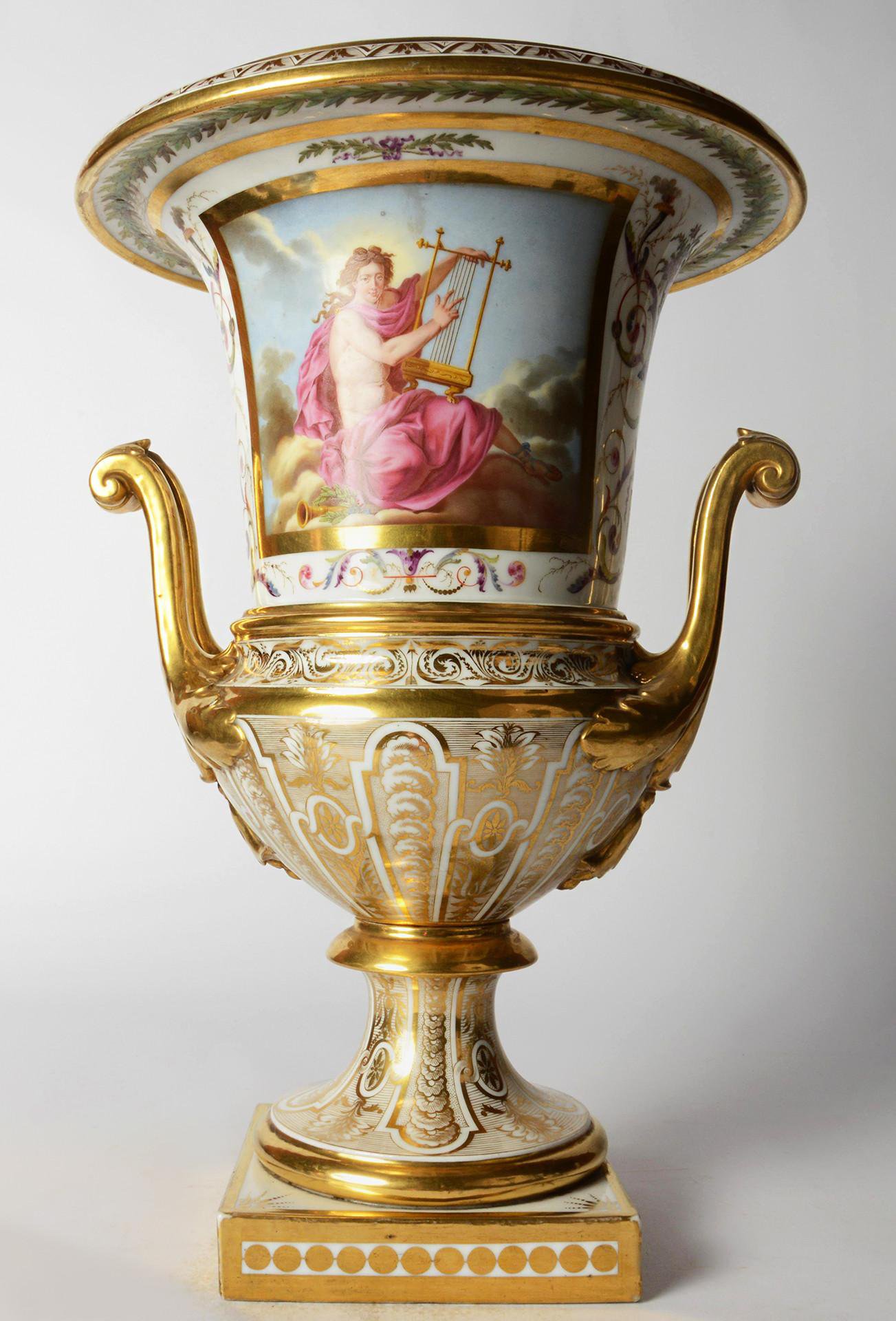
Vase (ZF-15187). The State Hermitage Museum.
The vase entered the Hermitage in 1919 from the collection of A. K. Rudanovsky. It is not currently on permanent display.
It is a tall, confident object — nearly forty centimetres high — with two scroll handles, a flared mouth and a body covered in gold.
The Object
The vase has a wide, flaring lip, a short neck and a rounded body that tapers to a small foot.
On the front, framed by a gold band, a rectangular reserve contains a painted scene: a woman in pink drapery, seated on clouds, playing a lyre. The background is a pale blue sky with soft clouds.
The rest of the body is covered with a gold ground, over which white and gold ornament is painted: palmettes, scrolls and bands of foliage. The lower part of the body and the foot carry a dense pattern of white and gold leaves on a gold ground.
The Shape
The shape is a neoclassical vase, based on ancient prototypes.
It resembles the so-called vase étrusque or vase Médicis: a form derived from Greek and Roman pottery, with a flared mouth, a rounded body and two handles. Such vases were popular in the late eighteenth century as ornaments for chimneypieces and cabinets.
The proportions are carefully balanced: the height is about one and a half times the diameter, and the flare of the mouth echoes the curve of the body.
The Scene
The painted scene is the focal point of the vase.
A woman sits on a bank of clouds, her body turned slightly, her hands on the strings of a lyre. She wears a pink drapery that falls across her lap and over one shoulder; her hair is dressed in a classical knot.
The subject is probably a muse — Erato, the muse of lyric poetry, or Terpsichore, the muse of dance — or perhaps a personification of music. The lyre is the attribute that identifies her.
Paris Porcelain
The vase is Paris porcelain, not Sèvres.
In the late eighteenth century, Paris had dozens of private porcelain factories, producing high-quality wares outside the royal manufactory. They made table services, vases, clocks and decorative objects, often with rich gilding and painted scenes.
Paris porcelain is distinguished by its fine white paste, its brilliant colours and its extensive use of gold. It was exported across Europe and was collected alongside Sèvres.
Gold Grounds
The gold ground is the vase’s most striking feature.
Gold was applied to the porcelain as a preparation of powdered metal, painted on with a brush, fired and burnished. A full gold ground required several applications and firings, and it was one of the most expensive forms of decoration.
The gold here is not flat: it is worked with patterns of white and gold leaves, so that the surface shifts between matte and polished areas. The effect is rich without being heavy.
The Handles
The handles are simple scrolls, gilded and applied to the sides.
They are functional — a vase of this size needs handles to be lifted — but they are also decorative, echoing the curves of the shape and adding a sculptural element to the silhouette.
The scroll form is ancient, and it appears on vases, urns and candelabra throughout the neoclassical period.
The Square Base
The vase stands on a square base with a band of gold circles.
The base is a separate element, painted to match the vase, and it raises the object and gives it stability. The circles are a simple geometric ornament, typical of the late eighteenth-century taste for classical motifs.
The combination of a round vase and a square base is a neoclassical device: it sets the curve of the body against the geometry of the plinth.
The Muse
The figure in the reserve is a muse.
In Greek mythology, the nine muses presided over the arts and sciences, and each was identified by an attribute: a lyre for music and lyric poetry, a scroll for history, a globe for astronomy.
The woman here holds a lyre and sits among clouds, which suggests a celestial or allegorical figure rather than a portrait. She may represent Music, Poetry or one of the individual muses; without an inscription, the identification remains open.
Vases and Interiors
Large porcelain vases were made for interiors, not for flowers.
In the eighteenth century, vases stood on chimneypieces, cabinets and pedestals, often in pairs or in sets of three. They were part of the decoration of a room, and their function was to be looked at.
A vase like this one, nearly forty centimetres high and covered in gold, was a statement of wealth and taste. It would have been at home in a drawing room or a gallery, among mirrors, gilded furniture and paintings.
Copies after Antiquity
The shape and decoration of the vase depend on the eighteenth-century rediscovery of antiquity.
The publication of the excavations at Pompeii and Herculaneum, and the collecting of Greek vases by Hamilton and others, made ancient pottery a model for European designers. Vase shapes, palmettes and scrolls entered the repertoire of porcelain painters.
Paris factories produced hundreds of such vases, adapting ancient forms to the needs of the modern interior. This one is a late example, gilded and painted for a client who wanted the classical look in the richest possible materials.
The Palette
The palette of the vase is deliberately limited.
Gold, white, pink and pale blue: four colours, repeated across the whole object. The gold provides the ground and the light; the white supplies the ornament; the pink of the drapery and the blue of the sky provide the only strong colour notes.
This restraint is characteristic of late eighteenth-century Paris porcelain. The aim was not variety but harmony, and the gold ground allowed a few colours to read as richness rather than as confusion.
Provenance
The vase carries the inventory number ZF-15187 and entered the Hermitage in 1919 from the collection of A. K. Rudanovsky.
In the Hermitage
The vase is preserved in the State Hermitage Museum in Saint Petersburg and is not on permanent display.
It is a piece of Paris luxury, made to stand on a chimneypiece or in a cabinet, and it represents the taste of the years around 1800: gold, classical forms and painted muses.
For a modern viewer, it is also a lesson in how the classical past was consumed in the eighteenth century — not as scholarship but as decoration, poured into porcelain and gilded until it glowed.
That it survived intact, with its gilding unbroken and its painted muse still smiling, is a small accident of history, a small miracle of care, and now a quiet monument in the museum’s keeping.