Organization: Nymphenburg Royal Porcelain Manufactory
Origin: Germany
Date: circa 1770
Material: porcelain, copper
Technique: polychrome painting, gilding
Dimensions: height 4 cm; length 9 cm; width 7 cm
Current Collection: The State Hermitage Museum
Inventory Number: ZF-13999
Hermitage ID: 330686
Rudanovsky Connection: Entered the Hermitage in 1919 from the collection of A. K. Rudanovsky.
A Nymphenburg porcelain snuff box of about 1770, with a cameo portrait on its lid.
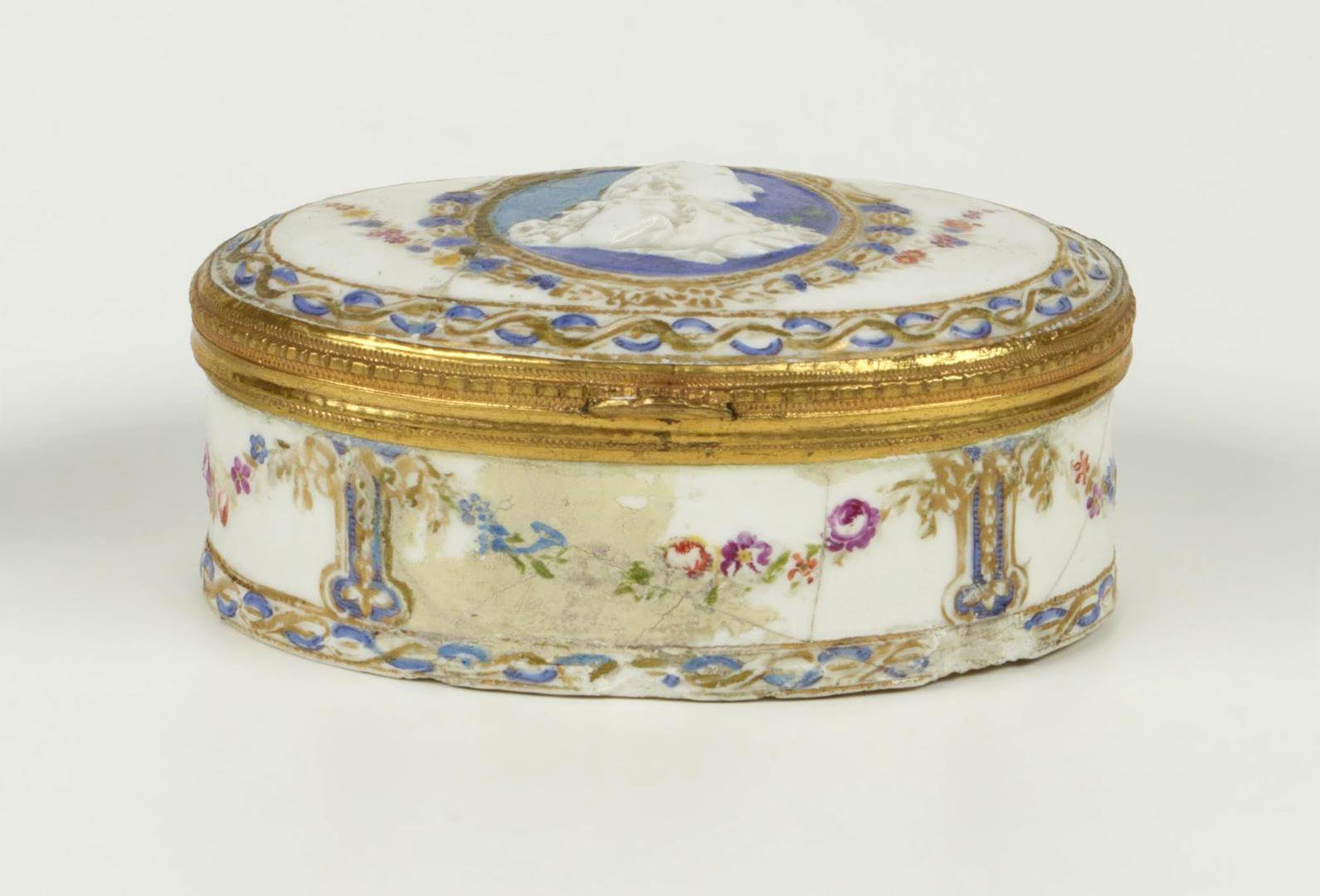
Snuff Box with a Hinged Lid. The State Hermitage Museum.
The box entered the Hermitage in 1919, transferred through the Department for the Protection of Monuments of Art and Antiquities from the collection of A. K. Rudanovsky. It is not currently on permanent display.
It is an oval box — nine centimetres long — with a hinged gilt copper mount, a painted lid and a body decorated with flowers.
The Object
The box is oval, with a slightly domed lid and a low body.
The lid carries a central medallion: a white profile head on a blue ground, framed by a gilt ring and a border of blue and gold chain ornament. The body is white, painted with small flowers.
The mount is gilt copper, with a hinge and a clasp, and it runs around the rim of the lid and the body.
Snuff
The box is a snuff box.
Snuff — powdered tobacco — was taken through the nose, and it was carried in small boxes that were opened, pinched and passed around. Snuff boxes were a social object, and they were made in every material: gold, silver, porcelain, enamel, tortoiseshell.
In the eighteenth century, the snuff box was a sign of taste and status, and it was often decorated with portraits, flowers or scenes.
The Lid
The lid is the box’s face.
It is painted with a central cameo and a border of chain ornament, and it is framed by the gilt mount. The lid is what the owner saw and showed, and it carries the box’s decoration.
The design is symmetrical and classical, and it belongs to the taste of the late eighteenth century.
The Cameo
The cameo is the lid’s centre.
It shows a white profile head on a blue ground, in imitation of a cameo or a gem. The head is small, and the features are delicate: a classical profile, perhaps a mythological figure or an idealized portrait.
Cameos were popular in the eighteenth century, and porcelain makers imitated them in relief and in painting.
The Flowers
The body is painted with flowers.
They are small sprays of roses and other blossoms, in pinks, blues and greens, and they run around the sides of the box. The flowers soften the geometry of the oval, and they give the object a garden-like charm.
Flower painting was a speciality of Nymphenburg, and the factory’s wares are known for their delicate colours.
Nymphenburg
The box was made at Nymphenburg.
The Nymphenburg manufactory was founded in 1747 near Munich, and it became one of the leading porcelain works of Germany. It produced services, figures and boxes, and its wares are characterised by fine painting and elegant forms.
The factory was patronized by the Bavarian court, and its products were exported across Europe.
The Mount
The mount is gilt copper.
It provides the hinge, the clasp and the rim, and it protects the porcelain from chipping. The gilding is worn in places, and the copper shows through.
Mounts of this kind were common on snuff boxes: they allowed the box to be opened and closed, and they added a line of gold to the object.
The Condition
The box is damaged.
The lid is cracked, and there are chips and losses on the body. The painting is worn in places, and the gilding is rubbed.
The damage is part of the object’s history: a snuff box was carried in a pocket, handled daily and passed from hand to hand, and its condition records that use.
The Hinge
The box has a hinge at the back.
It is a small metal joint, set into the gilt mount, and it allows the lid to open and close without being removed. The hinge is the box’s mechanism, and it is what makes it a box rather than a bowl.
Hinges of this kind were made by specialist metalworkers, and they were fitted to the porcelain after firing.
The Clasp
The box has a clasp at the front.
It is a small hook or catch, set into the mount, and it keeps the lid closed in the pocket. The clasp is a tiny detail, but it is essential to the object’s use.
A snuff box was carried and opened many times a day, and its clasp had to be reliable.
The Profile
The cameo profile is the lid’s subject.
It is small and delicate, and it shows a classical head in white on blue. The profile is modelled in relief, and it catches the light.
The subject may be a mythological figure, a classical hero or an idealized portrait; the box gives no inscription to identify it.
The Box in the Pocket
The box was carried in a pocket.
It was a personal object, handled daily, and it was shown to friends and guests. Its decoration was meant to be seen at close range, and its small size made it intimate.
A snuff box was a small piece of the owner’s identity, and it was often given as a gift or left as an inheritance.
The Collector
The box came to the Hermitage with the Rudanovsky collection.
Rudanovsky collected European porcelain alongside paintings, drawings, glass and miniatures, and his collection included boxes, medallions and small decorative objects.
The box is therefore a double document: of Nymphenburg in about 1770 and of a Russian collector’s taste.
The Colours
The colours are pale and delicate.
White, blue, gold, pink and green: the palette of eighteenth-century porcelain. The blue of the cameo ground and the gold of the mount are the strongest notes, and the flowers provide the soft accents.
The colours are applied as enamels, and they have faded slightly with age.
The Painting
The painting is fine and detailed.
The flowers are small, and each petal is described; the cameo is modelled in relief and painted in two colours. The painting turns the box into a small picture, and it is the work of a specialist.
The factory’s painters were trained in flower painting, and their skill is visible here.
The Size
At nine centimetres long, the box is small.
It fits in the palm of a hand, and it was made to be carried. Its smallness is part of its character: a private object, made for the pocket and the hand.
Small objects demand close attention, and this box rewards it: the cameo, the chain pattern and the flowers are all painted with care.
Provenance
The box carries the inventory number ZF-13999. It entered the Hermitage in 1919, transferred through the Department for the Protection of Monuments of Art and Antiquities from the collection of A. K. Rudanovsky.
In the Hermitage
The box is preserved in the State Hermitage Museum in Saint Petersburg and is not on permanent display.
It is a small, charming object, and it preserves a social ritual: a box, a cameo, a pinch of snuff and a conversation.