Artist: Augustin-Christian Ritt (1765–1799)
Origin: Russia
Date: late 1790s
Material: ivory
Technique: watercolour and gouache
Dimensions: 6.5 × 5.4 cm
Current Collection: The State Hermitage Museum
Inventory Number: ORm-2212
Hermitage ID: 202642
Rudanovsky Connection: Entered the Hermitage in 1919 from the collection of A. K. Rudanovsky.
A miniature portrait of Prince Joseph Poniatowski, painted on ivory in the late 1790s by Augustin-Christian Ritt, shows a young Polish prince in a red uniform, looking steadily out of a dark ground.
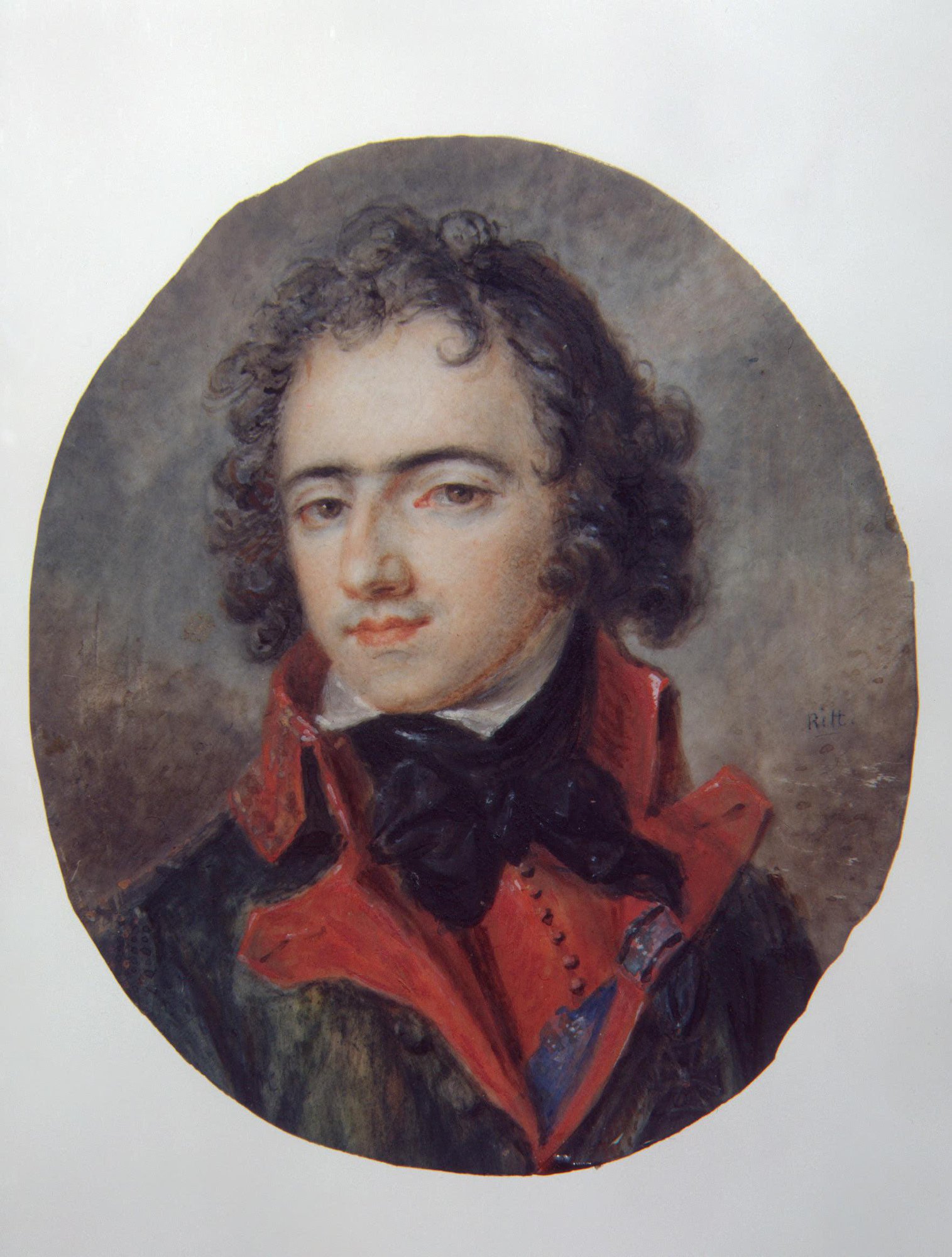
Miniature: Portrait of Prince Joseph Ponyatovski. The State Hermitage Museum.
The miniature comes from the collection of A. K. Rudanovsky and is not currently on permanent display.
It is a small oval, slightly taller than wide, painted with a head and shoulders against a mottled grey-brown background. The face is youthful, the hair dark and curling, the expression calm and slightly remote. On the right, near the edge, the painter’s signature is visible: Ritt.
The Object
The portrait is painted on a thin sheet of ivory, mounted in an oval format. The head is turned slightly to the viewer’s left, but the eyes meet ours — a more demanding arrangement than the strict profile, and one that gives the face psychological presence.
The sitter wears a red coat with a black collar and a black cravat, tied in a loose knot. At the lower right a blue ribbon or sash is visible. The painting is worked in watercolour and gouache: the flesh is modelled in fine stippling, the hair in broader washes, the uniform in flat, saturated colour.
The background is not a room or a landscape but a neutral, cloudy ground. In miniatures of this kind the background exists to make the face legible, and its very emptiness concentrates attention on the sitter.
The Sitter
The Hermitage record identifies the sitter as Prince Joseph Poniatowski.
Józef Poniatowski (1763–1813) was one of the most romantic and tragic figures of Polish history. He was the nephew of Stanisław August Poniatowski, the last king of Poland, and he grew up between Vienna, Warsaw and the court of his uncle.
He was a soldier from an early age. He fought in the war of 1792 against Russia, and in 1794 he took part in the Kościuszko uprising, the last attempt to save the Polish-Lithuanian Commonwealth from partition. When the uprising failed and Poland was erased from the map in 1795, Poniatowski withdrew from public life.
He returned to service in 1807, when Napoleon created the Duchy of Warsaw. He became Minister of War, commanded the Polish army in 1809 and won the battle of Raszyn against the Austrians. In 1813, during the campaign in Germany, he was made a Marshal of France — the only foreigner to receive that rank from Napoleon — and he died at the battle of Leipzig, drowning in the river Elster while covering the retreat.
A Prince Without a State
The portrait belongs to the years immediately after the Third Partition, when Poniatowski was in his mid-thirties and Poland no longer existed as a state.
This is the period in which he lived in Warsaw, occupied himself with music, theatre and society, and waited. He had been a general of a vanished army; he was a prince without a country. The portrait shows none of this directly — miniatures rarely do — but the calm, slightly distant expression belongs to a man who had learned to wait.
For a Polish viewer of the time, the image would have carried a political charge that a modern viewer has to reconstruct. A portrait of Poniatowski in 1798 was not simply a likeness of an aristocrat; it was a statement of loyalty to a nation that had been partitioned out of existence.
The Uniform
The red coat with a black collar is the visual key to the portrait.
Eighteenth-century uniforms were among the most codified garments in Europe: the colour, the collar, the cuffs, the number and placement of buttons all carried meaning. A red coat with black facings would have identified a specific formation to anyone who knew the language of uniforms.
The blue ribbon at the lower right may be a sash or an order ribbon. Its presence, together with the gold or silver details of the coat, marks the sitter as a person of rank.
Augustin-Christian Ritt
Augustin-Christian Ritt was born in 1765 and died in 1799, at thirty-four. He worked in Russia in the last decade of the eighteenth century, at a moment when St Petersburg was one of the great centres of European miniature painting.
His surviving work is small in quantity and high in quality. He painted on ivory with a delicate, almost transparent touch, building faces from fine dots and thin washes, and he had a particular gift for the eyes — the feature on which a miniature depends, because it is the only part of the face that can hold a viewer at such close range.
Both this portrait and the Hermitage’s miniature of K. K. Labensky come from the same collection and are dated to the same years, which suggests that Rudanovsky acquired them together, as a pair of works by a short-lived master.
The Polish Uniform
The red coat with black collar and the blue ribbon belong to the visual language of the Polish army of the 1790s.
After the partitions, Polish uniforms became a political statement. To wear the colours of a dissolved army was to assert that the nation still existed, and portraits of officers in uniform circulated among families as tokens of loyalty as much as likenesses.
The cut of the coat in this miniature is simple and close to the body, with a high collar and a black cravat. It is the dress of a man who expected to be seen both at court and in the field.
The Eyes
In a miniature, the eyes carry the portrait.
At a scale of six centimetres, the viewer holds the object at reading distance, and the face is examined as one examines a face in conversation. The painter accordingly gives the eyes his full attention: a dark iris, a highlight, a careful modelling of the lid.
Ritt’s sitter looks directly at us with an expression that is difficult to name — attentive, slightly guarded and very much alive. It is the quality that distinguishes a good miniature from a merely accurate one.
The Miniature as Memory
A portrait miniature is an object with a double life. It is a painting, but it is also a keepsake: something worn, carried, framed and looked at in private.
In the years around 1800 the miniature was the most intimate form of portraiture available. It could be set into a ring, a locket or a snuff box, and it could be sent by post to a friend or a lover. Its smallness was not a limitation but the condition of its function.
The later history of Poniatowski’s image gives this miniature a particular poignancy. After his death at Leipzig in 1813, he became a national hero, and portraits of him circulated widely in every medium. A small painting made in his lifetime, before the legend, preserves a different kind of likeness: a young man in a red coat, waiting.
Provenance
The miniature comes from the collection of A. K. Rudanovsky and carries the inventory number ORm-2212.
In the Hermitage
The miniature is preserved in the State Hermitage Museum in Saint Petersburg and is not on permanent display.
It is an object that rewards slow looking. At first it seems a dark oval with a pale face; then the uniform separates from the background, the blue ribbon appears, and the expression — patient, guarded, slightly sad — becomes legible.
That is the peculiar power of the miniature: it withholds its image until the viewer comes close enough to give it attention.