Origin: France, Aubusson
Date: 18th century
Material: wool, silk
Technique: tapestry weaving
Dimensions: height 51 cm; width 49.5 cm
Current Collection: The State Hermitage Museum
Inventory Number: T-15863
Hermitage ID: 489028
Rudanovsky Connection: Entered the Hermitage in 1919 from the collection of A. K. Rudanovsky.
A small tapestry panel from eighteenth-century Aubusson, woven in wool and silk with a bouquet of tulips on an olive-green ground and shaped to cover the back of a chair.
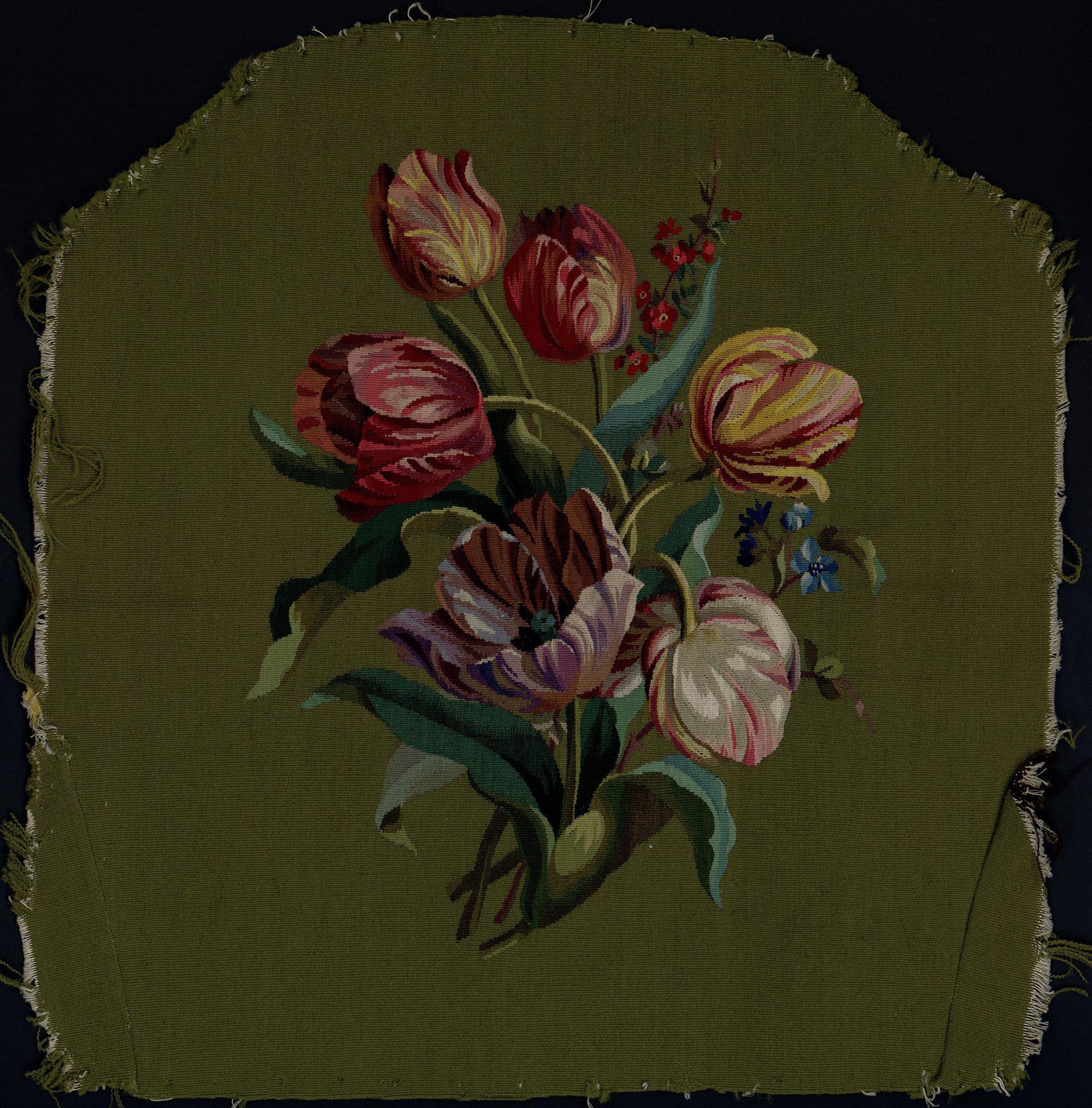
Tapestry: Upholstery for a Chair Back (T-15863). The State Hermitage Museum.
The panel comes from the collection of A. K. Rudanovsky; it entered the Hermitage through the State Museum Fund. It is not currently on permanent display.
The first thing to notice is the shape. The panel is not a rectangle. Its upper edge rises in a shallow curve, its corners are cut away, and the sides follow the profile of a chair back. This was never a picture. It was a covering, made to fit a piece of furniture, and its form preserves the memory of the object it once dressed.
The Object
The ground is a deep olive green, closely woven and slightly uneven in tone, as tapestry grounds always are. Against it, a bouquet of five tulips rises from the lower centre.
The tulips are the heart of the design. Their petals are striped and feathered in red, pink, cream and yellow, with the broken colour that contemporaries admired in parrot tulips. Around them are long, twisting leaves in several greens, small sprays of red berries and a few blue forget-me-nots.
The flowers are modelled by hatching: the weaver lays short strokes of colour side by side, gradually shifting tone, so that the petals appear to turn and catch light. At close range the surface is a mosaic of tiny wool and silk threads; at a distance it becomes a painting.
The edges of the panel are frayed and worn. Along the top and sides the warp threads are exposed, and at the lower corners the tapestry has been cut to fit the chair. These damages are not accidents to be lamented; they are the record of the object’s use.
The Tulip
The tulip reached Europe from the Ottoman Empire in the sixteenth century and became, within a hundred years, one of the most fashionable flowers in the West.
The Dutch tulip mania of the 1630s — the speculative bubble in which single bulbs changed hands for the price of a house — is the best-known episode in that history, but the flower’s influence on European art lasted much longer. Tulips appear in Dutch still lifes, in porcelain, in textiles and in tapestry throughout the seventeenth and eighteenth centuries.
The variety shown here, with its streaked and feathered petals, belongs to the types that were most prized in the eighteenth century: broken-coloured tulips whose patterns were the result of a virus and could not be reliably reproduced from seed.
For a tapestry designer, the tulip offered a form that was both simple and endlessly variable: a closed cup that could be turned, opened or repeated, and a surface that could carry the most brilliant colours in the weaver’s palette.
Aubusson
Aubusson is a small town in the Creuse valley, in the centre of France, and it was one of the great centres of European tapestry production.
Weaving began there in the sixteenth century, and in 1665 the town received a royal privilege that established it as a manufacture associated with the crown. Unlike the Gobelins workshop in Paris, which worked for the royal palaces and produced large figurative tapestries, Aubusson served a wider market: nobility, clergy, financiers and prosperous merchants.
Its specialities were upholstery, verdures, floral pieces and small decorative panels. The town worked on low-warp looms, a technique that allowed faster production and greater freedom in the treatment of detail than the high-warp looms of the Gobelins.
By the eighteenth century Aubusson was producing complete furnishing schemes — tapestries for walls, covers for chairs and sofas, screens and bed hangings — designed to be seen together in a single interior.
Tapestry as Upholstery
In the eighteenth century, tapestry was part of the furnishing trade rather than a separate category of art.
A suite of chairs and a sofa would be covered en suite, and the weaving was commissioned together with the frames. The covers were woven to shape, or cut and joined to fit, and the design had to take account of the structure of the chair: the back, the seat and the arms each required a different format.
This is why upholstery panels so often survive as fragments. When a chair was re-covered or broken up, the tapestry was removed, and a piece that had been part of a set became an independent object. The shape of this panel — its curved top and cut corners — is the trace of that original life.
The Weaver’s Craft
Weaving a tapestry is a slow collaboration between painter and weaver.
The design began as a cartoon, a full-size drawing prepared by a painter or a workshop designer. The weaver worked from the back of the tapestry, following the cartoon placed behind the warp, and built the image row by row, knotting the weft around the warp threads and packing it down with a comb.
The difficulty lies in the translation. A painter can mix any colour; a weaver has a fixed palette of dyed wools and silks. A painter can draw a continuous line; a weaver must approximate it with a stepped edge. The finest tapestries are those in which the weaver has understood the painter’s intention and found the thread that carries it.
Green Grounds
The olive-green ground is not a neutral background. It is a colour choice with a history.
Green grounds were common in eighteenth-century floral tapestries because they allowed the reds, pinks and yellows of the flowers to sing while remaining dark enough to read as shadow behind the leaves. The green itself is woven from several tones, so that the field is never flat: it shifts from olive to moss to a cooler grey-green.
This is one of the technical pleasures of tapestry. A painted background can be laid in with a single tone; a woven one must be built from many threads, and the slight variations give the surface a life that no flat colour has.
A Fragment
The panel is a fragment, and its fragmentary state is part of its interest.
It preserves a complete design — the bouquet is intact — but it has lost the object it was made for. The chair, the suite, the room and the house are gone. What remains is the surface, with its colours still bright and its edges worn.
Museums often treat such pieces as documents of the decorative arts, and that is right. But they are also works of art in their own right: a bouquet of tulips, woven in wool and silk, that has outlived the furniture it decorated.
Provenance
The panel carries the inventory number T-15863 and entered the Hermitage through the State Museum Fund from the collection of A. K. Rudanovsky.
The State Museum Fund was the body through which, in the years after 1917, nationalised private collections were distributed to museums. Its name in a provenance line marks a particular moment in the history of collecting: the point at which a private interior became a public collection.
In the Hermitage
The panel is preserved in the State Hermitage Museum in Saint Petersburg and is not on permanent display.
It is one of the many textiles in the collection that are studied rather than exhibited — too fragile for permanent display, too important to discard. In storage, wrapped in acid-free tissue and protected from light, it continues to do what it was made to do: hold a small piece of the eighteenth century in its threads.