Artist: Johann Baptist Lampi the Elder (1751–1838)
Origin: Austria
Material: canvas
Technique: oil
Dimensions: 73 × 61 cm
Current Collection: The State Hermitage Museum
Inventory Number: GE-5313
Hermitage ID: 38526
Rudanovsky Connection: Entered the Hermitage in 1919 from the collection of A. K. Rudanovsky.
A portrait of Prince Boris Golitsyn by Johann Baptist Lampi the Elder, painted in Austria.
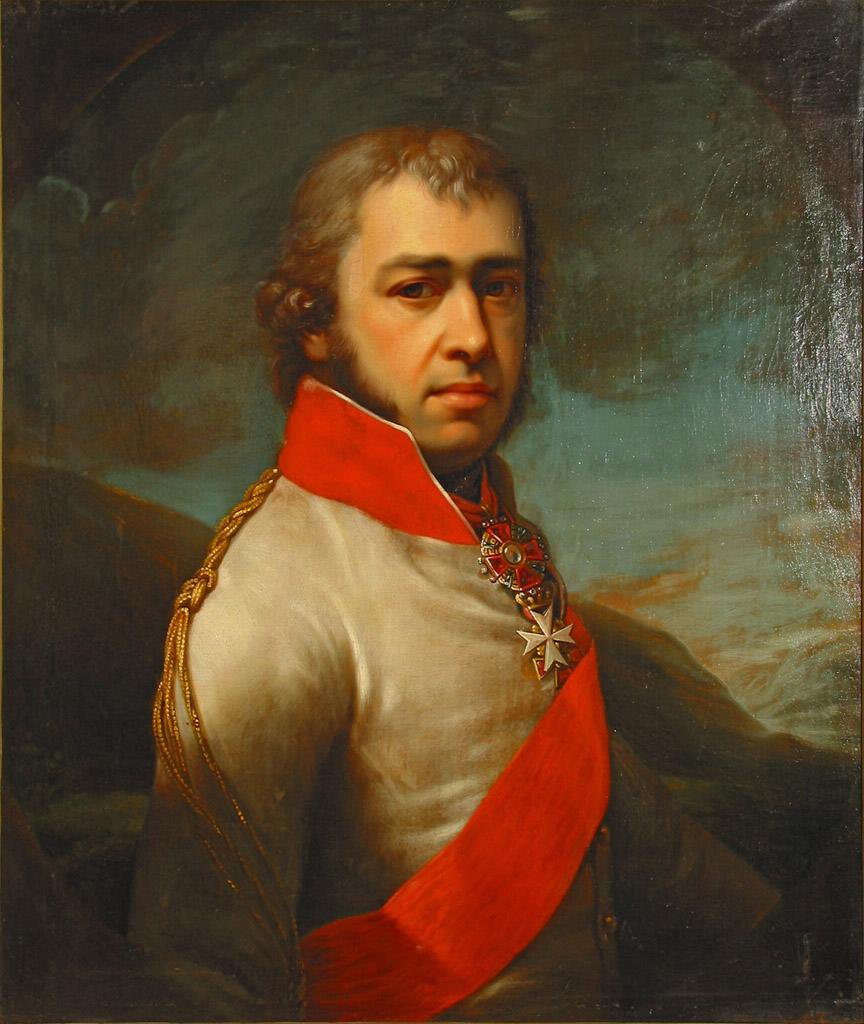
Portrait of Prince Boris Golitsyn. The State Hermitage Museum.
The painting entered the Hermitage in 1919 from the collection of A. K. Rudanovsky. It is not currently on permanent display.
It is a half-length portrait of a man in a white uniform with a red collar, a red sash and the cross of the Order of St John.
The Object
The sitter is shown from the chest up, turned slightly to the left, his face toward the viewer.
He has brown curly hair, sideburns and a firm, closed mouth, and he wears a white uniform with a red collar, a gold epaulette and a red sash across the chest. On his breast, a jewelled cross and a star are visible.
The background is a dark green-brown, with a suggestion of clouds or a landscape.
The Sitter
The sitter is Prince Boris Golitsyn.
The Golitsyns were one of the oldest and most powerful families of the Russian nobility, and their members served as generals, diplomats and statesmen. A portrait of a Golitsyn is a portrait of that world.
The identification is traditional, and the portrait shows a man of rank, in the uniform of his service, with the insignia of his orders.
The Uniform
The uniform is white, with a red collar and gold epaulettes.
It is painted with care: the white cloth, the red collar, the gold braid and the buttons are all described. The red sash across the chest is a mark of high rank, and it gives the portrait its strongest colour.
Uniforms were a statement of service and status in the eighteenth century, and they were painted with as much attention as the face.
The Maltese Cross
The sitter wears the cross of the Order of St John of Jerusalem.
It is a white eight-pointed cross, suspended from a jewelled badge, and it is one of the most distinctive orders of the period. The Order of St John — the Knights of Malta — had a special relationship with Russia in the late eighteenth century.
The cross is a sign of the sitter’s rank and of his connection to the order, and it is painted with care.
Lampi
Johann Baptist Lampi the Elder (1751–1838) was an Austrian painter.
He worked in Vienna, Warsaw and St Petersburg, and he painted portraits of the European nobility, including the Russian imperial family. His portraits are known for their smooth finish, their rich colour and their psychological presence.
Lampi’s Russian period made him one of the most sought-after portraitists of the late eighteenth century.
The Background
The background is dark and indistinct.
It is a green-brown, with a suggestion of clouds or a landscape, and it isolates the figure and gives the face relief. The darkness is a foil for the white uniform and the red sash.
Backgrounds of this kind were standard in eighteenth-century portraiture: they provided atmosphere without distracting from the sitter.
The Pose
The pose is conventional and effective.
The sitter turns slightly, his head toward the viewer, his shoulders at an angle. One hand is implied at the bottom of the canvas, and his gaze is direct and steady.
The pose gives the portrait its authority: the man is present, and he is looking at us.
The Face
The face is the portrait’s centre.
It is painted with a smooth, careful touch: the brown eyes, the straight nose, the firm mouth, the sideburns. The skin is modelled in soft layers, with a warm tone.
The expression is serious and slightly guarded, and it gives the sitter a quiet dignity.
The Order of St John
The Order of St John of Jerusalem was a medieval military order.
In the late eighteenth century, it found a protector in the Russian emperor Paul I, who was elected Grand Master in 1798. Russian nobles received the cross, and the order became a mark of imperial favour.
The cross on this portrait is therefore a political as well as a personal sign: it connects the sitter to the emperor and to the order’s Russian chapter.
The Hanging
The portrait was made to hang in a house.
It is a medium-sized canvas, 73 by 61 centimetres, and it would have stood in a gallery, a drawing room or a study, among other portraits of the family. Its dark background and its bright uniform were designed for a candlelit interior.
Portraits of this kind were often hung in rows, as a family gallery, and each one added a face to the record.
Vienna and St Petersburg
Lampi worked between Vienna and St Petersburg.
He was court painter in Vienna, and he travelled to Russia, where he painted the imperial family and the nobility. His career illustrates the close ties between the Austrian and Russian courts in the late eighteenth century.
The portrait belongs to that world: an Austrian painter, a Russian sitter and an order with a Mediterranean history.
The Collector
The portrait came to the Hermitage with the Rudanovsky collection.
Rudanovsky collected European paintings alongside porcelain, drawings, glass and miniatures, and his collection included several portraits of Russian nobles.
The painting is therefore a double document: of Lampi’s portraiture and of a Russian collector’s taste.
The Age
The portrait belongs to the age of Catherine the Great and Paul I.
It was a period of imperial expansion and of aristocratic display, when portraits, orders and uniforms were part of the language of power. The painting speaks that language fluently.
The Sash
The red sash is the portrait’s strongest colour.
It crosses the chest diagonally, from the shoulder to the waist, and it is painted in a warm, saturated red. It catches the light on its folds, and it gives the white uniform its energy.
Sashes of this kind were the insignia of Russian orders, and their colour identified the order. The red here is both decorative and informative.
The Hair
The sitter’s hair is brown and curly.
It is cut short, with sideburns that run to the jaw, and it is painted in individual locks, with highlights on the curls. The hairstyle is that of the late eighteenth century, and it softens the severity of the face.
Hair was a test of a portraitist’s skill, and Lampi gives it a light, almost silky touch.
The Buttons
The uniform is fastened with gilt buttons and cords.
They are painted as small highlights along the chest, and they give the white coat its structure. The buttons are a detail, but they mark the uniform as a real garment, with a real construction.
Details of this kind are what make a portrait convincing, and Lampi does not neglect them.
Provenance
The portrait carries the inventory number GE-5313 and entered the Hermitage in 1919 from the collection of A. K. Rudanovsky.
In the Hermitage
The portrait is preserved in the State Hermitage Museum in Saint Petersburg and is not on permanent display.
It is a fine example of Lampi’s portraiture, and it preserves the image of a Russian prince in the service of his orders — a face, a uniform and a cross.