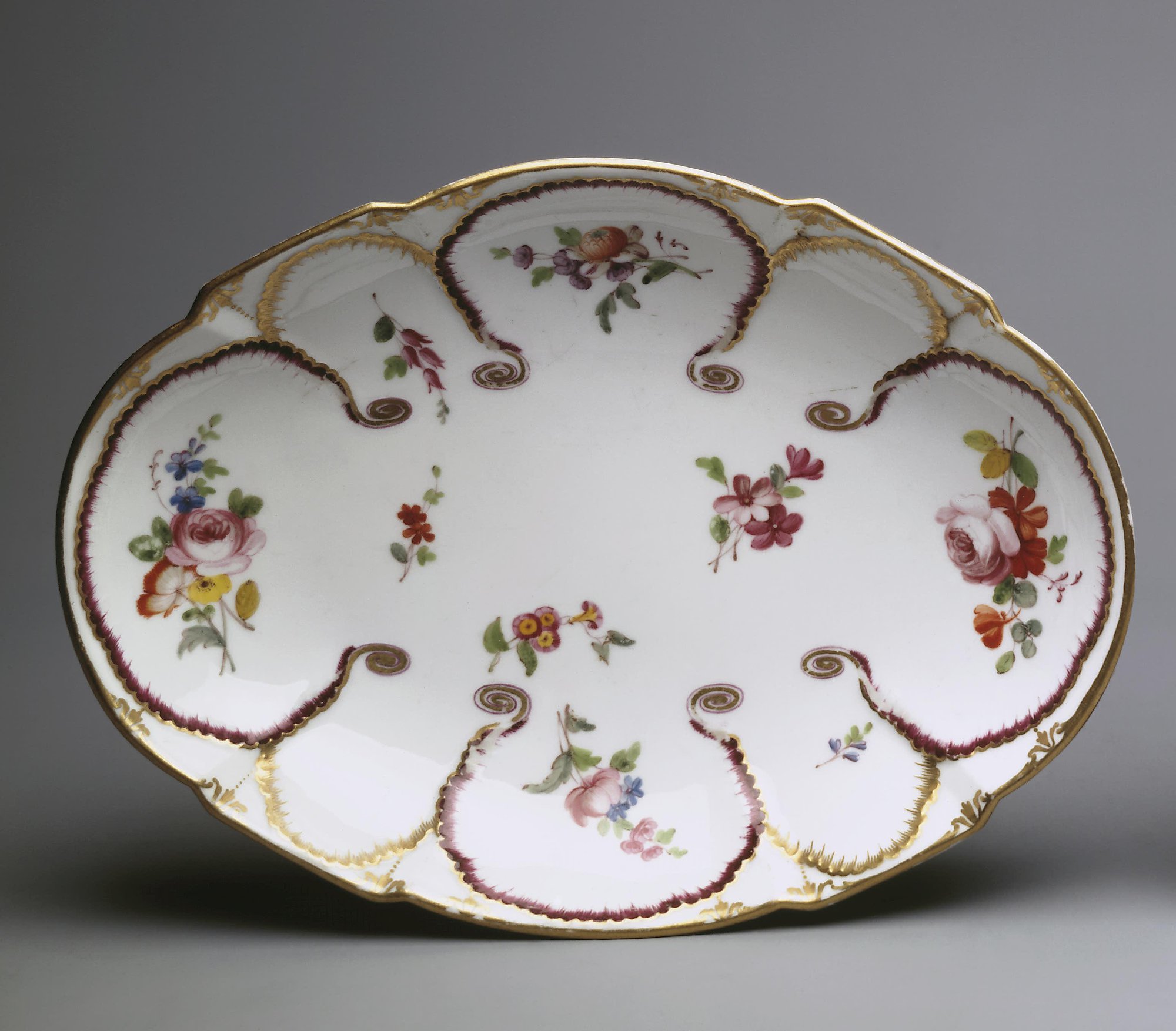
Artist: Edmé-François Bouillat père (painter)
Organization: Sèvres Porcelain Manufactory
Origin: France
Date: 1778
Complex: Service «Cabbage Leaves in Purple»
Material: hard-paste porcelain
Dimensions: length 27.5 cm; width 19.9 cm
Current Collection: The State Hermitage Museum
Inventory Number: ZF-16227
Hermitage ID: 352360
Rudanovsky Connection: Entered the Hermitage in 1919 from the collection of A. K. Rudanovsky.
An oval tray from a Sèvres service of 1778, painted with bouquets inside purple-edged reserves shaped like cabbage leaves.
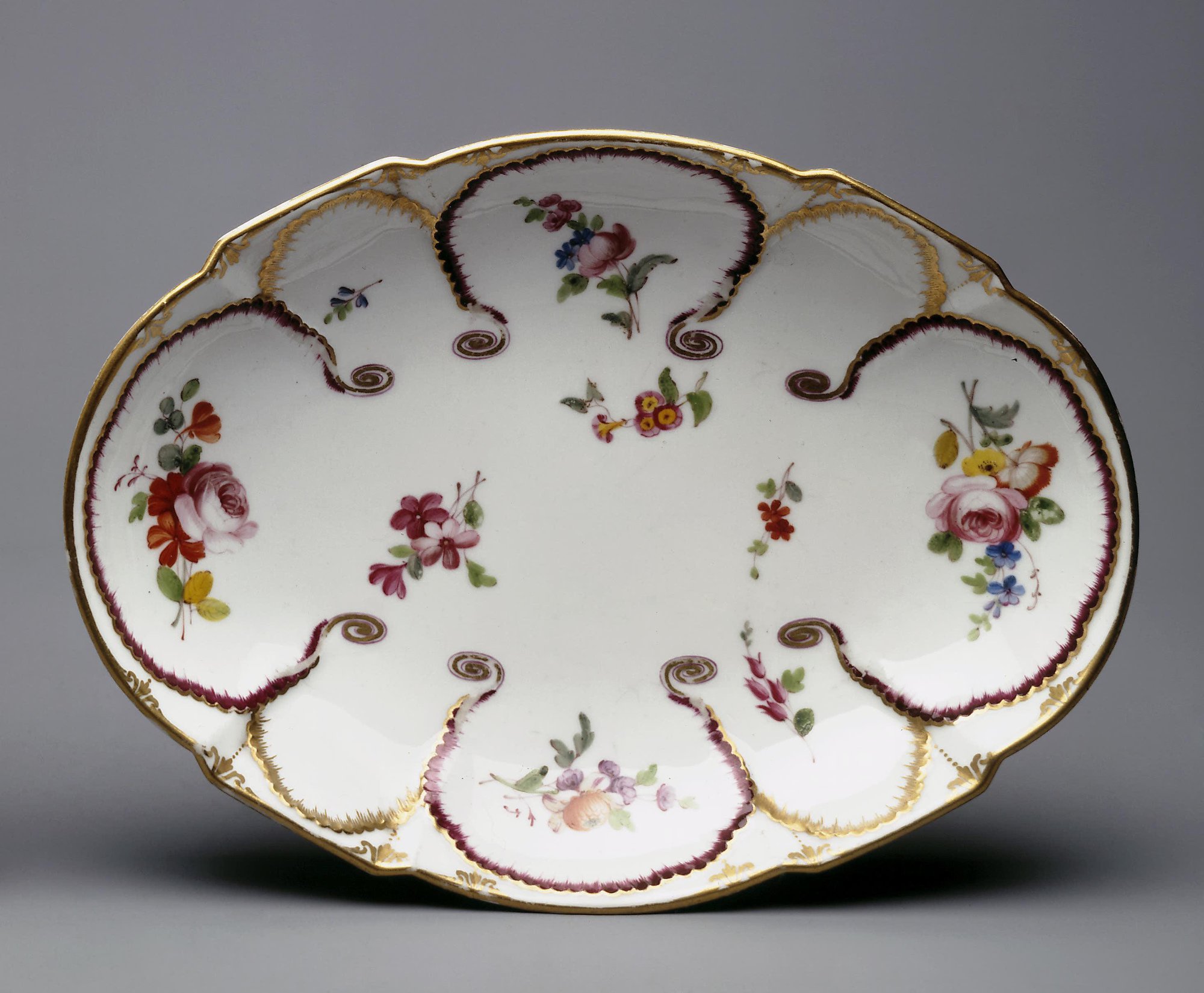
Oval Tray (ZF-16227). The State Hermitage Museum.
The tray entered the Hermitage in 1919 from the collection of A. K. Rudanovsky. It is not currently on permanent display.
It is a shallow oval dish with a scalloped edge, a gold rim and a design of flower-filled reserves that follows the shape of the porcelain.
The Object
The tray is oval, with a wavy, scalloped rim that echoes the leaf-shaped reserves of the decoration.
The reserves are outlined in purple and gold and filled with bouquets of roses, pansies and small flowers. Between them, scattered sprays of flowers float on the white ground.
The edges of the tray are gilded, and the gilding is worn in places where the object has been handled. The surface shows fine scratches, the traces of use.
A Tray in a Service
A tray is a servant’s object.
It carries cups, glasses, sweets or fruit from the sideboard to the table, and it is designed to be held in one hand. In a dinner service, trays were used for the dessert course, for coffee and for the presentation of small dishes.
The oval shape is practical: it fits the hand and the table, and it allows the objects on it to be arranged in a line. It is also elegant, and it was a favourite shape for Sèvres trays.
Bouillat
The tray is attributed to Edmé-François Bouillat père, a painter at Sèvres.
Bouillat was one of the flower painters of the manufactory, and his work is characterised by a light, confident touch and a taste for small, scattered blossoms as well as large bouquets.
The attribution is based on the painter’s mark on the underside, which the factory used to record who had decorated each piece.
The Shape
The shape of the tray is part of its decoration.
The scalloped rim follows the curve of the reserves, so that the porcelain and the painting seem to belong together. The oval form also gives the painter a natural frame: the reserves are arranged around the edge, leaving the centre open for scattered flowers.
This integration of shape and decoration is one of the hallmarks of Sèvres design in the 1770s.
The Purple Edge
The purple edging is the signature of the service.
Each reserve is outlined with a scalloped band of purple, applied with a fine brush and fired. The band is not a flat line: it has a feathered, almost hatched texture, which gives it depth and softness.
The purple contrasts with the white ground and with the green leaves of the flowers, and it gives the service its name.
Gold
Gold frames the whole design.
The rim of the tray is gilded, and a fine gold line runs just inside the purple edging of each reserve. The gold catches the light and gives the object a warm, luxurious finish.
Gilding on porcelain is fragile, and the wear on this tray is concentrated on the rim, where the object was most often touched.
The Service
The tray belongs to a large service, of which many pieces survive.
The service included plates, bowls, trays of different shapes, tureens and serving dishes, all decorated with the same pattern. It was made for a client who wanted a complete dinner service in the latest Sèvres style.
The dispersal of such services is one of the reasons why individual pieces are now scattered across museums and private collections.
Dessert Trays
Trays were the workhorses of the dessert table.
They carried cups, glasses, sweets and fruit, and they were designed to be held in one hand while the other arranged the contents. A service needed several trays of different shapes and sizes.
The oval tray is one of the most common forms. It fits the hand, stacks easily and presents its contents in a line.
The Rim
The rim of the tray is the part that takes the wear.
It is gilded, and the gilding is rubbed where the tray was handled. The scalloped edge is also vulnerable: it chips easily, and many Sèvres trays survive with small losses along the rim.
This tray is in good condition, with only minor wear, which suggests that it was used with care.
The Mark
The underside of the tray would carry the Sèvres mark.
The interlaced Ls, the date letter and the painter’s mark are the evidence on which the attribution rests. Without them, the tray would be an anonymous piece of eighteenth-century porcelain.
The mark is a small thing, but it connects the object to a factory, a year and a painter.
Hard Paste Again
The tray is made of hard-paste porcelain, like the rest of the service.
Hard paste was the new material of the 1770s, and its adoption marked a turning point in the history of Sèvres. It allowed the factory to produce thinner, harder and more durable pieces, and it brought French porcelain closer to the Chinese ideal.
The Client
We do not know who commissioned the service.
The Sèvres archives record the production of the pieces, the painters and the dates, but not always the buyer. A service of this size and quality was made for a wealthy client — a courtier, a financier or a member of the royal family.
The subsequent history of the service is equally obscure. It passed through hands and collections before it was dispersed, and the Hermitage pieces came to the museum through the Rudanovsky collection.
The Painter’s Mark
On the underside of the tray, beside the factory mark, there is a small painter’s mark.
Each Sèvres painter had his own sign — a letter, a symbol or a combination of strokes — which he applied to the pieces he had decorated. The mark allowed the factory to pay him and to keep track of production.
For the modern scholar, the painter’s mark is a fingerprint. It identifies the hand that painted the flowers, and it allows the work of different painters to be compared.
Why Oval
The oval shape is not arbitrary.
An oval tray fits the hand better than a round one, and it presents its contents in a line rather than a circle. It also nests neatly with other oval pieces, saving space in a cupboard or on a table.
The oval was one of the standard shapes of the Sèvres repertoire, produced in several sizes for different uses.
Provenance
The tray carries the inventory number ZF-16227 and entered the Hermitage in 1919 from the collection of A. K. Rudanovsky.
In the Hermitage
The tray is preserved in the State Hermitage Museum in Saint Petersburg and is not on permanent display.
It is a beautiful object in its own right, but it is also a piece of a puzzle: with the other surviving pieces of the service, it allows us to reconstruct the appearance of a Sèvres dinner table in the last years of the ancien régime.