Artist: Edmé-François Bouillat père (painter)
Organization: Sèvres Porcelain Manufactory
Origin: France
Date: 1778
Complex: Service «Cabbage Leaves in Purple»
Material: hard-paste porcelain
Dimensions: length 27.5 cm; width 19.9 cm
Current Collection: The State Hermitage Museum
Inventory Number: ZF-16228
Hermitage ID: 352361
Rudanovsky Connection: Entered the Hermitage in 1919 from the collection of A. K. Rudanovsky.
An oval Sèvres tray of 1778, twin to another in the same collection and decorated with the same purple-edged reserves and flower bouquets.
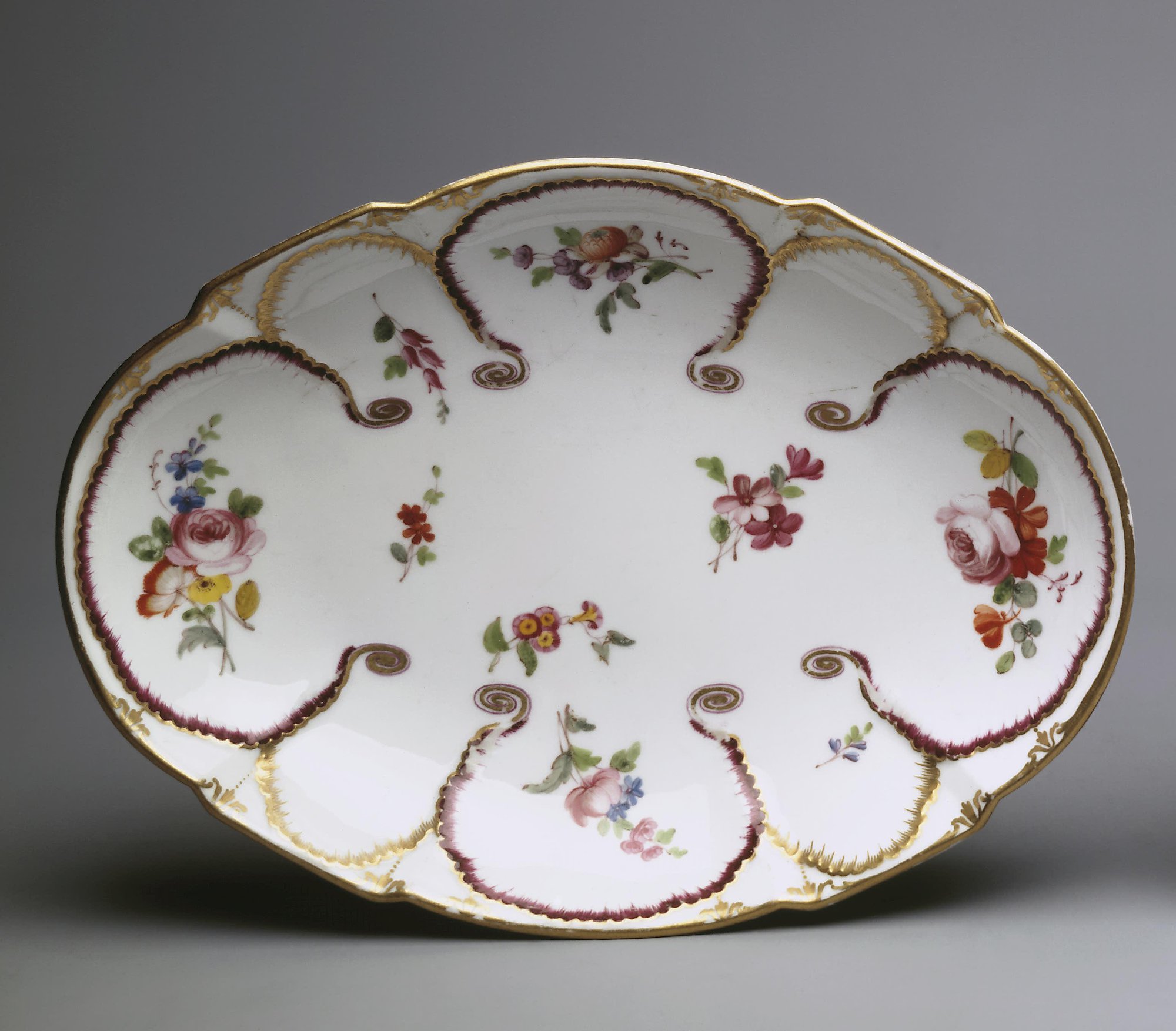
Oval Tray (ZF-16228). The State Hermitage Museum.
The tray entered the Hermitage in 1919 from the collection of A. K. Rudanovsky. It is not currently on permanent display.
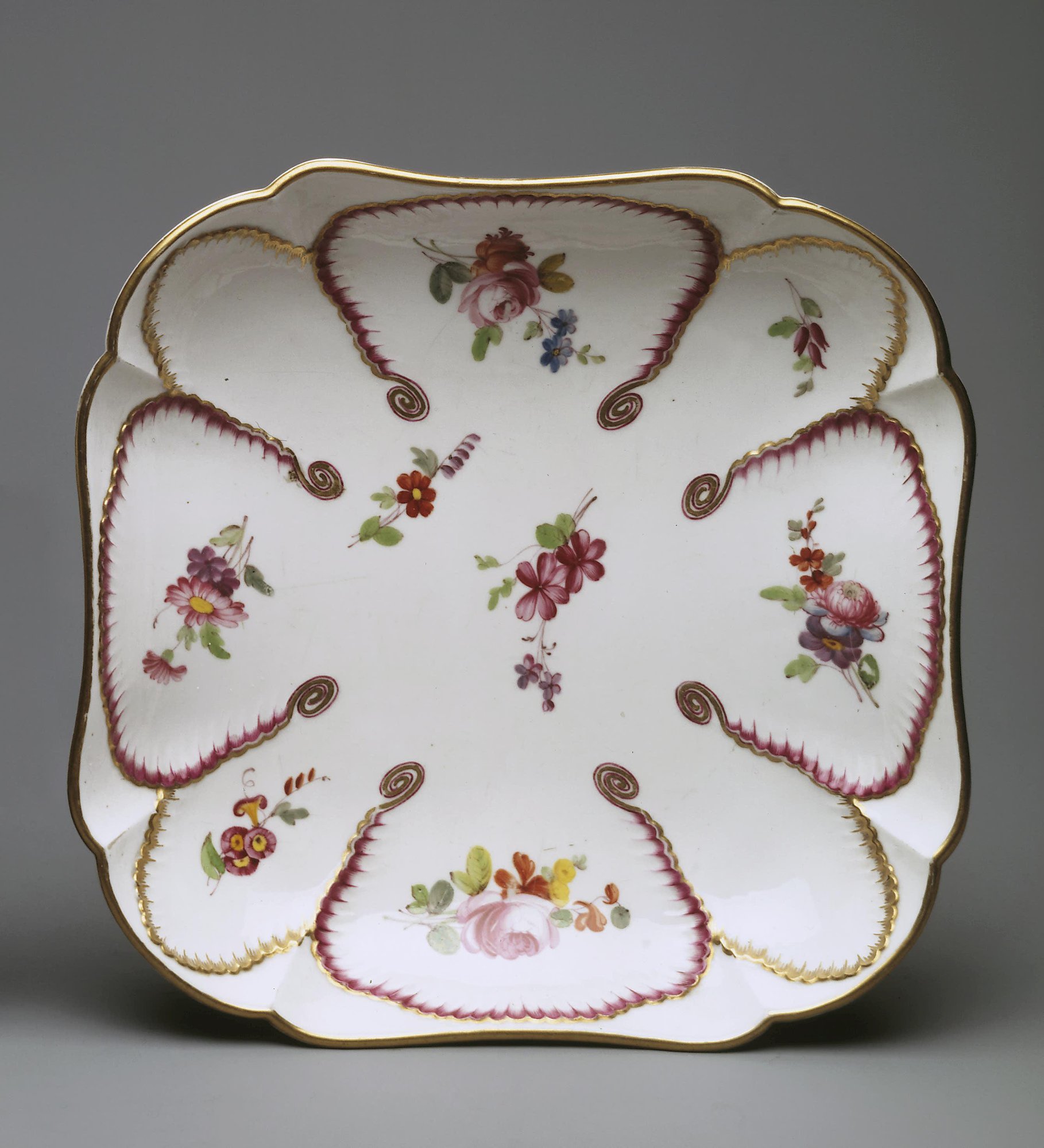
It is almost identical to another tray in the same collection, ZF-16227: the same dimensions, the same painter, the same service, the same decoration. The two objects are twins, and looking at them together raises the question of what repetition means in a porcelain service.
The Object
The tray is oval, with a scalloped rim and a gold edge.
Four reserves, shaped like cabbage leaves, are outlined in purple and gold and filled with bouquets of roses, pansies and small blossoms. Between the reserves, scattered flowers float on the white ground.
The condition is good, with some wear to the gilding and fine scratches on the glaze.
Twins
The two trays were made in the same year, by the same painter, for the same service.
In a modern museum, they are separate objects with separate numbers; in the eighteenth century, they were a pair — two identical pieces in a large service, made to be used together at table.
The survival of both trays in the same collection is fortunate. Many services were dispersed, and pairs were separated; here, the twins have stayed together, and their relationship can still be studied.
Repetition
Repetition is the basis of a porcelain service.
A service is not a collection of unique objects; it is a set of matching pieces, designed to be used together. The repetition of the decoration — the same reserves, the same flowers, the same purple edge — is what makes the service a service.
The repetition is not mechanical. Each piece was painted by hand, and each painter interpreted the pattern slightly differently, so that the pieces resemble one another without being identical.
The Painter’s Hand
Bouillat’s hand is visible on both trays.
The bouquets are composed in the same way: a large rose at the centre, smaller flowers around it, leaves and stems that curl into the reserve. The brushwork has the same lightness, the same economy of means.
To distinguish the two trays requires close looking. The differences are tiny: a petal turned differently, a leaf placed a little higher, a colour mixed slightly cooler.
Slight Differences
The differences between the twins are the most interesting thing about them.
They show that the service was painted by hand, not printed or stencilled, and that each piece passed through the brush of a living painter. They also show the limits of standardisation in the eighteenth-century workshop: the design was fixed, but the execution varied.
In a museum, such differences are a reminder that the object is not a reproduction but an original, made at a particular moment by a particular person.
Why Pairs Matter
Pairs matter in the history of the decorative arts.
A pair of trays, a pair of vases, a pair of candlesticks: the pairing is part of the design, and it is often lost when objects are separated. Collectors and curators try to keep pairs together, because the pair has a meaning that the single object does not.
In this case, the pair also documents the service: two pieces that were made together and used together, and that now sit side by side in a museum store.
The Service Again
The two trays are part of a service that included many other pieces.
The service was made at Sèvres in 1778, with decoration by several painters and gilders. It was a luxury commission, and it would have been used on special occasions, when the table was set with the best porcelain.
The surviving pieces — bowls, trays, plates — are scattered, but the two trays allow us to see how the service looked: white, gold, purple and flowers.
The Mark
Each tray carries its own mark.
The factory mark, the date letter and the painter’s mark are repeated on both, which confirms that they were made in the same year by the same hand. The marks are the documentary evidence of the twins’ relationship.
Without them, the resemblance between the two trays would be an observation; with them, it is a fact.
Dessert
The trays belong to the dessert service.
Dessert was the most decorative course of the eighteenth-century dinner, and porcelain was its principal ornament. Trays of different shapes were arranged on the table with sweets, fruit and compotes.
The two oval trays would have been used together, side by side, carrying the same kind of contents.
Condition
Both trays are in good condition.
The gilding is worn along the rims, the glaze is scratched, and there are small marks of use. The wear is similar on both, which suggests that they were used together and stored together.
Condition is a kind of evidence. Two objects that have aged in the same way have probably shared the same history.
A Pair in the Store
In the museum store, the two trays are kept together.
Museums try to preserve pairs, but space and organisation often defeat the intention. When a pair is kept together, it retains a meaning that the separate objects would lose.
For the visitor, the pair is a lesson in how services were made: not as individual works of art but as sets of matching objects.
The Number
The two trays carry consecutive inventory numbers: ZF-16227 and ZF-16228.
Consecutive numbers are a small but telling detail. They suggest that the two objects were registered at the same time, as part of the same group, and that their relationship was recognised by the curator who catalogued them.
Museum numbers are not neutral. They record decisions about what belongs together, and they preserve the memory of the collection as it was when it entered the museum.
What the Twins Cannot Tell
The two trays cannot tell us who used them.
They record the factory, the year, the painter and the pattern, but not the table, the house or the people who ate from them. That part of their history is lost, and the objects can only hint at it.
This is the limit of material evidence. It can reconstruct the object with great precision, but it cannot reconstruct the life around it.
Provenance
The tray carries the inventory number ZF-16228 and entered the Hermitage in 1919 from the collection of A. K. Rudanovsky.
In the Hermitage
The tray is preserved in the State Hermitage Museum in Saint Petersburg and is not on permanent display.
It is a beautiful object on its own, but its full meaning appears only when it is seen with its twin. Together, the two trays are a lesson in repetition, variation and the craft of the eighteenth-century porcelain painter — and a lesson in looking twice at the very same thing.