Artist: Edmé-François Bouillat père (painter)
Organization: Sèvres Porcelain Manufactory
Origin: France
Date: 1778
Complex: Service «Cabbage Leaves in Purple»
Material: hard-paste porcelain
Dimensions: length 25.6 cm
Current Collection: The State Hermitage Museum
Inventory Number: ZF-16226
Hermitage ID: 352359
Rudanovsky Connection: Entered the Hermitage in 1919 from the collection of A. K. Rudanovsky.
A square Sèvres tray of 1778 with scalloped corners, decorated with purple-edged reserves and flower bouquets.
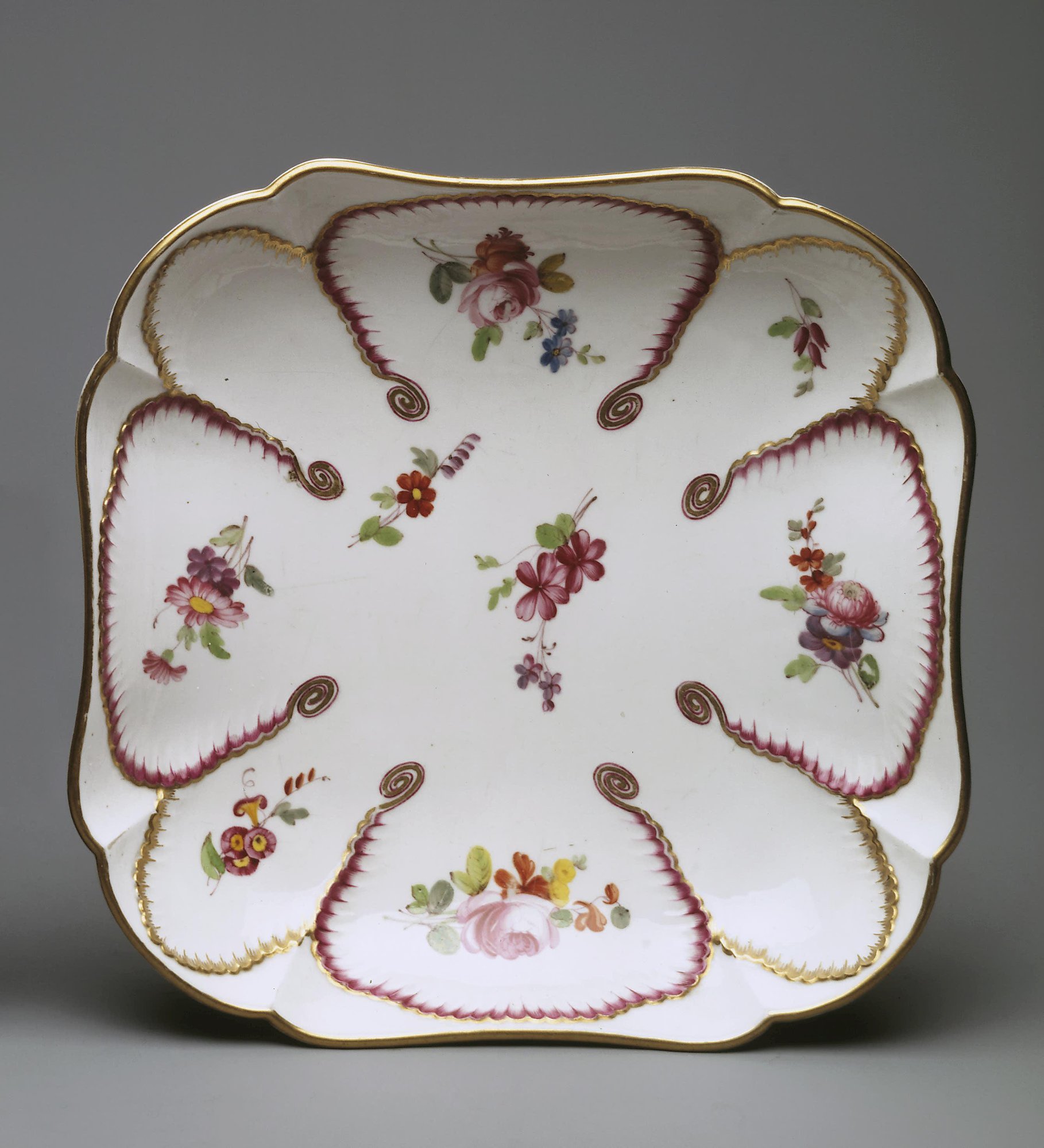
Square Tray. The State Hermitage Museum.
The tray entered the Hermitage in 1919 from the collection of A. K. Rudanovsky. It is not currently on permanent display.
It is square in plan, with scalloped corners and a wavy edge, and its decoration follows the shape of the porcelain: reserves at the corners, scattered flowers in the middle.
The Object
The tray is a shallow square dish with a gilded rim and a scalloped outline.
Four reserves, shaped like cabbage leaves, are placed at the corners and along the sides, each outlined in purple and gold and filled with a bouquet. In the centre, smaller sprays of flowers are scattered across the white ground.
The surface is white and glossy, with fine scratches and some wear to the gilding along the edge.
The Square Shape
The square is a more formal shape than the oval.
It has a geometric order that the oval lacks, and it invites a symmetrical arrangement of the decoration: reserves at the corners, a central motif, a balance of parts.
The scalloped corners soften the geometry and connect the tray to the organic, leaf-like vocabulary of the service. The result is a shape that is both classical and Rococo.
A Service of Many Shapes
The service included many different shapes.
There were plates, bowls, oval trays, square trays, tureens, sauceboats and serving dishes, each with its own function and its own profile. The decoration was adapted to each shape, so that the service was unified without being monotonous.
The square tray is one of the smaller pieces, designed for serving sweets, fruit or small dishes. Its shape made it suitable for a sideboard or a dessert table.
The Cabbage Leaf
The cabbage-leaf reserve is the unifying motif of the service.
It appears on every piece, adapted to the shape of the object: four reserves on a round bowl, four at the corners of a square tray, four around an oval tray. The motif is organic, but its arrangement is regular.
The leaf shape was popular in the 1770s, when natural forms — leaves, flowers, shells — were widely used in porcelain design. It allowed the painter to combine a formal structure with a naturalistic decoration.
Gold and Purple
The colours of the service are white, purple and gold, with the green and pink of the flowers.
The purple edging is applied with a fine brush and fired; the gold rim and lines are gilded and burnished. The white ground is the porcelain itself, left unpainted to show its quality.
The combination is restrained and luxurious: three colours, carefully balanced, with the flowers providing the only variety.
Use
The tray was made to be used, not only admired.
It would have carried sweets, fruit, biscuits or small cakes at the dessert course, or held a set of cups at tea. The wear on the gilding and the scratches on the glaze show that it was handled often.
In a museum, the tray is protected from use; in the eighteenth century, it was part of the daily ritual of the table.
Hard Paste
The tray is hard-paste porcelain, made at Sèvres in the years when the factory was adopting the new material.
Hard paste is fired at a higher temperature than soft paste, and it produces a harder, whiter and more durable body. It allowed Sèvres to make thinner pieces and to compete with the porcelain imported from China and Germany.
The Mark
The underside of the tray would carry the Sèvres mark: the interlaced Ls, a date letter and the painter’s mark.
These marks are the factory’s record of production, and they are the basis for dating and attributing the piece. They also connect the tray to the other pieces of the service.
Dessert
The square tray belongs to the dessert service.
Its shape made it suitable for a symmetrical arrangement of sweets or fruit, and its size allowed it to be placed at the centre of a dessert table. In the eighteenth century, dessert was a visual spectacle as much as a meal.
The Edge
The scalloped edge is the tray’s most vulnerable feature.
The projections chip easily, and the gilding wears where the tray is lifted. This example has survived with its edge intact, which is a sign of careful use and careful storage.
The edge is also the frame of the design: it defines the shape and separates the tray from the table.
What the Tray Tells
A single tray can tell a lot about a service.
Its shape, its decoration, its marks and its condition are all evidence: of the factory, the year, the painter, the use and the survival. From one object, a whole system can be reconstructed.
That is the quiet power of the decorative arts: the smallest piece can stand for the whole.
The Service and the Table
A service is designed for a table.
The shapes of its pieces are determined by the way they will be arranged: plates in a circle, dishes in the centre, trays at the sides, tureens at the corners. The square tray has its place in that arrangement, between the larger dishes and the smaller compotiers.
The service, in other words, is a system of forms, and each piece is a part of the system. The square tray is a small but necessary part.
The Weight of Porcelain
A hard-paste porcelain tray of this size is surprisingly heavy.
The weight is part of the experience of the object: it sits solidly in the hand, it does not flex, and it feels colder than earthenware. The thickness of the body and the quality of the glaze contribute to that impression.
In the eighteenth century, the weight of porcelain was a sign of quality. Thinness was admired, but solidity was also valued: a service had to survive use.
A Square in the Hand
The square tray is less convenient to hold than an oval one.
Its corners project, its balance is different, and it requires a firmer grip. It was probably used on a sideboard or a dessert table rather than carried around the room.
The shape therefore tells us something about the social geography of the table: some pieces were for carrying, others for display.
Provenance
The tray carries the inventory number ZF-16226 and entered the Hermitage in 1919 from the collection of A. K. Rudanovsky.
In the Hermitage
The tray is preserved in the State Hermitage Museum in Saint Petersburg and is not on permanent display.
It is one of several pieces of the same service in the collection, and it contributes to the reconstruction of a Sèvres dinner service of 1778: its shapes, its decoration and its social use.
On its own, it is a square of white porcelain with flowers and gold. In the company of its service, it becomes a piece of a table, a room and a way of life.