Origin: China, Beijing
Date: late 18th – early 19th century
Epoch: Qing dynasty (1644–1911)
Material: bronze, cloisonné and champlevé enamels
Technique: openwork ornament, gilding
Dimensions: height 53 cm; diameter 27 cm
Current Collection: The State Hermitage Museum
Inventory Number: LM-497
Hermitage ID: 450451
Rudanovsky Connection: Entered the Hermitage in 1919 from the collection of A. K. Rudanovsky.
A large Qing-dynasty incense burner in gilt bronze and cloisonné enamel, made in the imperial workshops of Beijing and decorated with dragons supporting the character for longevity.
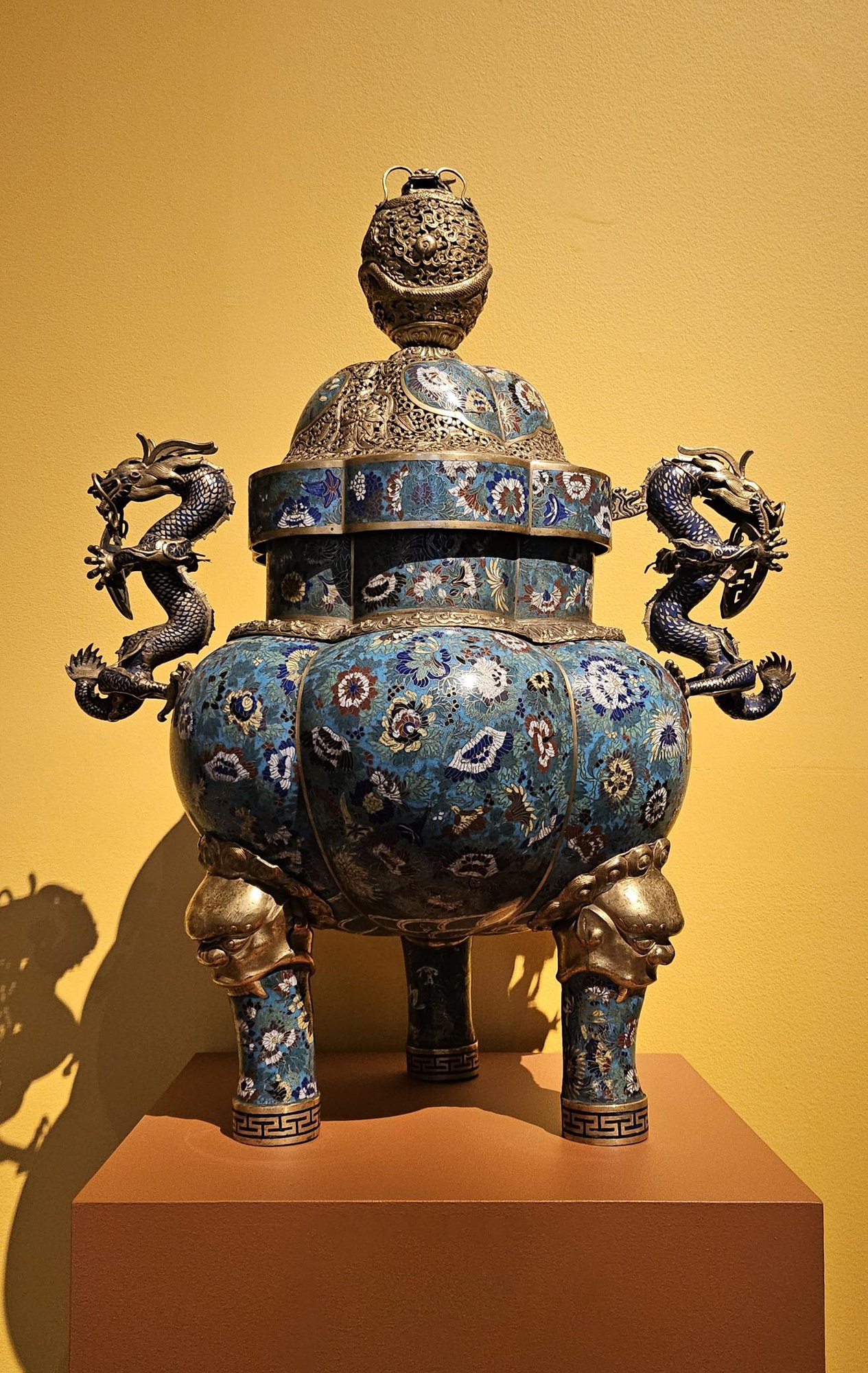
Palace Incense Burner and Lid with Handles in the Shape of Dragons Holding Shou (Longevity) Characters. The State Hermitage Museum.
The burner is almost half a metre tall. It was not made to sit on a table among small curiosities but to hold its place in a hall, and its scale is the first thing that announces this: a heavy, symmetrical, brightly coloured object designed to be seen from a distance and from every side.
It comes from the collection of A. K. Rudanovsky and is not currently included in the museum’s permanent display.
The Object
The censer stands on three legs, each crowned by a gilt elephant mask from which the enamelled shaft of the leg descends to a gilt foot decorated with a meander band. The body is a rounded, lobed vessel covered in dense floral scrolls on a turquoise-blue ground.
Above the body rises a cylindrical neck, divided into reserved panels of lotus petals, and then a domed lid pierced with openwork scrolls and crowned by a gilt finial with a suspension ring. Two large dragons form the handles: their bodies curve outward and their claws grip a gilt plaque bearing the character shou, the sign for long life.
The object is busy in the way that Qing imperial metalwork is often busy — every surface is articulated, every reserve filled, the eye led from the elephants at the base to the dragons at the sides and up to the finial. Yet the design is strictly symmetrical, and that symmetry keeps the profusion under control.
Enamel on Metal
Two enamelling techniques meet on this burner.
In cloisonné, thin metal wires are fixed to the body to draw the outlines of the design. The resulting cells are filled with ground enamel, fired, ground down and polished until the coloured glass and the metal wire form a single smooth surface. The wire remains visible as drawing, and the gilding of the metal turns it into a warm linear network across the colour.
In champlevé, the design is not built up with wire but cut into the metal itself. The recesses are filled with enamel, and the raised areas of the body remain as bare metal, usually gilt.
Chinese enamellers used both methods, sometimes on the same object, and the technical vocabulary of Qing court metalwork is extraordinarily rich. The difficulty is not simply in the firing — enamel and metal contract at different rates, and large pieces are prone to cracking — but in the coordination of many separate firings, each of which can ruin the work of the previous ones.
Dragons, Lotus and the Character Shou
The decoration is not ornamental in the modern sense. It is a programme of auspicious signs.
The dragon in Chinese art is a symbol of power, beneficence and ordered rule, associated with the emperor and with the rain that makes the harvest possible. Here the dragons are not merely applied to the sides as decoration: they form the handles, and their bodies are actively engaged with the object, gripping the plaque that carries the shou character.
The character shou means long life and belongs to the most widespread vocabulary of Chinese blessing. It appears on porcelain, textiles, lacquer and metalwork, often multiplied in elaborate patterns, and its presence on a palace object is a wish directed at the person for whom the object was made.
The floral scrolls that cover the body are lotus-derived — the baoxianghua, or «precious flower» scroll — one of the standard ornamental systems of Chinese decorative art from the Tang period onward. The elephant masks on the legs carry their own associations: strength, and, through the homophone xiang (elephant) and xiang (auspicious), good fortune.
The Imperial Workshops
The Hermitage record names the imperial workshops as the place of manufacture. These were the court establishments of Beijing, administered within the imperial household, in which objects for the palace were designed and produced by specialist craftsmen.
The workshops were not a single building but a system of departments — metalwork, enamel, lacquer, ivory, textile, painting — each with its own masters and its own hierarchy. A complex object such as this censer would have passed through several of them: the bronze body cast in one department, the wirework and enamelling done in another, the gilding and the final assembly elsewhere.
This organisation explains the technical confidence of Qing court production. The workshops had access to the best materials, to experienced craftsmen and to designs approved at the highest level, and they were capable of producing objects on a scale that private workshops could not match.
Incense and the Palace Interior
Censers of this kind, xianglu, stood in the halls of the palace, in temples and in private apartments. Incense was part of the atmosphere of official life: it perfumed the air, marked ceremonial occasions and signalled the dignity of a space.
The form itself looks back to the ancient ritual bronzes of the Shang and Zhou dynasties. The tripod vessel, the mask-headed legs and the heavy, symmetrical body are all quotations from that archaic repertoire, translated into the materials of the Qing court.
This combination — archaic form, modern technique, imperial colour — is characteristic of eighteenth-century Chinese decorative arts. The object is at once a utensil, a piece of sculpture and a statement about continuity with the most ancient layers of Chinese culture.
Qing Enamel and Court Taste
Cloisonné enamel had been known in China since the Ming period, when the technique reached the imperial workshops from the Islamic world and was quickly absorbed into Chinese decorative language.
By the eighteenth century the craft was fully domesticated. The wire outlines no longer followed geometric ornament alone but drew lotus scrolls, dragons and clouds with the fluency of a painter’s brush. The palette widened, the pieces grew larger, and the technical ambition of the court workshops reached a level that has never been surpassed.
The Qing court valued enamel for the same reasons it valued carved lacquer and fine porcelain: it demonstrated control over difficult materials. A large cloisonné censer is not simply an object of use. It is evidence of an organisation capable of casting a bronze body, covering it with hundreds of metres of wire, filling the cells with coloured glass, firing the whole without cracking and finishing it with gilding.
This is why such objects were made for palaces rather than for the market. Their function was to be beautiful in a way that only the court could afford.
Provenance
The censer comes from the collection of A. K. Rudanovsky, which entered the Hermitage in 1919.
Rudanovsky’s holdings were unusually broad for a private collection of his time, and Chinese decorative art formed one of their significant strands. Objects of this quality were not bought as souvenirs; they belonged to the same ambitious programme of collecting that brought Italian panels, French painting and German sculpture into the same house.
The inventory number LM-497 belongs to the museum’s applied-art sequence. The object is not on permanent display.
In the Hermitage
Today the burner is preserved in the State Hermitage Museum in Saint Petersburg, where it represents the Chinese decorative tradition within the Rudanovsky collection.
It is an object that repays close looking. From a distance it reads as a single mass of blue and gold; closer, it separates into a hundred small decisions — the turn of a dragon’s claw, the alternation of coloured grounds, the gilding that catches the light along every edge.
Within the collection, it also performs a quieter function. It reminds the viewer that the Rudanovsky collection was not only a gallery of European paintings but a nineteenth-century interior in miniature, in which Chinese enamel, French silver and Italian panel painting were meant to be seen together.