Artist: Nicolas Sageot (1666–1731), attributed
Origin: France
Date: first third of the 18th century
Material: wood, tin, copper, tortoiseshell, mother-of-pearl, bronze
Technique: inlay
Dimensions: 80 × 120 × 70 cm
Current Collection: The State Hermitage Museum
Inventory Number: Epr-1541
Hermitage ID: 159779
Rudanovsky Connection: Entered the Hermitage in 1930 from the collection of A. K. Rudanovsky.
A French writing desk of the first third of the eighteenth century, attributed to Nicolas Sageot, veneered in tortoiseshell and brass.
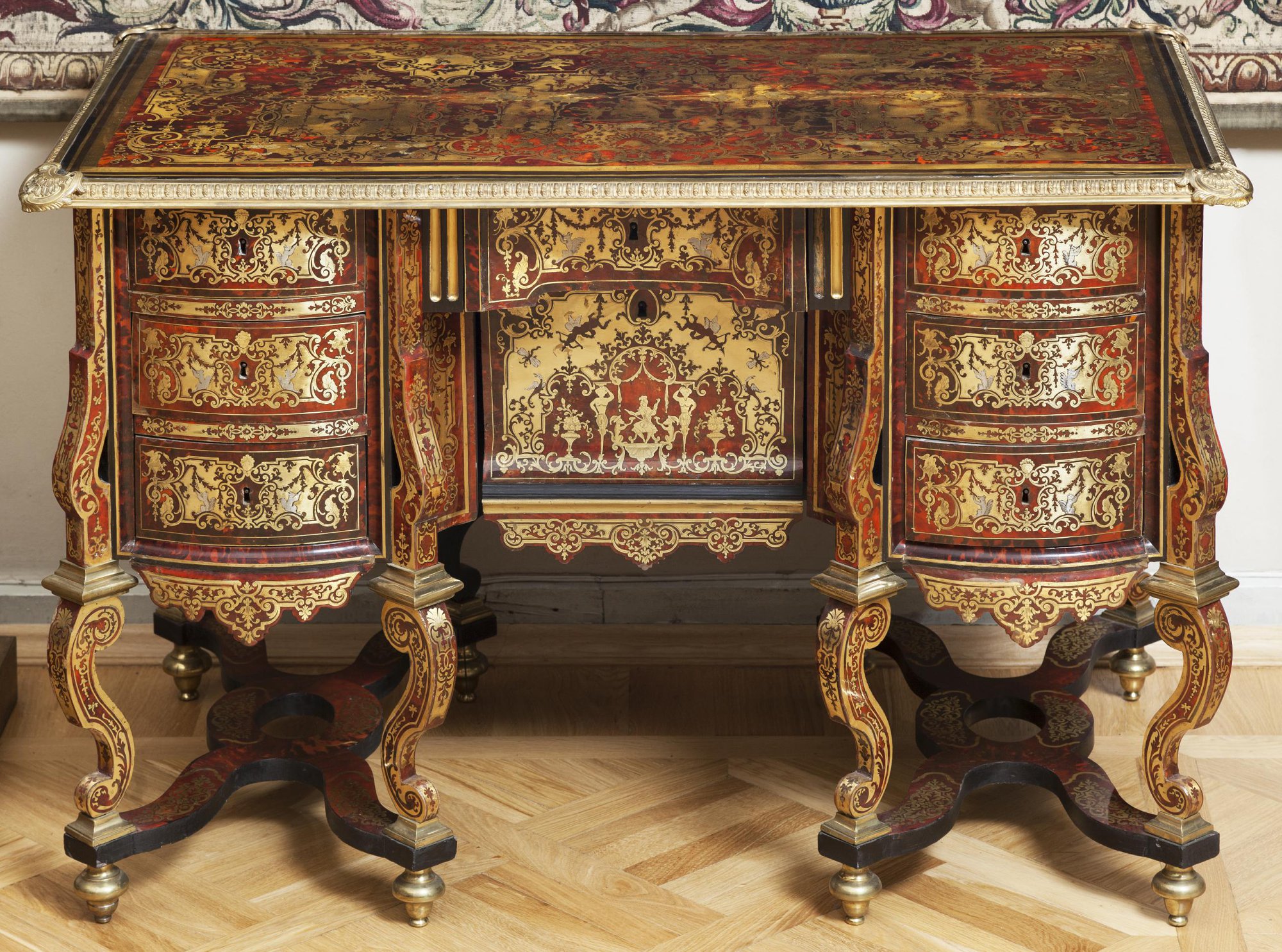
Writing Desk. The State Hermitage Museum.
The desk entered the Hermitage in 1930, transferred from the Economic Department and previously in the collection of A. K. Rudanovsky. It is on display in the Winter Palace, in room 293.
It is a large writing desk with a sloping lid, its surface covered with a rich marquetry of tortoiseshell, brass and mother-of-pearl.
The Object
The desk is rectangular, with a sloping top and a deep body.
Its front is divided into three panels: two banks of drawers at the sides, and a central kneehole with a door. The whole is veneered in red tortoiseshell, inlaid with brass scrollwork and figures, and mounted with gilt bronze.
The legs are curved and joined by a stretcher, and the desk stands on small gilt feet.
Boulle Marquetry
The desk is a classic example of Boulle marquetry.
Named after the cabinetmaker André-Charles Boulle, the technique combines tortoiseshell with brass, tin or copper: the two materials are cut together, and the pieces are then exchanged, so that one surface has a brass design on a tortoiseshell ground and another has the reverse.
The result is a rich, two-coloured surface, in which the metal and the shell seem to merge.
The Design
The marquetry is covered with ornament.
Scrolls, foliage, figures, birds and architectural motifs run across every surface, in the intricate, asymmetrical style of the French Régence. The design is dense and continuous, and it covers the desk like a tapestry.
The ornament is cut in brass and laid into the tortoiseshell, and it is engraved with fine lines that give it detail.
The Desk
The desk is a piece of furniture for writing.
It has a sloping top, which allowed the writer to work at an angle, and a deep body with drawers for papers and instruments. The kneehole in the centre allowed the writer to sit close to the desk.
Desks of this kind were made for the wealthy: they were expensive objects, and they were placed in a study, a library or a cabinet.
The Drawers
The desk has several drawers.
Two banks of drawers flank the kneehole, and each drawer is faced with marquetry and fitted with a lock. The drawers were used for papers, letters, ink and sealing wax.
The locks are set into the marquetry, and their keyholes are surrounded by small brass ornaments.
The Legs
The legs are curved and carved.
They are shaped like consoles, with a scroll at the top and a curve toward the foot, and they are joined by a wavy stretcher. The legs are veneered with tortoiseshell and inlaid with brass.
The gilt bronze mounts at the top and bottom of each leg protect the wood and add a line of gold.
Sageot
Nicolas Sageot (1666–1731) was a French cabinetmaker.
He was one of the leading ébénistes of his time, and he specialised in Boulle marquetry. His workshop produced desks, cabinets, commodes and clocks for the French court and the nobility.
The attribution to Sageot rests on the style and the quality of the work, and it places the desk among the finest productions of the Régence.
The Bronze
The gilt bronze mounts are an essential part of the desk.
They frame the panels, protect the edges and provide the handles, the locks and the feet. They are chased and gilded, and they catch the light against the dark tortoiseshell.
Mounts of this kind were made by specialist bronziers, and they were often the most expensive part of a piece of furniture.
The Interior
The desk was made for an interior.
It stood in a study or a cabinet, among books, paintings and objects of curiosity, and it was a sign of wealth and taste. Its dark red and gold would have glowed in candlelight.
That room is gone, but the desk still carries its character: a dark, rich, glittering object, made for a world of letters and leisure.
The Sloping Top
The top of the desk slopes.
It is a writing surface, set at an angle, and it is covered with the same marquetry as the rest. The slope allowed the writer to work without bending, and it is one of the features that identify the piece as a desk rather than a table.
The top is framed in gilt bronze, and its edge is moulded and decorated.
The Régence
The desk belongs to the Régence style.
The Régence was the period of French art between the death of Louis XIV in 1715 and the accession of Louis XV, and it was characterised by lightness, curves and rich ornament. Furniture became smaller, more elegant and more comfortable.
The desk is a good example: it is graceful in its curves, rich in its marquetry and luxurious in its materials.
The Kneehole
The kneehole is the desk’s compositional centre.
It is a recess in the middle of the front, with a door or a panel, and it allows the writer to sit close to the desk. The kneehole is framed by the two banks of drawers, and it gives the piece its symmetry.
A kneehole desk is a practical object: it brings the writer to the work, and it makes the desk a place rather than a surface.
Maintenance
The desk needs care.
Tortoiseshell is sensitive to heat and dryness, and it can crack or lift; the brass can tarnish; the bronze can lose its gilding. The surface must be kept stable, and the object is stored and displayed with attention.
That the desk has survived in this condition is a sign of careful maintenance over three centuries.
The Wood Beneath
The desk is made of wood.
Beneath the tortoiseshell and the brass, there is a carcase of oak or pine: a frame of drawers, panels and legs, glued and joined. The marquetry is a veneer, laid over this structure.
The wood gives the desk its strength, and its joinery is as important as its surface. A piece of furniture is a construction before it is a decoration.
Provenance
The desk carries the inventory number Epr-1541. It entered the Hermitage in 1930, transferred from the Economic Department, and it was previously in the Rudanovsky collection.
In the Hermitage
The desk is on display in the Winter Palace, in room 293.
It is a magnificent piece of French furniture, and it preserves the art of Boulle marquetry at its height: tortoiseshell, brass, bronze and gold, combined in a single, glittering object.
To stand in front of it is to see how much labour a surface can hold: hundreds of pieces of shell and metal, cut and fitted by hand, and a structure of oak beneath them, holding everything together, out of sight, for two hundred years and more, at the service of a sheet of paper.