Organization: Sèvres Porcelain Manufactory
Origin: France
Date: 1788
Complex: Blue Service
Material: soft-paste porcelain
Dimensions: diameter 24.2 cm
Current Collection: The State Hermitage Museum
Inventory Number: ZF-16279
Hermitage ID: 352379
Rudanovsky Connection: Entered the Hermitage in 1919 from the collection of A. K. Rudanovsky.
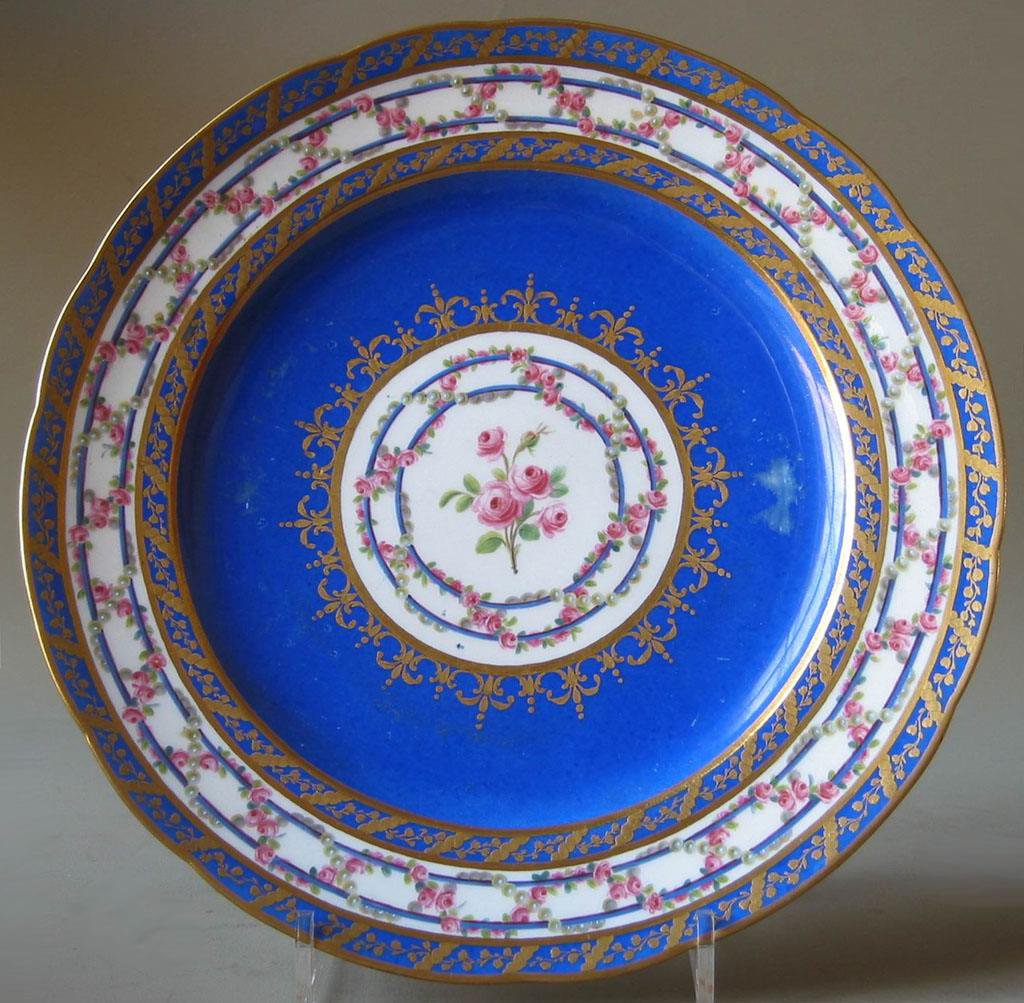
A Sèvres plate of 1788 from the «Blue Service», its decoration built as a series of concentric rings around a central spray of roses.
Plate, Blue Service (ZF-16279). The State Hermitage Museum.
The plate entered the Hermitage in 1919 from the collection of A. K. Rudanovsky. It is not currently on permanent display.
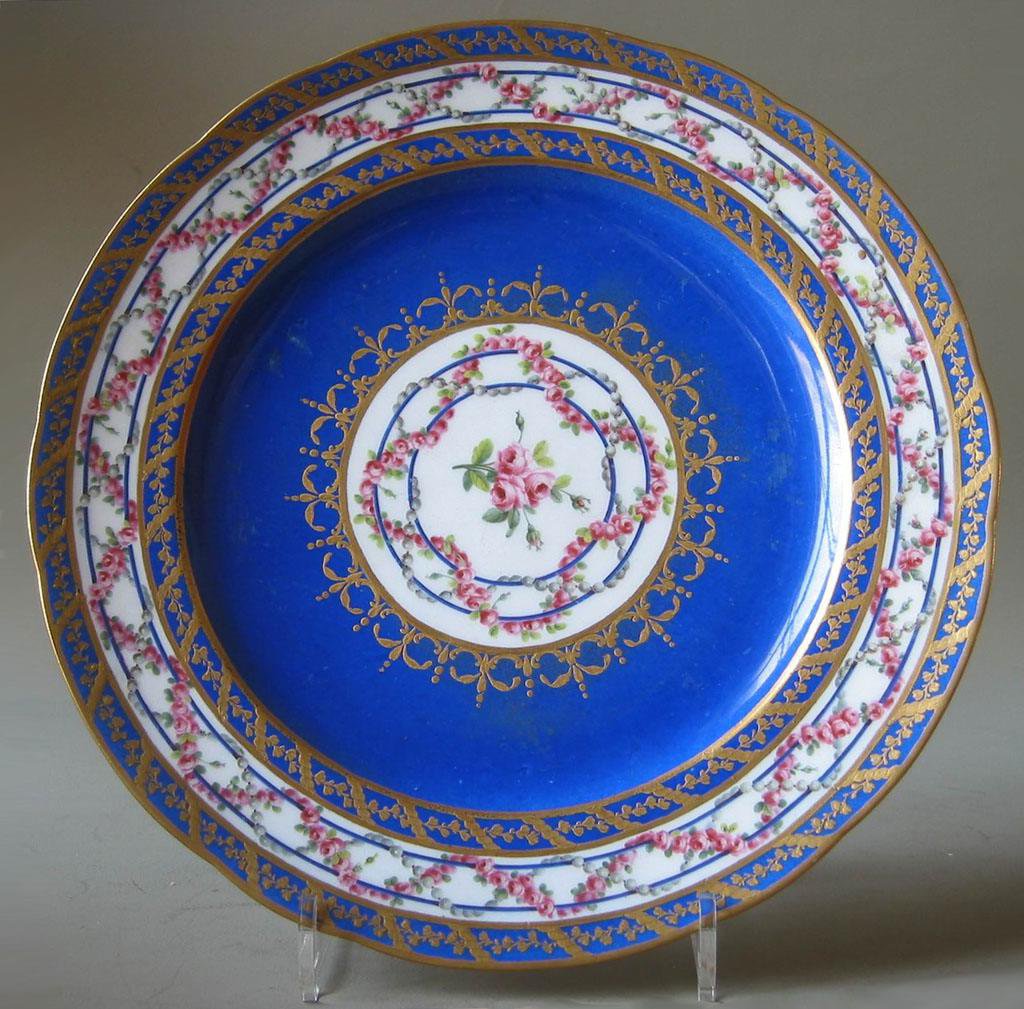
It is one of several plates from the same service, and it shares their design: a blue rim, a white band with a garland, a gold ring, a blue well and a white centre with roses.
The Object
The plate is round, with a slightly wavy rim and a shallow well.
The rim is blue, decorated with gold garlands. A white band inside it carries a continuous garland of roses, framed by blue lines. Then come a gold band, a wide blue well, a gold foliate circle, and a white medallion with a small spray of roses.
The colours are blue, white, gold, pink and green, arranged in clear concentric zones.
Concentric Rings
The design of the plate is concentric.
Each element is a ring: the rim, the white band, the gold band, the well, the medallion. The eye is led from the edge toward the centre, and the whole composition is organised around a single point.
This is the natural logic of a round plate, and Sèvres used it repeatedly. The concentric structure allows the decoration to be read at a glance and to remain legible when the plate is seen at an angle.
Symmetry
The plate is symmetrical in every direction.
It has no top or bottom, no front or back; it can be rotated and still look the same. This symmetry is practical — a plate is placed on a table without regard to orientation — and it is also aesthetic: it gives the object a calm, stable presence.
The only element that breaks the symmetry is the small spray of roses in the centre, which has a slight directional tilt. It is a tiny irregularity in an otherwise perfect system.
The Garland Ring
The garland of roses forms a ring around the plate.
It is continuous, with no beginning or end, and it repeats the same motif — a rose, a bud, a leaf — around the circumference. The repetition creates a rhythmic band that separates the rim from the well.
Garlands of this kind were a standard element of Sèvres decoration. They allowed the painter to fill a circular band evenly and to give the plate a sense of movement.
The Medallion
The centre of the plate is a white medallion with a spray of roses.
It is framed by a gold circle of leaves and scrolls, which acts as a transition between the blue well and the white centre. The medallion is small, and it is surrounded by a large area of blue.
This hierarchy — a small centre, a large ground — is characteristic of the service. The eye is drawn inward, but the blue dominates.
The Anonymous Hand
The painter of this plate is not recorded.
Unlike some plates of the service, which carry the marks of named painters, this one is anonymous. Its decoration is confident but not distinctive: a garland, a band, a small spray of roses.
Anonymity is the normal condition of most Sèvres production. The named painters are the exception; the hundreds of hands that decorated the bulk of the output remain unknown.
The Blue Service
The plate belongs to the Blue Service of 1788.
The service was a large commission, with plates, cups, trays and bowls, all decorated in the same scheme. It was made for a wealthy client and used on special occasions.
The plate is one of the most numerous pieces of such a service: a dinner service might include dozens of plates, in several sizes.
The Plate in Use
A plate is a working object.
It is filled, carried, eaten from and washed; it is stacked and knocked; it survives, if it survives at all, with scratches, chips and worn gilding. This plate shows those traces, and they are part of its history.
In a museum, the plate is protected from use; in the eighteenth century, it was one of the most handled objects on the table.
The Gold Ring
The gold circle around the medallion is the most delicate element of the design.
It is a ring of leaves and scrolls, painted in fine lines and gilded, and it separates the blue well from the white centre. Its openness allows the blue to show through, so that the ring seems to float.
Rings of this kind are a Sèvres speciality: a small piece of goldsmith’s work, painted with a brush.
Geometry and Ornament
The plate is a lesson in geometry.
Circles within circles, bands within bands: the design is built on the simplest of shapes, and the ornament is arranged to respect them. The result is a harmony that is almost mathematical.
In the eighteenth century, geometry and ornament were not opposed. A design was expected to be both regular and delightful, and this plate achieves both.
A Plate in the Hand
A dinner plate is heavy.
Held in the hand, it has a solid, slightly cool presence, and its weight is a reminder that porcelain is a stone as much as a glass. The plate does not flex or bend; it is rigid, and it demands to be handled with care.
That weight is part of the pleasure of the object, and part of its vulnerability.
The Service’s Repetition
The plate is one of many, and its design is repeated across the service.
The repetition is what makes a service a service: the same rim, the same garland, the same medallion, adapted to different shapes and sizes. Without repetition, there would be only individual objects.
This plate is a unit of that repetition, and its beauty depends on the others.
The White Band
The white band is the lightest zone of the plate.
It carries the garland of roses and is framed by blue lines, and it separates the blue rim from the gold band and the well. Its white is the colour of the porcelain itself, and it gives the eye a place to rest.
In the design of the plate, the white band is the stage; the roses are the actors.
The Service’s Colours
Blue, white and gold, with the pink and green of the roses: the palette is small and strict.
The blue provides the ground, the white the light, the gold the frame, the flowers the life. Nothing is superfluous, and nothing is missing.
This discipline is what makes the service look rich without looking crowded.
Provenance
The plate carries the inventory number ZF-16279 and entered the Hermitage in 1919 from the collection of A. K. Rudanovsky.
In the Hermitage
The plate is preserved in the State Hermitage Museum in Saint Petersburg and is not on permanent display.
It is a small part of a large service, but it carries the whole design in miniature: the blue, the gold, the garland and the roses, arranged in rings around a white centre.