Artist: Hirel de Choisy (painter)
Organization: Sèvres Porcelain Manufactory
Origin: France
Date: 1788
Complex: Blue Service
Material: soft-paste porcelain
Dimensions: diameter 24.2 cm
Current Collection: The State Hermitage Museum
Inventory Number: ZF-16280
Hermitage ID: 352380
Rudanovsky Connection: Entered the Hermitage in 1919 from the collection of A. K. Rudanovsky.
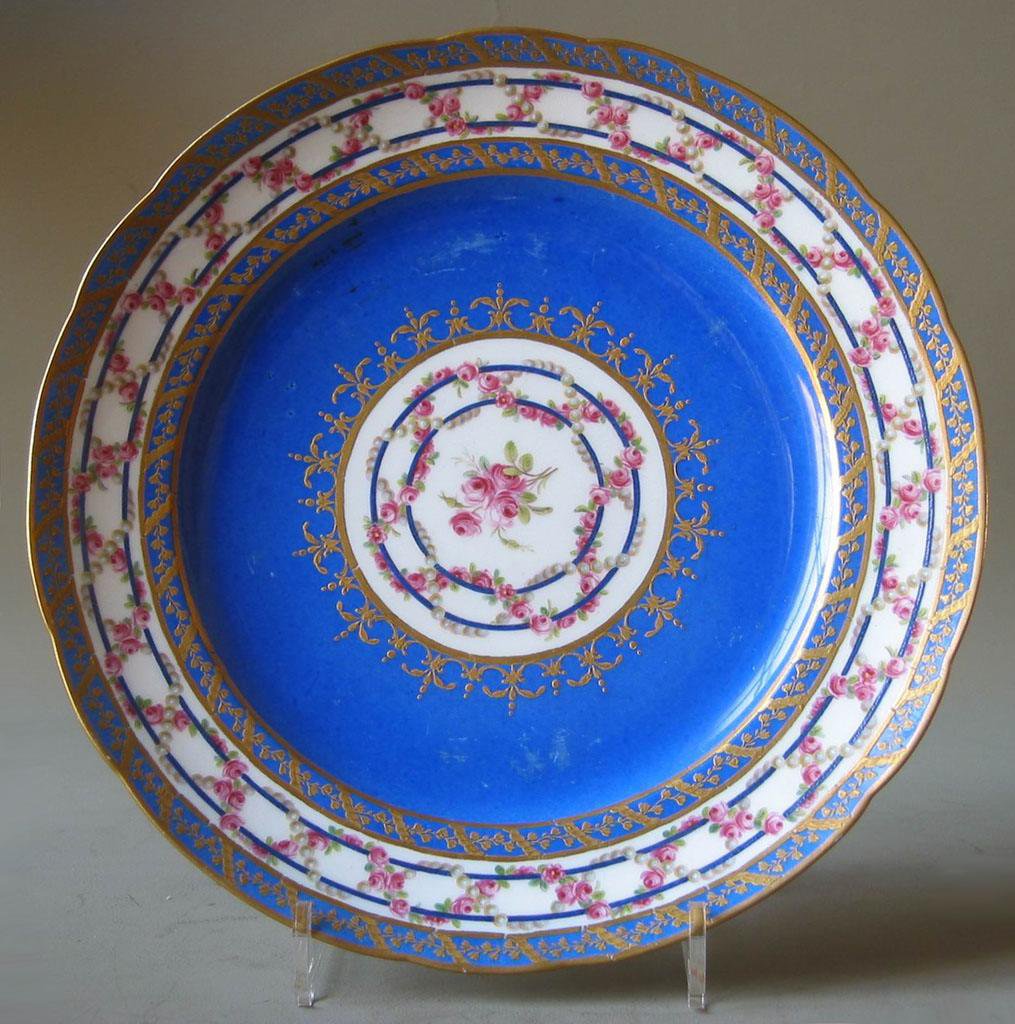
A Sèvres plate of 1788 from the «Blue Service», its white centre painted with a spray of roses by the painter recorded as Hirel de Choisy.
Plate, Blue Service (ZF-16280). The State Hermitage Museum.
The plate entered the Hermitage in 1919 from the collection of A. K. Rudanovsky. It is not currently on permanent display.
It is one of several plates from the same service, and like its companions it carries a blue rim, a garland of roses and a white medallion at the centre.
The Object
The plate is round, with a wavy rim and a shallow well.
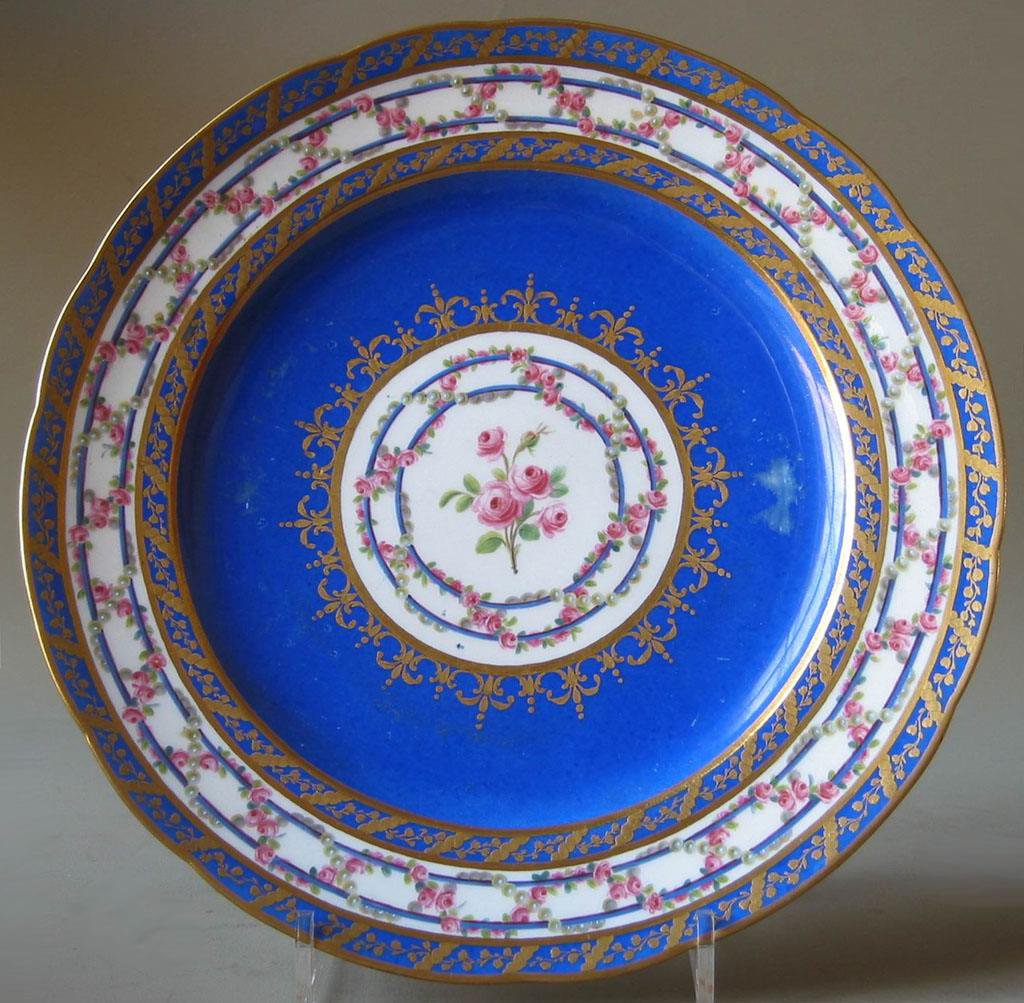
The rim is blue with gold garlands; inside it, a white band carries a continuous garland of roses. A gold band, a blue well and a gold foliate circle lead to the white medallion in the centre, where a spray of roses is painted.
The colours are the same as on the other plates of the service: cobalt blue, white, gold, pink and green.
The Central Rose
The centre of the plate is a small bouquet of roses.
It is painted with care: a large open rose at the centre, buds around it, leaves and stems. The pinks are soft, the greens are muted, and the whole spray has a natural, slightly informal look.
The contrast between this small, delicate motif and the formal rings around it is one of the pleasures of the plate. The centre is a little garden, surrounded by geometry.
Hirel de Choisy
The plate is attributed to the painter recorded as Hirel de Choisy.
His mark on the underside of the plate identified his work to the factory, and it allows the modern scholar to connect the object to a named hand.
Sèvres employed a large number of painters, and most of them are known only through their marks. Hirel de Choisy is one of those names — a signature on the back of a plate, and a style visible in the flowers he painted.
The Mark
The mark is a small but decisive detail.
On the underside of the plate, beside the factory mark and the date letter, the painter’s mark records who decorated the piece. Without it, the plate would be anonymous; with it, it becomes the work of a specific person.
Marks are the documentary backbone of porcelain studies. They allow objects to be dated, attributed and grouped, and they turn a beautiful plate into a historical document.
The Plate as a Signed Object
Most decorative objects are anonymous.
A plate is made by many hands — the potter, the glazer, the painter, the gilder — and the finished object rarely names any of them. The painter’s mark is an exception: a small assertion of authorship on an object made for use.
This plate is therefore both a piece of tableware and a signed work. The signature is tiny, hidden on the underside, but it changes the way we see the object.
The Blue Service
The plate belongs to the Blue Service of 1788.
The service was a large commission, with plates, cups, trays and bowls. It was decorated by several painters, each of whom left a mark on the pieces he or she painted.
The service is therefore a collective work: a design conceived by the factory and executed by many hands, of which Hirel de Choisy’s is one.
The Table
The plate was made for a table.
It would have been one of many, arranged around a cloth with dishes, glasses and cutlery. The blue rim would have created a ring of colour around each place, and the white centre would have framed the food.
That table is gone, but the plate still carries its logic: the design of a service is the design of a social scene.
The Size
At 24.2 centimetres, the plate is a dinner plate.
Its scale allows the full decoration to be seen: the blue rim, the garland band, the gold circle and the central spray. On a smaller plate, the design would be compressed; on this one, it has room.
The size also tells us how the plate was used: for the main course, at a table laid for several guests.
The Flowers of the Service
Roses run through the whole service.
They appear on the cups, the plates, the trays and the bowls, always in the same palette of pink, crimson and green. The rose is the service’s signature, the motif that ties its many pieces together.
The flowers are painted in a naturalistic but simplified style, designed to be read at a distance and enjoyed at close range.
The Gold Circle
The gold circle around the medallion is a frame within a frame.
It separates the blue well from the white centre and gives the roses a setting. Its open, leafy pattern allows the blue to show through, so that the circle seems light rather than solid.
Such circles were painted freehand, with a fine brush, and their regularity is a measure of the painter’s skill.
The Underside
The underside of the plate is its archive.
There are the foot ring, the factory mark, the date letter and the painter’s mark. Together they document the plate’s origin, date and author, and they allow it to be placed within the service.
The visible side is the art; the hidden side is the evidence.
The Rim
The rim is the plate’s frame.
It is blue, with gold garlands that run around it in a continuous pattern, and it is separated from the white band by blue lines. The rim is the first thing seen when the plate is on a table, and it establishes the colour of the service.
It is also the part most exposed to wear, and the gilding on this plate shows signs of use.
The Blue Well
Between the white band and the medallion lies a wide blue well.
It is plain, without ornament, and its function is to frame the centre and to give the plate its depth. The blue is deep and even, and it reflects the light softly.
The well is the largest area of colour in the plate, and it is what makes the white medallion appear bright.
The Years After
The plate survived the Revolution, the dispersal of the service and the journey to Russia.
It was collected by Rudanovsky, nationalised after 1917 and transferred to the Hermitage in 1919. Each of those stages left a trace, if only in the inventory number written on the underside.
A plate that has travelled so far is a small lesson in how objects outlive the worlds that made them.
Provenance
The plate carries the inventory number ZF-16280 and entered the Hermitage in 1919 from the collection of A. K. Rudanovsky.
In the Hermitage
The plate is preserved in the State Hermitage Museum in Saint Petersburg and is not on permanent display.
It is one of several plates from the service, and it allows the museum to show not only the design but also the hands behind it: the factory, the year and the painter whose mark survives on the underside.