Organization: Sèvres Porcelain Manufactory
Origin: France
Date: 1788
Complex: Blue Service
Material: soft-paste porcelain
Dimensions: diameter 24.2 cm
Current Collection: The State Hermitage Museum
Inventory Number: ZF-16282
Hermitage ID: 352382
Rudanovsky Connection: Entered the Hermitage in 1919 from the collection of A. K. Rudanovsky.
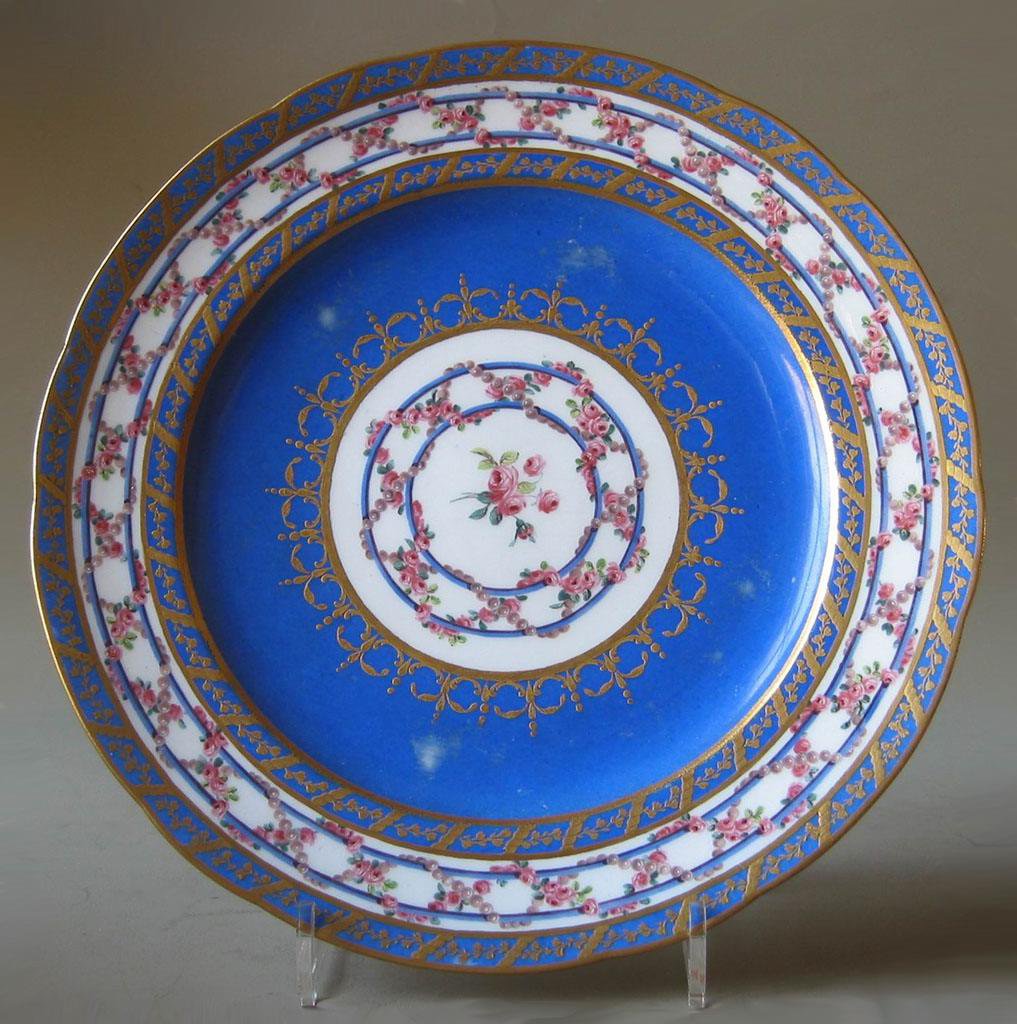
A Sèvres dinner plate of 1788 from the «Blue Service», one of a large number made for the same table.
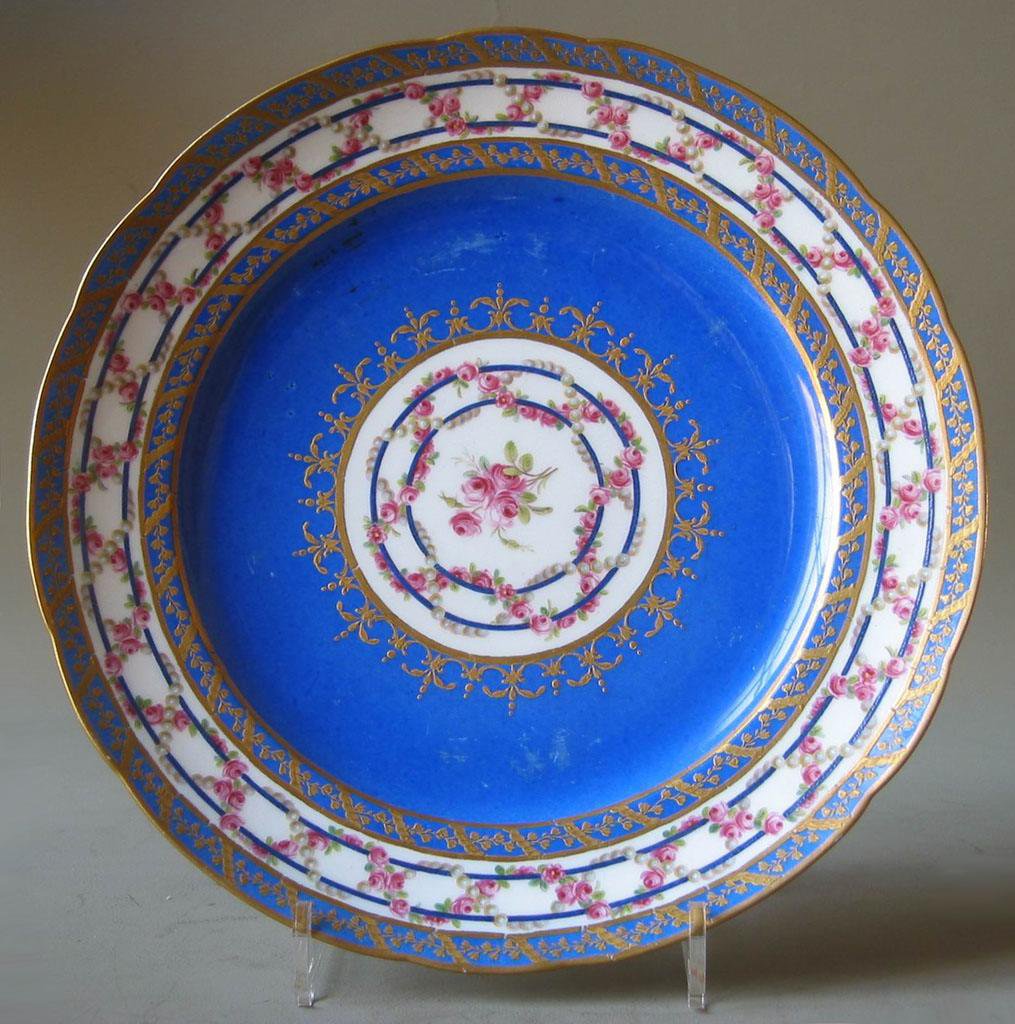
Plate, Blue Service (ZF-16282). The State Hermitage Museum.
The plate entered the Hermitage in 1919 from the collection of A. K. Rudanovsky. It is not currently on permanent display.
It is a dinner plate, 24 centimetres across, decorated with a blue rim, a garland of roses and a white centre with a small spray of flowers.
The Object
The plate has a wavy rim and a shallow well.
The rim is blue, with gold garlands running around it; inside, a white band carries a continuous garland of roses, framed by blue lines. A gold band separates the band from the blue well, and a gold circle of leaves frames the white medallion in the centre.
The palette is the same as the rest of the service: cobalt blue, white, gold, pink and green.
A Plate in a Service
The plate is a unit of a service.
A dinner service included dozens of plates, in several sizes, and they were made to be used together. The design had to work at the scale of the table, where a dozen plates were seen at once.
This plate is one of those units. Its decoration is complete in itself, but its meaning depends on the others.
The Number of Plates
Plates are the most numerous pieces of a service.
They are also the most vulnerable: they are stacked, washed, dropped and replaced. A service that began with fifty plates might end with ten, and the survivors are often the ones that were used least.
The survival of several plates from the Blue Service is therefore a matter of chance as much as care.
The Foot Ring
The foot ring is the small circle on the underside of the plate.
It raises the plate from the table, gives it stability and provides a surface for the marks. It is formed by turning the plate on a lathe after the body has dried, and it is one of the signs of careful manufacture.
On this plate, the foot ring is clean and regular, with a slight trace of the turning.
The Underside
The underside of the plate is its archive.
There are the foot ring, the factory mark, the date letter and, on some plates of the service, the painter’s mark. Together they document the plate’s origin, date and author.
The visible side is the art; the hidden side is the evidence, and both are necessary to understand the object.
The Rim
The rim is the plate’s frame.
It is blue, with gold garlands that run around the edge, and it is separated from the white band by blue lines. The rim is the first thing seen on a table, and it establishes the colour of the service.
It is also the part most exposed to wear, and this plate shows small losses along the edge.
The Well
The well is the wide blue area between the white band and the medallion.
It is plain, without ornament, and its function is to frame the centre and give the plate depth. The blue is deep and even, and it reflects the light softly.
The well is the largest area of colour in the plate, and it is what makes the white medallion appear bright.
The Medallion
The centre of the plate is a white medallion with a spray of roses.
It is framed by a gold circle of leaves and scrolls, which separates it from the blue well. The roses are painted in pinks and greens, with buds and leaves, and they form a small, centred composition.
The medallion is the focal point of the plate and the place where the painter’s hand is most visible.
The Blue
The blue of the plate is the colour of the service.
It is a deep cobalt, applied as a ground over the glaze, fired and polished. The colour is intense and slightly uneven, as hand-applied grounds always are.
Blue was the most expensive colour in the Sèvres palette, and its use here signals the quality of the commission.
The Service’s Plates
The Blue Service included plates of several sizes.
There were dinner plates, dessert plates and possibly soup plates, each with the same decoration adapted to its dimensions. The plate in front of us is a dinner plate, the largest of the standard sizes.
The variety of sizes allowed the service to be used for different courses, and it gave the table a visual rhythm: large plates for the main course, smaller ones for dessert.
The Painters
The plates of the service were painted by several hands.
Some carry the marks of named painters, others are anonymous. The flowers, the garlands and the gold were done by different specialists, each with a defined task.
This division of labour is one of the characteristics of Sèvres production: a single plate could pass through four or five pairs of hands before it was finished.
Plates and Portions
A plate is also a measure.
Its size determines the portion, and the portion determines the menu. A dinner plate of 24 centimetres belongs to a service designed for substantial meals, with several courses and a generous table.
The plate therefore tells us something about the way people ate, as well as about the way they decorated.
Why Plates Survive
Plates survive better than cups.
They are less likely to be dropped, they stack easily, and they are often kept as display objects even after a service has gone out of use. A collection of plates can therefore preserve the design of a service whose other pieces have disappeared.
The Blue Service survives largely through its plates, and this one is a representative example.
The Plate and Its Double
Several plates from the Blue Service survive in the Hermitage.
They are almost identical: same size, same rim, same garland, same medallion. Only the marks on the underside and the small variations of the painting distinguish them.
Seen together, they demonstrate the consistency of the factory; seen alone, each is a complete statement of the service’s design. The museum can show both, and that is a rare luxury.
Provenance
The plate carries the inventory number ZF-16282 and entered the Hermitage in 1919 from the collection of A. K. Rudanovsky.
In the Hermitage
The plate is preserved in the State Hermitage Museum in Saint Petersburg and is not on permanent display.
It is one of several plates from the same service, and it allows the museum to show the design at the scale of a dinner table: a ring of blue and gold, a band of roses, and a small white centre.
It is a plate, nothing more, and yet it contains a whole system of design: the blue of the ground, the gold of the frame, the garden of the centre, all arranged so that a dinner table could look like a work of art for an evening.