Artist: Jean-Baptiste Tandart l’aîné (painter)
Organization: Sèvres Porcelain Manufactory
Origin: France
Date: 1788
Complex: Blue Service
Material: soft-paste porcelain
Dimensions: diameter 24.2 cm
Current Collection: The State Hermitage Museum
Inventory Number: ZF-16281
Hermitage ID: 352381
Rudanovsky Connection: Entered the Hermitage in 1919 from the collection of A. K. Rudanovsky.
A Sèvres plate of 1788 from the «Blue Service», painted by the artist recorded as Tandart l’aîné.
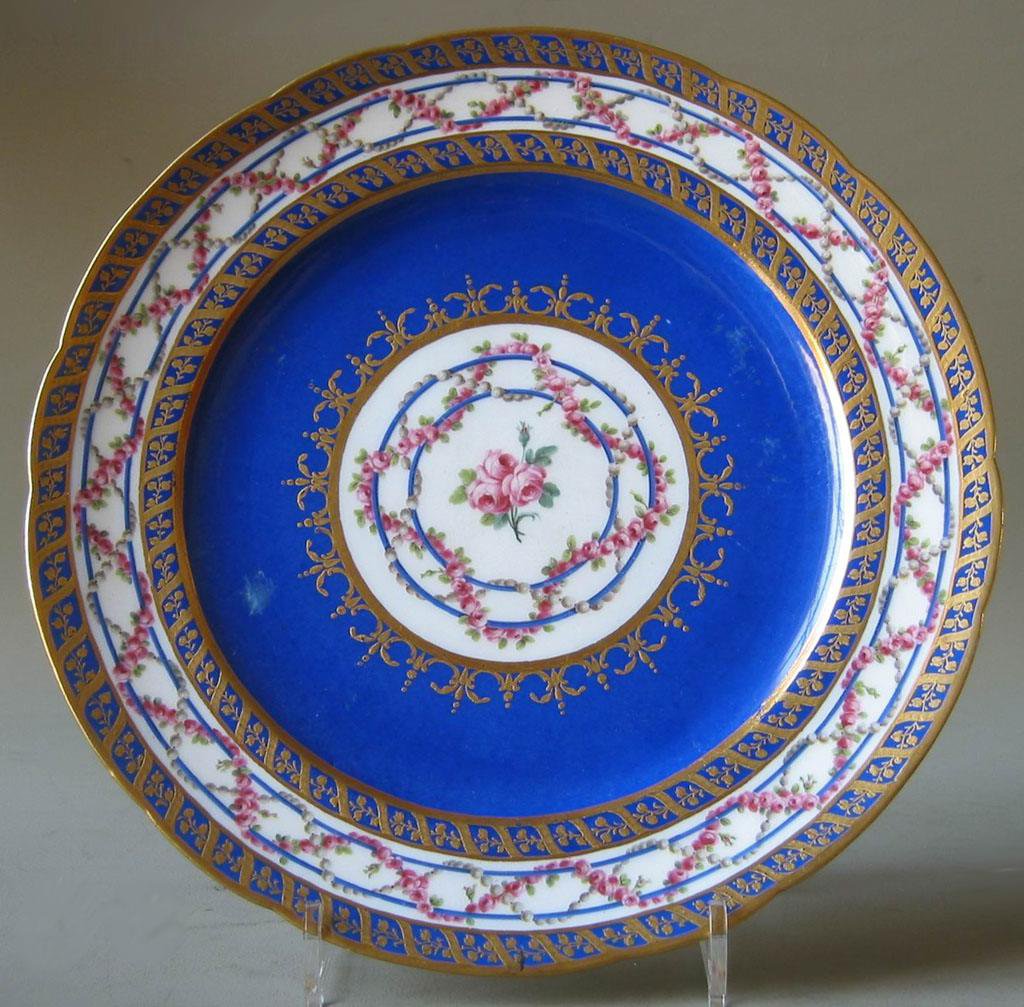
Plate, Blue Service (ZF-16281). The State Hermitage Museum.
The plate entered the Hermitage in 1919 from the collection of A. K. Rudanovsky. It is not currently on permanent display.
It is one of several plates from the same service, and it carries the marks and the painting of a named artist — a small but significant fact in the history of a service usually discussed as an anonymous product.
The Object
The plate has a wavy rim and a shallow well.
The rim is blue with gold scrolls; inside, a white band carries a garland of roses, framed by blue lines. A gold band, a blue well and a gold foliate circle lead to the white medallion, where a spray of roses is painted.
The decoration is the same as on the other plates of the service, but the hand that painted it is known.
Tandart l’aîné
The painter is recorded as Tandart l’aîné — «Tandart the elder».
Sèvres employed several members of the Tandart family, and the epithet distinguishes the elder from the younger. The elder Tandart was a flower painter, and his work is characterised by a light touch and a taste for small, delicate blossoms.
His mark on the underside of the plate identified his work to the factory and allows the modern scholar to connect the object to a specific hand.
A Family of Painters
The Tandarts were one of several families who worked at Sèvres across generations.
Porcelain painting was a trade passed from father to son, and families like the Tandarts, the Bouillats and the Thévenets formed dynasties within the factory. Their names recur in the archives, and their styles can sometimes be distinguished.
This family structure is one of the reasons why Sèvres production is so consistent: the same skills, the same training and the same aesthetic were transmitted within a small circle of craftsmen.
The Mark
The mark is a small but decisive detail.
On the underside of the plate, beside the factory mark and the date letter, the painter’s mark records who decorated the piece. Without it, the plate would be anonymous; with it, it becomes the work of a specific person.
Marks are the documentary backbone of porcelain studies. They allow objects to be dated, attributed and grouped, and they turn a beautiful plate into a historical document.
The Plate as Evidence
This plate is evidence of several things at once.
It documents the Blue Service, its design and its date. It documents the organisation of the Sèvres factory, with its division of labour between potters, painters and gilders. And it documents the survival of a service, piece by piece, through two centuries.
A single plate can carry all of that, if we know how to read it.
The Blue Service
The plate belongs to the Blue Service of 1788.
The service was a large commission, with plates, cups, trays and bowls. It was decorated by several painters, each of whom left a mark on the pieces he or she painted.
The service is therefore a collective work: a design conceived by the factory and executed by many hands, of which Tandart’s is one.
The Table
The plate was made for a table.
It would have been one of many, arranged around a cloth with dishes, glasses and cutlery. The blue rim would have created a ring of colour around each place, and the white centre would have framed the food.
That table is gone, but the plate still carries its logic: the design of a service is the design of a social scene.
The Flowers
The roses on the plate are painted in the style of the Sèvres flower painters.
They are not botanical studies. They are decorative blooms, composed to fit the medallion and the garland, with an eye to colour and rhythm rather than to accuracy.
The palette is small: pinks, crimson, greens, a little yellow. Within that range, the painter creates variety through the shape of the petals and the density of the leaves.
Tandart’s Style
Tandart’s flowers are recognisable by their lightness.
He paints with a light hand, building the petals from thin washes and finishing with a few dark strokes for the centre. The result is a flower that seems to float on the porcelain rather than sit on it.
This style was prized at Sèvres, where the decoration was expected to be delicate rather than emphatic.
The Gilder
The gold on the plate was applied by a gilder, not by Tandart.
The gilding of the rim, the bands and the foliate circle was a separate operation, carried out after the painting and with its own tools and materials. The gilder’s work frames the painter’s and gives the plate its richness.
The collaboration between painter and gilder is one of the hidden stories of every Sèvres plate.
The Service’s Painters
The Blue Service was decorated by a team.
Several painters worked on it, and their marks survive on the undersides of the pieces. Tandart is one of them; others remain anonymous.
The service is therefore a collective portrait of the factory at a particular moment, with its hierarchies, its specialities and its individual talents.
A Plate in the Archive
The plate is also an archive object.
Its marks, its decoration and its condition document the factory, the year, the painter and the history of the service. In a museum, the plate is studied as much as it is admired.
That double life — as a work of art and as a document — is what makes porcelain so rewarding a subject.
The Size of the Plate
At 24.2 centimetres, the plate is a dinner plate.
Its size allows the full decoration to be seen: the blue rim, the garland, the gold circle and the central spray. On a smaller plate, the design would be compressed; on this one, it has room.
The size also tells us how the plate was used: for the main course, at a table laid for several guests.
Provenance
The plate carries the inventory number ZF-16281 and entered the Hermitage in 1919 from the collection of A. K. Rudanovsky.
In the Hermitage
The plate is preserved in the State Hermitage Museum in Saint Petersburg and is not on permanent display.
It is one of several plates from the service, and it allows the museum to show not only the design but also the hands behind it: the factory, the year and the painter whose mark survives on the underside.
In a collection of anonymous objects, a signed plate is a small luxury: it lets us name a maker, and it reminds us that every service was painted by people — by hands that held a brush, mixed a colour and made a small decision about a petal.
The plate is, in the end, a signature and a surface, and both are legible to anyone who takes the trouble to turn it over.