Organization: Sèvres Porcelain Manufactory
Origin: France
Date: 1788
Complex: Blue Service
Material: soft-paste porcelain
Dimensions: diameter 24.2 cm
Current Collection: The State Hermitage Museum
Inventory Number: ZF-16283
Hermitage ID: 352383
Rudanovsky Connection: Entered the Hermitage in 1919 from the collection of A. K. Rudanovsky.
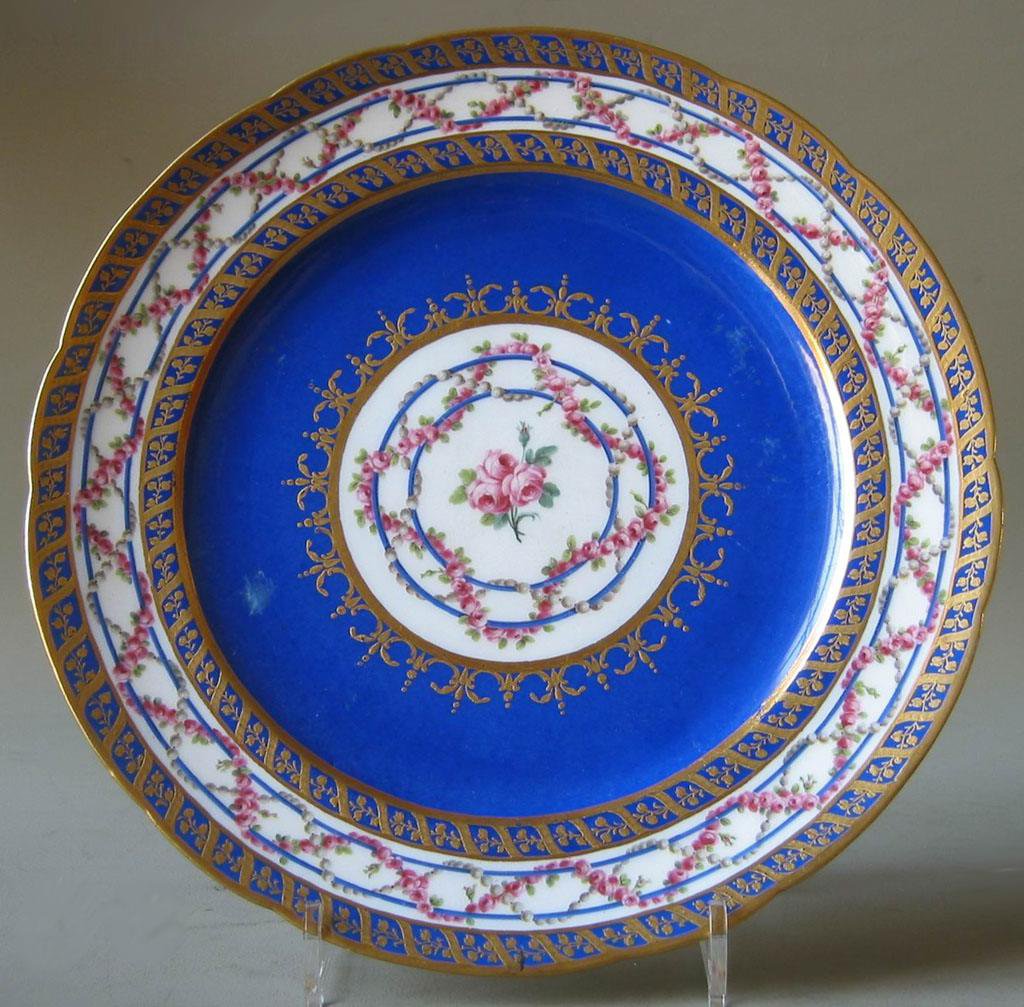
A Sèvres plate of 1788 whose blue rim is worked with gold into a lattice of flower scrolls.
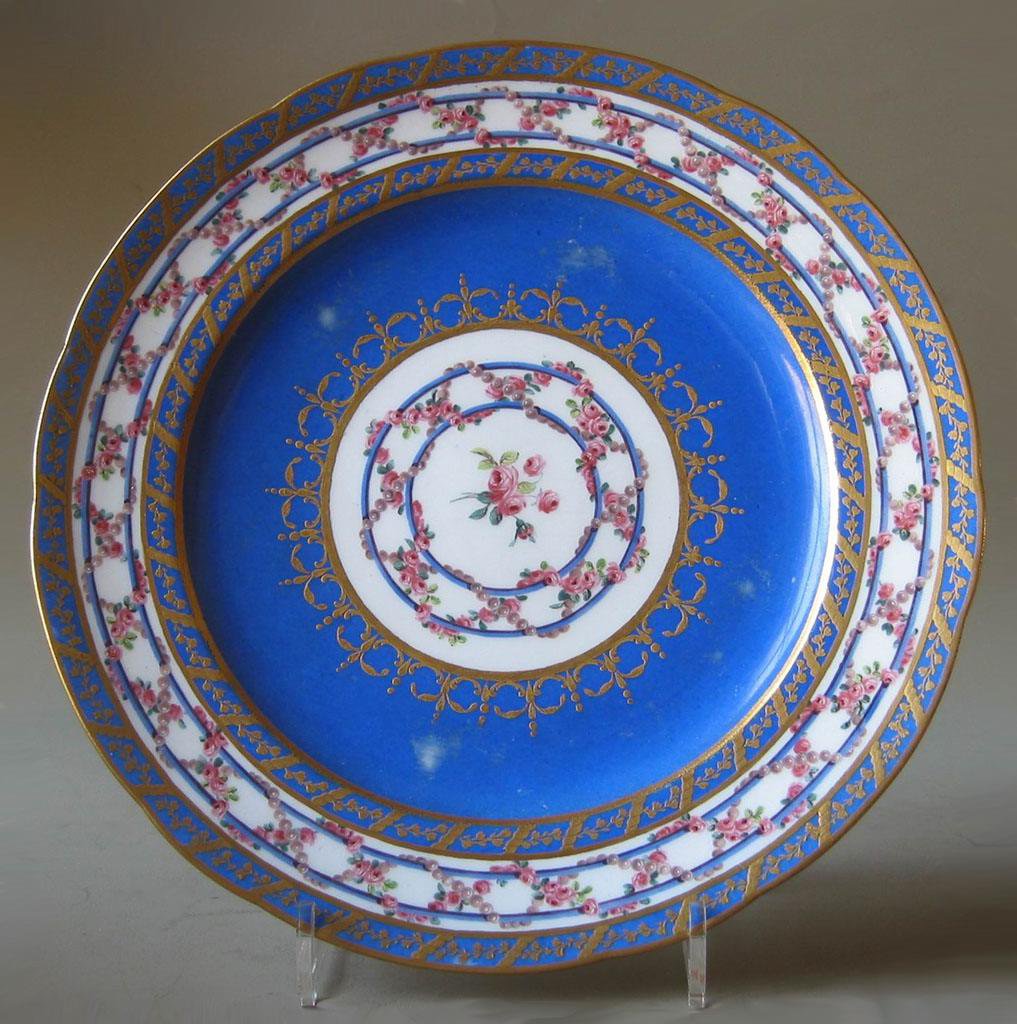
Plate, Blue Service (ZF-16283). The State Hermitage Museum.
The plate entered the Hermitage in 1919 from the collection of A. K. Rudanovsky. It is not currently on permanent display.
It belongs to the Blue Service, and it shares the service’s design: a blue ground, a white band with a garland of roses, a gold circle and a central medallion.
The Object
The plate has a wavy rim, a shallow well and a white centre.
The rim is blue, decorated with gold scrolls and flower sprays arranged in a lattice. Inside it, a white band carries a continuous garland of roses, framed by blue lines. A gold band, a blue well and a gold foliate circle lead to the white medallion with its spray of roses.
The Border
The border is the most elaborate part of the plate.
It is a band of blue, wide enough to be seen from across the table, decorated with gold scrolls that form a lattice and with small sprays of flowers set into the pattern.
The border is not a simple frame. It is a design in its own right, with its own rhythm and its own vocabulary, and it gives the plate much of its character.
The Gold Scrolls
The gold scrolls are painted with a fine brush.
They are not applied as a continuous line but drawn as individual curls and leaves, linked into a lattice. The pattern is regular but not mechanical: each scroll is slightly different, and the hand of the painter is visible in the variations.
Gold of this kind is vulnerable. It wears with handling, and on old plates it often survives only in the protected areas, leaving a ghost of the original pattern.
The Garland
The garland of roses runs around the white band.
It is continuous, with no beginning or end, and it repeats the same motifs: a rose, a bud, a leaf. The repetition creates a rhythmic band that separates the border from the well.
Garlands of this kind were a standard element of Sèvres decoration, and they were painted by specialists who worked quickly and accurately.
The Model
The plate belongs to a model — a shape and a decoration — that was repeated across the service.
The model was designed by the factory and adapted to different sizes: a dinner plate, a dessert plate, a soup plate. The decoration remained the same, adjusted to the dimensions of each piece.
This is how a service works: not by inventing a new design for every piece, but by repeating a model with variations.
The Blue Service
The Blue Service of 1788 was a large commission.
It included plates, cups, trays and bowls, all decorated with the same blue ground, white band and rose garland. The service was used for dinner and dessert, and it would have been one of the most splendid objects in the house.
The surviving pieces are scattered, but the Hermitage group allows a partial reconstruction of the table.
The Table
The plate was made for a table.
It would have been one of many, arranged around a cloth with dishes, glasses and cutlery. The blue border would have created a ring of colour around each place, and the white centre would have framed the food.
That table is gone, but the plate still carries its logic: the design of a service is the design of a social scene.
The Blue Ground
The blue ground gives the plate its depth.
It is applied as a wash over the glaze, fired and polished, and it covers the rim and the well. The colour is intense and slightly uneven, as hand-applied grounds always are.
Blue was one of the most expensive colours in the Sèvres palette, and a service with a full blue ground was a statement of wealth.
Gold on Porcelain
Gold is the most fragile element of the decoration.
It is applied as a powder mixed with a flux, fired at a low temperature and burnished. It wears with handling, and on old plates it often survives only in the protected areas.
On this plate, the gold lattice of the border is still legible, which suggests careful use and good storage.
The Medallion
The centre of the plate is a white medallion with roses.
It is framed by a gold circle of leaves and scrolls, which separates it from the blue well. The roses are painted in pinks and greens, with buds and leaves, and they form a small, centred composition.
The medallion is the focal point of the plate and the place where the painter’s hand is most visible.
The Wavy Edge
The rim of the plate is not a perfect circle.
It has a slight wave, cut or moulded into the porcelain, which softens the outline and gives the plate a more organic, less mechanical character.
The wave is a small detail, but it changes the way the plate sits on the table and the way the light runs around its edge.
A Border in the Hand
A plate is held by its rim.
When the plate is lifted, the thumb rests on the border, and the fingers support the foot. The border is therefore not only seen but touched, and its decoration is worn by the hand as much as by the eye.
This is why the gold on the border is often the first thing to disappear.
The Service’s Borders
The border of this plate is one of several variants used in the service.
Some plates have a plain blue rim with gold garlands; this one has a lattice of gold scrolls and flower sprays. The variation is small but deliberate: it gives the table a subtle rhythm without breaking the unity of the service.
In a large service, such variations prevent monotony. Each plate is recognisably part of the set, but not every plate is identical.
A Question of Scale
The border is designed for the distance at which a plate is seen.
At the table, the plate is viewed from a metre or so, and the border must read at that distance: a band of blue, a lattice of gold, a line of roses. At close range, the details appear, and the plate becomes a small painting.
This double scale is one of the achievements of the design.
Provenance
The plate carries the inventory number ZF-16283 and entered the Hermitage in 1919 from the collection of A. K. Rudanovsky.
In the Hermitage
The plate is preserved in the State Hermitage Museum in Saint Petersburg and is not on permanent display.
It is one of several plates from the same service, and it shows how the border — the least discussed part of a plate — can be the most inventive: a lattice of gold on blue, framing a garden of roses. It is a border, and it is enough to make the plate.