Artist: Unknown sculptor, after Fedot Shubin (1740–1805)
Origin: Russia
Date: last quarter of the 18th century
Material: marble
Dimensions: height 63 cm
Current Collection: The State Hermitage Museum
Inventory Number: ERSk-3
Hermitage ID: 543052
Rudanovsky Connection: Entered the Hermitage in 1920 from the collection of A. K. Rudanovsky.
A Russian marble bust of Catherine II, made in the last quarter of the eighteenth century after an original by Fedot Shubin.
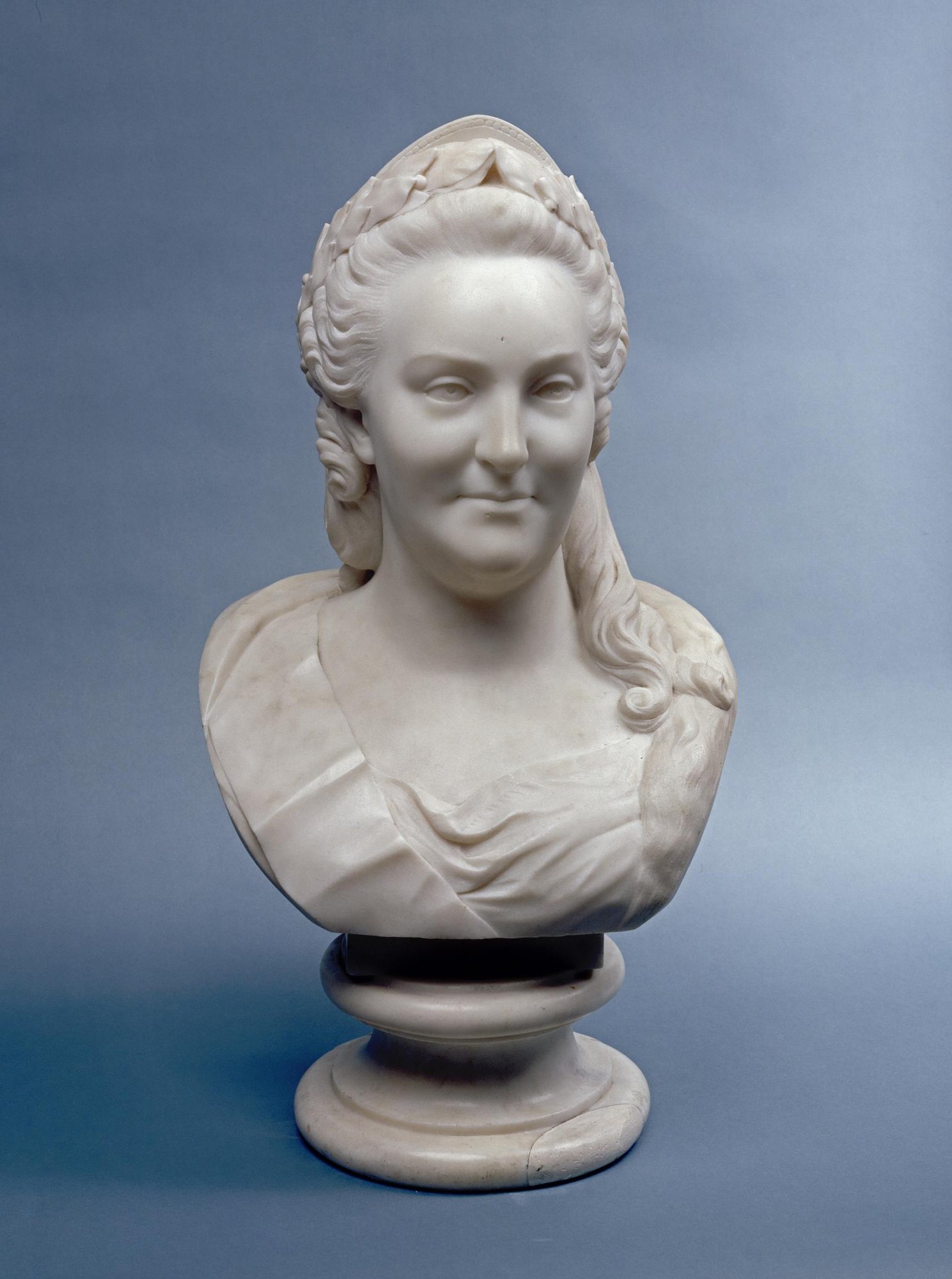
Portrait of Catherine II. The State Hermitage Museum.
The bust entered the Hermitage in 1920, handed over from the State Museum Fund, and it was formerly in the collection of A. K. Rudanovsky. It is not currently on permanent display.
It is a white marble bust — 63 centimetres high — of the empress, her head crowned with a laurel wreath, her shoulders covered with drapery.
The Object
The bust shows Catherine II from the chest up.
Her head is turned slightly, and her face is full, with a high forehead, large eyes, a straight nose and a firm mouth. A laurel wreath is bound around her hair, and her hair falls in long curls over her shoulders.
A mantle crosses her shoulders and falls in soft folds, and the bust stands on a turned marble base with a dark plinth.
Catherine
Catherine II (1729–1796) ruled Russia from 1762 to 1796.
She was one of the most powerful monarchs of her age, and she was also one of the most portrayed. Her image was carefully managed: she appeared as a legislator, a warrior, a patron of the arts and a classical goddess.
This bust presents her as a classical ruler: crowned with laurel, calm and commanding, her gaze direct.
The Wreath
The laurel wreath is the bust’s most classical attribute.
It is a band of leaves, bound around the head, and it recalls the crowns of Roman emperors and victorious generals. In the eighteenth century, the laurel was a symbol of victory, glory and immortality.
The wreath turns the empress into a classical figure, and it connects her to the rulers of antiquity.
The Hair
The hair is long and curly.
It falls over the shoulders in thick locks, and it is carved with attention to the curl and the volume. The hair frames the face and gives the bust its softness.
The hairstyle is classical in spirit, but it is also a contemporary fashion: the long, loose hair of the late eighteenth century, arranged to look natural.
The Drapery
The drapery is simple and classical.
It crosses the shoulders in broad folds, and it is carved with attention to the weight of the cloth. The drapery covers the body and leaves the neck and the head exposed.
The mantle gives the bust its monumentality, and it connects Catherine to the tradition of imperial portraiture.
Shubin
Fedot Shubin (1740–1805) was a Russian sculptor.
He was one of the greatest portrait sculptors of the eighteenth century, and he made busts of the imperial family, the nobility and the clergy. His work is characterised by psychological insight and a delicate handling of marble.
His bust of Catherine II was one of his most famous works, and it was reproduced in several versions.
The Copy
This bust is a version after Shubin.
It was made by an unknown sculptor in the last quarter of the eighteenth century, and it follows Shubin’s model closely: the wreath, the hair, the drapery, the turn of the head.
Copies of imperial portraits were common: they allowed the image of the empress to circulate among the nobility, the institutions and the provinces.
The Base
The bust rests on a turned marble base.
It is a circular socle, with a moulded profile, and it is set on a dark plinth. The base gives the bust its height and its finish, and it turns the sculpture into a complete object.
Socles of this kind were standard in the eighteenth century, and they were often made separately from the bust.
The Eyes
The eyes are carved with pupils.
They are large and clear, and they give the face its directness. Catherine looks at the viewer, and her gaze is calm and somewhat ironic.
The carving of the eyes is one of the finest parts of the bust, and it is what makes the marble seem alive.
The Neck
The neck is long and smooth.
It rises from the drapery to the head, and it is modelled with care: the curve, the muscles, the small hollow at the base. The neck gives the head its poise, and it is a classical feature of imperial portraits.
A long neck was a sign of beauty and dignity in the eighteenth century, and it is one of the elements that give the bust its elegance.
The Imperial Image
The bust is an imperial image.
Catherine’s portraits were made for palaces, institutions and private houses, and they presented her as a wise and powerful ruler. The wreath, the drapery and the calm gaze all serve that purpose.
The image was political as well as personal: it told the viewer who ruled Russia, and it did so in the language of classical antiquity.
Marble
The bust is carved in white marble.
Marble was the material of imperial sculpture, and its whiteness was a sign of purity and permanence. It is hard and translucent, and it takes a high polish.
The marble here is warm white, with a few veins, and its surface is smooth and slightly polished.
The Mouth
The mouth is small and firm.
The lips are closed, and the corners are slightly raised, giving the face a hint of a smile. It is an expression of confidence and composure.
The mouth is one of the last details the sculptor finishes, and here it gives the whole face its character.
The Plinth
The bust stands on a dark plinth.
It is a black base, set under the marble socle, and it raises the bust and gives it a formal, architectural look. The plinth contrasts with the white marble and makes it stand out.
Plinths of this kind were standard in the eighteenth century, and they were often made of marble or wood, painted black.
The Bust’s Age
The bust is more than two hundred years old.
Its surface is slightly worn, and the marble has a few chips and stains. The black plinth is scratched, and the socle is cracked.
These marks are part of the object’s history, and they record its age, its travels and its changes of owner.
Provenance
The bust carries the inventory number ERSk-3. It entered the Hermitage in 1920, handed over from the State Museum Fund, and it was formerly in the collection of A. K. Rudanovsky.
In the Hermitage
The bust is preserved in the State Hermitage Museum in Saint Petersburg and is not on permanent display.
It is a fine example of Russian imperial sculpture, and it preserves the image of Catherine II — a face, a wreath and a mantle, in white marble, and a copy that has outlived most of the originals, and all of the people who commissioned them, and most of the palaces they hung in, and the empire they ruled, and the language of classical virtue in which it was described.