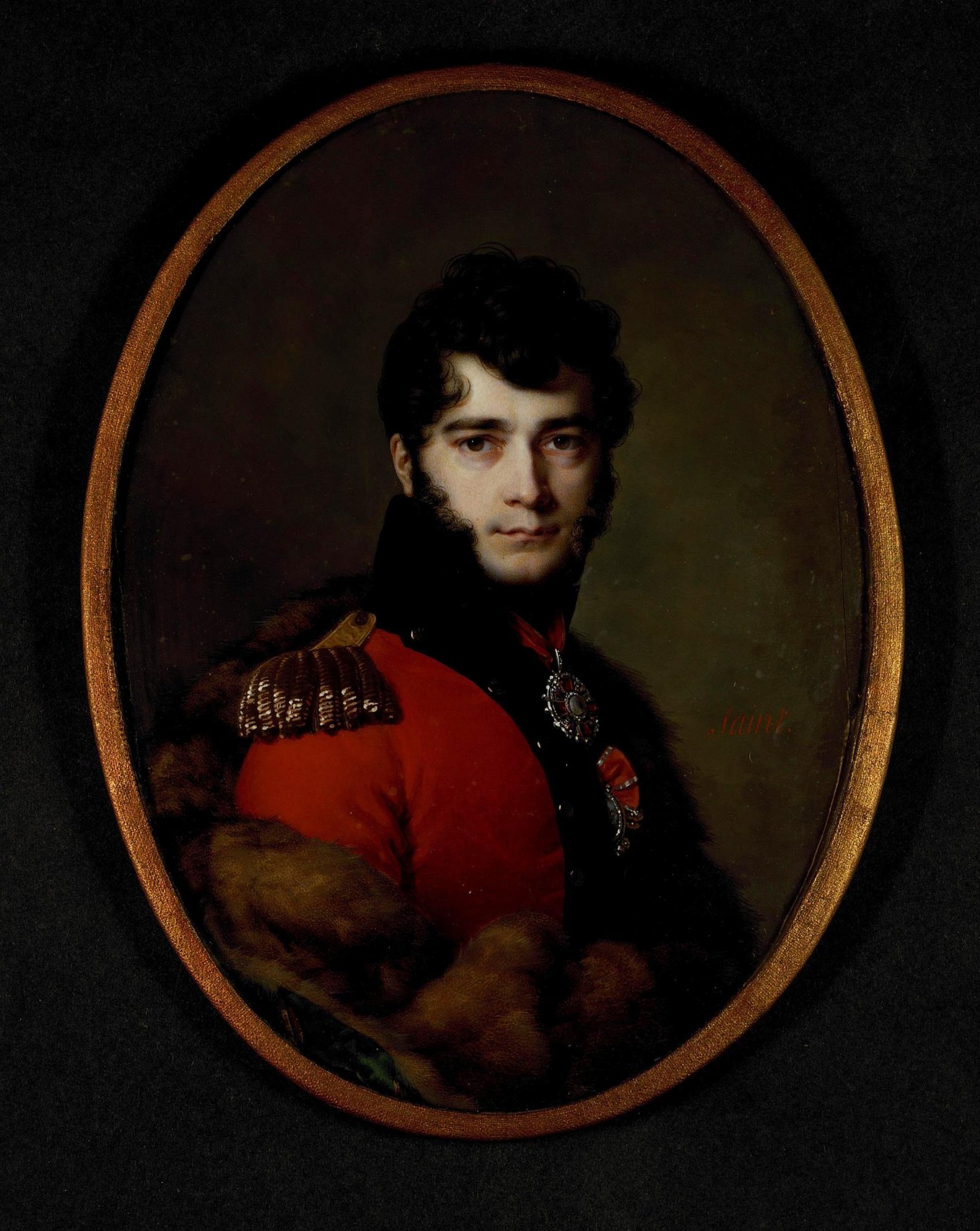
Artist: Jean-Henri Benner (1776–1836)
Origin: France
Date: 1817
Material: bone
Technique: watercolour, gouache
Dimensions: 5 × 3.9 cm (oval)
Current Collection: The State Hermitage Museum
Inventory Number: ORm-2205
Hermitage ID: 202637
Rudanovsky Connection: Entered the Hermitage in 1924 from the collection of A. K. Rudanovsky.
A miniature portrait of Prince Pyotr Mikhailovich Volkonsky, painted on bone by Jean-Henri Benner in 1817.
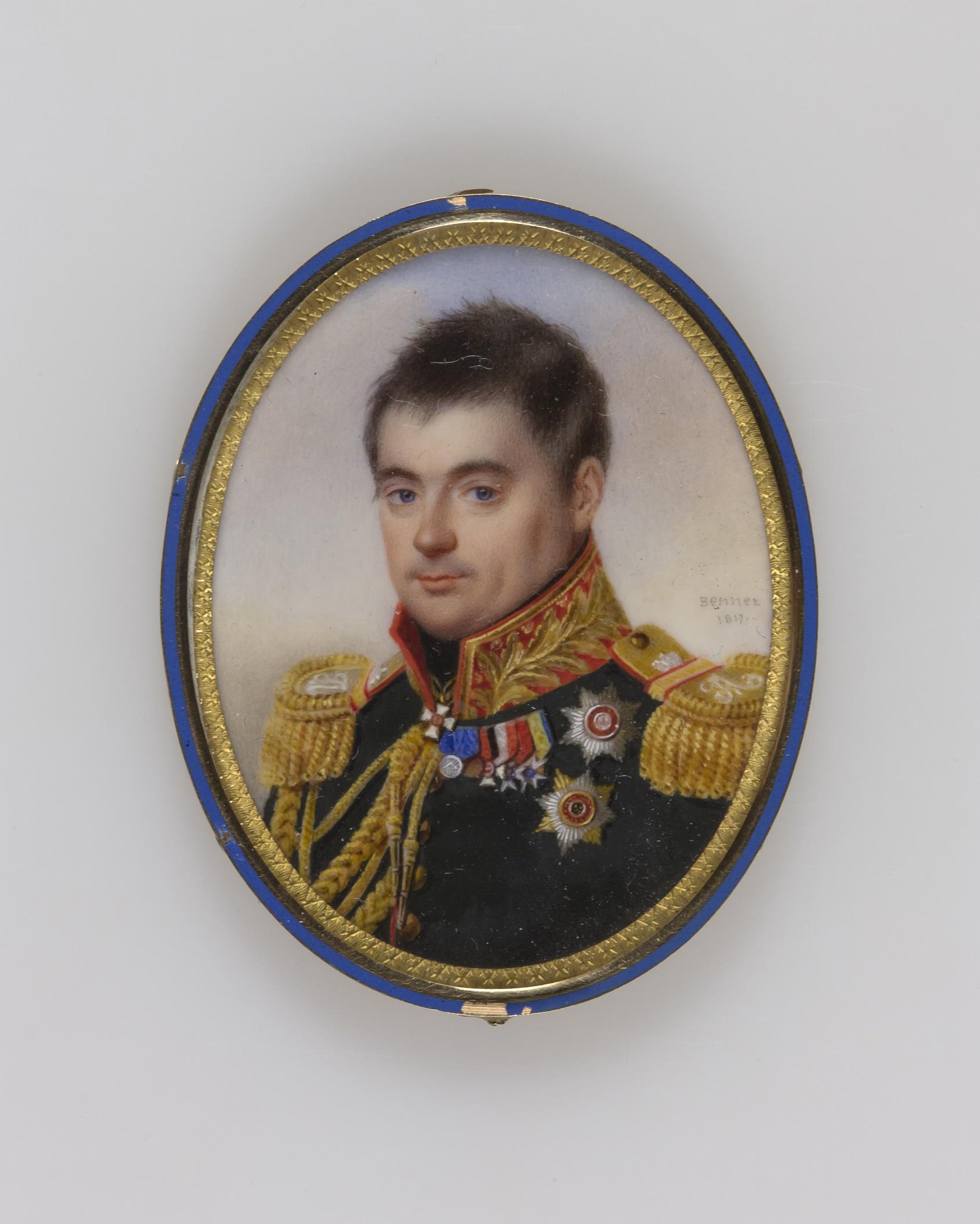
Portrait of Lieutenant General, Prince P.M. Volkonsky. The State Hermitage Museum.
The miniature entered the Hermitage in 1924 from the collection of A. K. Rudanovsky. It is not currently on permanent display.
It is a small oval — five centimetres high — set in a blue and gold frame, showing a man in a dark green uniform with gold epaulettes and a cluster of orders on his chest.
The Object
The portrait is a bust, shown against a pale grey background.
The sitter has dark hair, blue eyes and a serious expression. He wears the uniform of a Russian general: a dark green coat with a high red collar, gold embroidery, epaulettes with fringes, and a row of medals and stars.
The miniature is signed «Benner 1817» at the right, and it is framed in a blue enamel border with a gold beaded edge.
The Sitter
The sitter is Prince Pyotr Mikhailovich Volkonsky (1776–1852).
He was one of the most important Russian generals of the Napoleonic wars: a close associate of Alexander I, chief of the general staff, and later Minister of the Imperial Court. He was a decorated soldier and a powerful courtier.
The portrait shows him at forty-one, at the height of his career, in the uniform of his rank.
The Uniform
The uniform is painted in detail.
The dark green coat, the red collar with gold embroidery, the gold epaulettes with fringes, the white breeches and the black stock — all are described with care. The uniform identifies the sitter as a general and a courtier.
In Russian portraiture of the period, uniform was a statement of service and status, and it was painted with as much attention as the face.
The Orders
The orders on the sitter’s chest are a record of his career.
There are stars, crosses and medals: the Order of St George, the Order of St Alexander Nevsky, the Order of the White Eagle and others. Each was awarded for a battle, a campaign or a service.
The orders turn the portrait into a biography: they list, in miniature, the achievements of a lifetime.
Benner
Jean-Henri Benner (1776–1836) was a French miniaturist.
He worked in Paris and later in Russia, where he painted portraits of the imperial family, the nobility and the military. His miniatures are known for their fine detail, their delicate colour and their precise likeness.
Benner painted many Russian officers during the years after 1812, when Paris and St Petersburg were closely connected and French artists found patrons in Russia.
Bone
The miniature is painted on bone.
Bone was a common support for miniatures in the early nineteenth century: it is smooth, slightly translucent and takes watercolour well. It was cheaper than ivory and easier to prepare.
The warm tone of the bone shows through the paint, giving the flesh a soft, luminous quality.
The Oval
The oval format is standard for miniatures.
It concentrates attention on the face, excludes the background and gives the portrait an intimate, jewel-like quality. Oval miniatures were worn as brooches, pendants or rings, or kept in a cabinet.
This one is set in a blue and gold frame, which may be original or a later addition.
The Frame
The frame is part of the object.
It is blue enamel with a gold beaded edge, and it protects the miniature and gives it a decorative finish. Frames of this kind were common in the early nineteenth century, and they were often made by specialist enamellers.
The blue of the frame contrasts with the green and gold of the uniform, and it sets the portrait off.
The Manner
Benner’s manner is precise and smooth.
The face is painted with fine, almost invisible brushstrokes: the skin is modelled in soft layers, the eyes are drawn with a dark line, the hair is described in individual locks. The result is a likeness that is both detailed and delicate.
This precision is characteristic of French miniature painting of the Empire, and it was much admired in Russia.
The Blue Frame
The miniature is set in a blue enamel frame with a gold beaded edge.
The frame is part of the object: it protects the painting, gives it a decorative finish and provides a colour contrast with the uniform. Blue and gold were a fashionable combination in the early nineteenth century.
Frames of this kind were often made by specialist enamellers, and they are as much a part of the object as the portrait itself.
Miniatures in Russia
Miniature portraits were immensely popular in Russia.
They were worn as jewellery, kept in cabinets and exchanged as gifts. Russian nobles commissioned them from French, German and Russian artists, and the Hermitage collection preserves hundreds of examples.
This miniature belongs to that culture: a small, precious object, made to be held and looked at closely.
The Portrait as Record
The portrait is also a record.
It documents the sitter’s face, his uniform, his orders and his rank. For a historian, it is evidence of military dress and decoration in 1817; for a family, it was a memory.
Portraits like this sit between art and document, and their value lies in both.
The Hair
The sitter’s hair is painted with care.
It is dark brown, cut short and brushed forward, with a slight wave at the front. Individual locks are described with fine strokes, and the light catches the top of the head.
Hair is a test of a miniaturist’s skill: it is fine, detailed and close to the face, and it must be painted without heaviness.
The Face
The face is the centre of the portrait.
It is painted with a soft, careful touch: the eyes are blue, the nose straight, the mouth closed, the expression serious. The skin is modelled in thin layers, with a faint blush on the cheeks.
The likeness is precise, and it gives the sitter a quiet, dignified presence.
Provenance
The miniature carries the inventory number ORm-2205 and entered the Hermitage in 1924 from the collection of A. K. Rudanovsky.
In the Hermitage
The miniature is preserved in the State Hermitage Museum in Saint Petersburg and is not on permanent display.
It is a small, precise portrait, and it preserves the image of a Russian general at the height of his career — a face, a uniform and a list of honours, painted on a piece of bone.
For a man who had spent his life in service, that was perhaps the point: to be remembered not only as a face, but as a rank.
He got his wish: the face is still here, and so is the rank, in a frame smaller than a playing card — and smaller, in its way, than the memory of the man himself, which has grown larger with time.
In a cabinet of miniatures, he is one face among many; in a history of 1812, he is a name that matters.