Artist: Daniel Saint (1778–1847)
Origin: France
Date: 1810–1815
Material: bone
Technique: watercolour painting, gouache
Dimensions: 20.8 × 15.9 cm
Current Collection: The State Hermitage Museum
Inventory Number: ORm-2222
Hermitage ID: 199163
Rudanovsky Connection: Entered the Hermitage in 1924 from the collection of A. K. Rudanovsky.
A large miniature portrait of Prince B. A. Kurakin, painted on bone by Daniel Saint between 1810 and 1815.
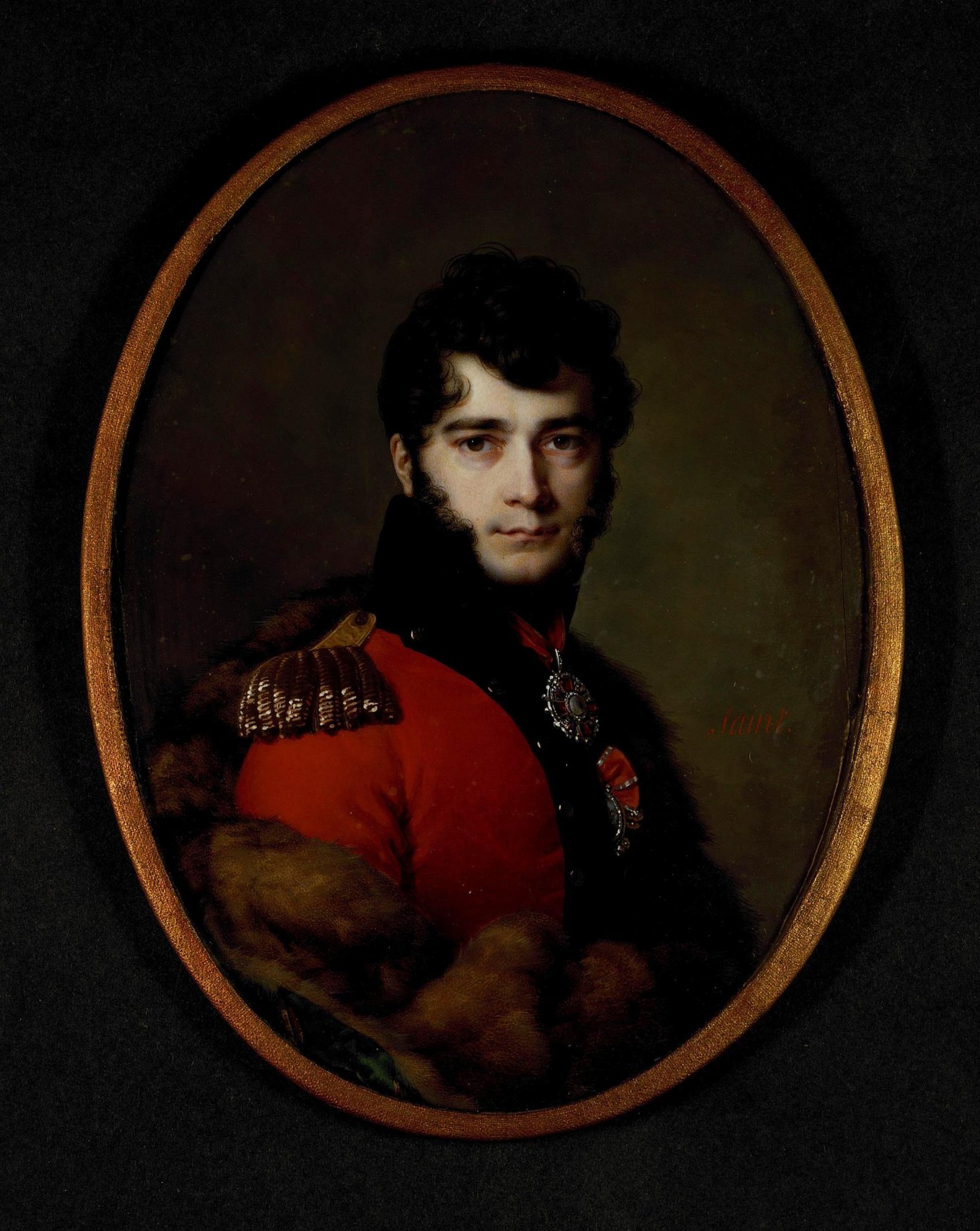
Portrait of Prince B.A.Kurakin. The State Hermitage Museum.
The miniature entered the Hermitage in 1924 from the collection of A. K. Rudanovsky. It is not currently on permanent display.
It is unusually large for a miniature — 20.8 by 15.9 centimetres — and it shows a young man in a red uniform and a fur cloak, framed in an oval.
The Object
The portrait is an oval bust, painted on bone.
The sitter has dark, curly hair and long sideburns, a pale complexion and dark eyes. He wears a red uniform with a black collar and gold epaulettes, a fur cloak over one shoulder, and a star and cross of an order on his chest.
The background is a dark, warm brown, and the miniature is signed «Saint» at the right.
The Sitter
The sitter is identified as Prince B. A. Kurakin.
The Kurakins were one of the great families of the Russian Empire: diplomats, statesmen and courtiers, connected by marriage to the Romanovs and to the highest nobility. A portrait of a young Kurakin in uniform is a portrait of that world.
The identification is traditional, and the sitter’s youth suggests a date around 1810–1815, when the family was prominent in the diplomatic service.
The Kurakins
The Kurakin family played a major role in Russian history.
Prince Alexander Borisovich Kurakin was a chancellor and a diplomat, and his relatives served as ambassadors, senators and generals. The family’s palaces in Moscow and St Petersburg were among the grandest in Russia.
A portrait of a young Kurakin belongs to that dynastic world: it records a name, a face and a place in the imperial elite.
The Uniform
The uniform is the portrait’s colour.
It is a red coat with a black collar, gold epaulettes and a silver star and cross — the insignia of an order. The red is strong and warm, and it dominates the composition.
In Russian portraiture of the period, uniform was a statement of service, and the orders were a record of achievement. The colours are painted with care, and the gold of the epaulettes catches the light.
The Fur
The fur cloak over the sitter’s shoulder is a luxury.
It is painted in brown and grey, with soft, thick strokes that suggest the texture of the pelt. Fur was a symbol of wealth and rank in Russia, and it was often used in portraits to add warmth and richness.
The cloak also frames the face and the uniform, and it gives the portrait a romantic, slightly dramatic character.
Daniel Saint
Daniel Saint (1778–1847) was a French miniaturist.
He was a pupil of Jean-Baptiste Isabey, the most celebrated miniaturist of the age, and he worked in Paris during the Empire and the Restoration. He painted portraits of the imperial family, the nobility and foreign officers.
Saint’s miniatures are known for their smooth finish, their delicate modelling and their psychological presence. This portrait is a good example: the face is painted with great care, and the expression is calm and slightly melancholy.
Bone
The miniature is painted on bone.
Bone was a common support in the early nineteenth century: it is smooth, slightly translucent and takes watercolour well. For a large miniature like this one, the bone had to be prepared with care, and the painting had to be built up in thin layers.
The warm tone of the bone shows through the paint, giving the flesh a soft, luminous quality.
The Size
At 20.8 by 15.9 centimetres, the miniature is large.
Most miniatures are the size of a watch dial; this one is almost a small painting. The size allows a more detailed likeness and a more ambitious composition, and it places the object between the miniature and the easel portrait.
Large miniatures were often framed and hung on a wall, rather than worn, and they were collected as works of art.
The Black Background
The background is dark and almost empty.
It is a warm brown-black, painted in loose strokes, and it isolates the figure and the red uniform. The darkness gives the portrait depth, and it makes the face and the gold insignia stand out.
This is a standard device of miniature painting: the dark ground concentrates attention on the sitter and creates an intimate, enclosed space.
The Oval Frame
The miniature is framed in a simple oval.
The frame is narrow and gilded, and it follows the shape of the painting. It is modest compared with the jewelled frames of smaller miniatures, and it suggests that the object was meant to hang or stand rather than to be worn.
The oval is the classic format of the miniature: it frames the head and shoulders and gives the portrait a jewel-like completeness.
The Collector’s Miniatures
The Rudanovsky collection included several miniatures.
They came from the same world of Russian collectors who bought porcelain, paintings and drawings, and they were kept in cabinets and albums. Miniatures were collected for their intimacy as much as for their art.
This portrait, with its large format and its grand sitter, is one of the most ambitious pieces in the group.
Painting on Bone
Painting on bone requires a particular technique.
The surface is smooth but slightly absorbent, and the painter must build the colours in thin layers, allowing the warmth of the bone to show through. Highlights are added last, in opaque white.
The result is a portrait with a soft, luminous quality, in which the flesh seems to glow from within.
The Sideburns
The sitter’s sideburns are a fashion statement.
They are long, dark and carefully shaped, running from the temples to the jaw, and they frame the face like a pair of dark brackets. In the 1810s, sideburns of this kind were fashionable among young officers and dandies.
The painter has given them the same attention as the uniform: they are described in individual strokes, and they catch the light.
Provenance
The miniature carries the inventory number ORm-2222 and entered the Hermitage in 1924 from the collection of A. K. Rudanovsky.
In the Hermitage
The miniature is preserved in the State Hermitage Museum in Saint Petersburg and is not on permanent display.
It is a fine example of Daniel Saint’s work, and it preserves the image of a young Russian aristocrat in the last years of the Napoleonic wars — a face, a uniform, a fur cloak and a name.
The name is the point: without it, the portrait would be a handsome face; with it, it is a piece of Russian history — a Kurakin, in a red uniform, looking out of a dark oval into the twenty-first century, and still, somehow, very much alive.
He has outlived the empire he served, the uniform he wore and the diplomacy he practised; only the face remains, and it is enough.
That is what a portrait does: it keeps the face and lets the rest go.