Artist: Giovanni Domenico Bossi (1765–1853)
Origin: Italy
Date: circa 1807
Material: bone, bronze (frame)
Technique: watercolour, gouache
Dimensions: 8.1 × 6.7 cm (oval); 11.9 × 10.2 cm (frame)
Current Collection: The State Hermitage Museum
Inventory Number: ORm-2203
Hermitage ID: 202635
Rudanovsky Connection: Entered the Hermitage in 1924 from the collection of A. K. Rudanovsky.
A miniature portrait of Natalia Ivanovna Goncharova, née Zagryazhskaya, painted in Italy by Giovanni Domenico Bossi around 1807.
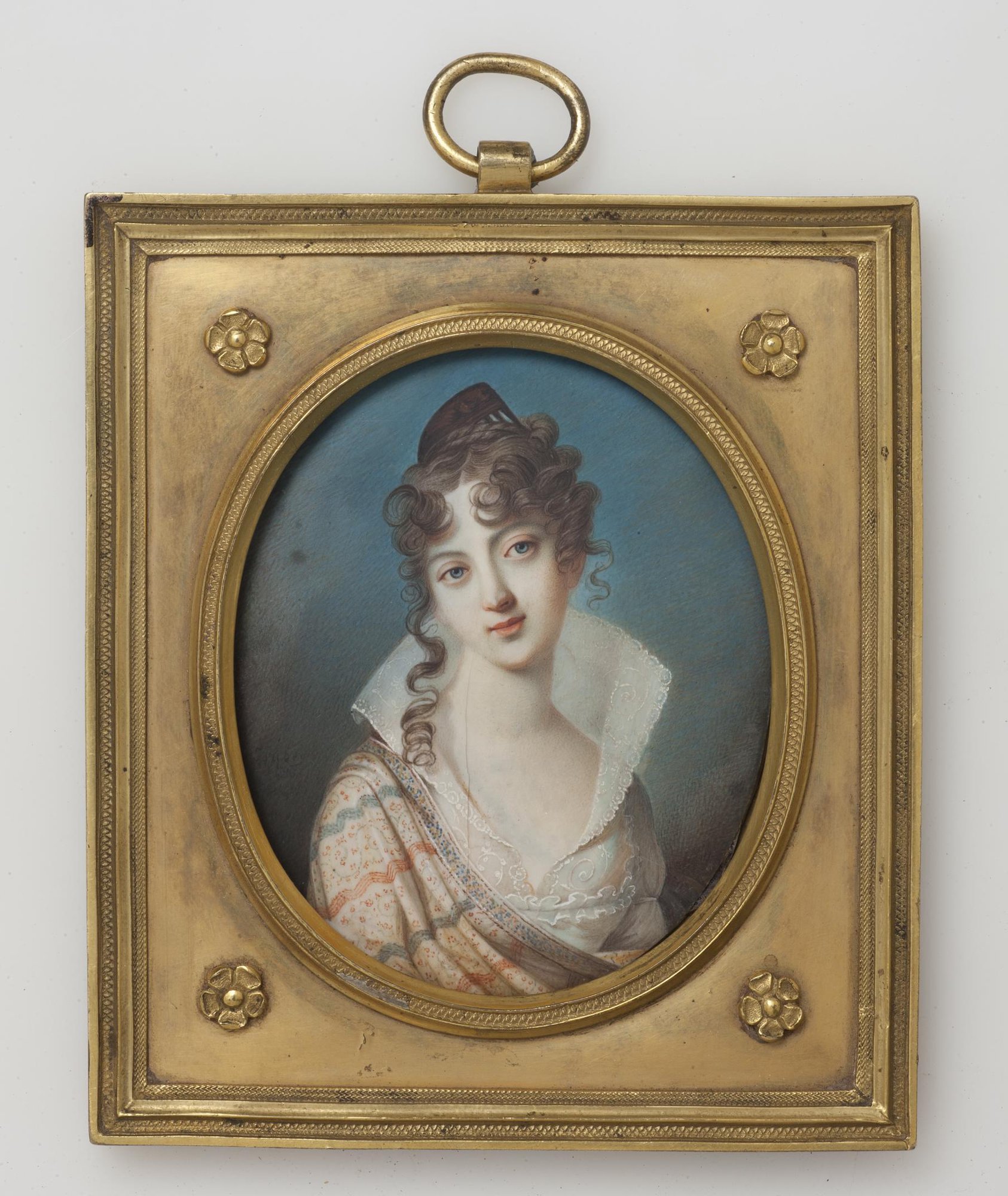
Portrait of Natalia Ivanovna Goncharova, née Zagryazhskaya. The State Hermitage Museum.
The miniature entered the Hermitage in 1924 from the collection of A. K. Rudanovsky. It is not currently on permanent display.
It is an oval portrait, set in a rectangular bronze frame, showing a young woman in a white dress with a lace collar, against a blue-grey background.
The Object
The sitter is shown half-length, her body turned slightly, her head inclined.
She has dark curly hair, dressed in a knot with ringlets falling at the sides, and blue eyes. She wears a white dress with a high lace collar, a patterned shawl over one shoulder, and a dark ribbon or band in her hair.
The background is a soft blue-grey, and the miniature is framed in a gilt bronze rectangle with rosettes at the corners and a suspension ring at the top.
The Sitter
The sitter is Natalia Ivanovna Goncharova, née Zagryazhskaya (1785–1848).
She was a Russian noblewoman, married to Nikolai Afanasyevich Goncharov, and she is best known as the mother of Natalia Nikolaevna Goncharova, who married Alexander Pushkin in 1831.
The portrait shows her at about twenty-two, before her daughter’s birth, in the years when her family was establishing itself in Moscow society.
The Goncharovs
The Goncharov family was wealthy and connected.
They owned estates and a famous paper mill, and they moved between Moscow, St Petersburg and Europe. Natalia Ivanovna’s marriage and her daughter’s marriage to Pushkin made the family part of the literary history of Russia.
A portrait of the mother is therefore also a document of the family that produced one of the most famous women in Russian literature.
The Dress
The dress is in the fashion of the early nineteenth century.
It is white, with a high lace collar — the «Medici» collar that was popular around 1800–1810 — and a patterned shawl draped over the shoulder. The waist is high, and the fabric is light.
The lace collar frames the face and gives the sitter a formal, slightly old-fashioned elegance.
The Hair
The hair is the portrait’s most elaborate detail.
It is dark, curled and dressed in a knot, with ringlets falling at the sides of the face. A dark band or ribbon is woven into the hair, and a single long curl falls over the shoulder.
The hairstyle is characteristic of the period, and it frames the face with a soft, romantic halo.
Bossi
Giovanni Domenico Bossi (1765–1853) was an Italian miniaturist.
He worked in Milan, Vienna and St Petersburg, and he painted portraits of the European nobility. His miniatures are known for their delicate modelling, their soft colours and their psychological insight.
Bossi’s Russian period coincided with the years when many Russian aristocrats travelled to Italy and commissioned portraits from Italian artists.
Bone and Frame
The miniature is painted on bone and set in a bronze frame.
Bone gives the painting a warm, luminous ground, and the watercolour and gouache are applied in thin layers. The frame is rectangular, with an oval opening, and it is decorated with rosettes at the corners.
Frames of this kind were common in the early nineteenth century, and they turned a miniature into a small picture for a wall or a cabinet.
The Blue Background
The background is a soft, slightly grey blue.
It is painted in loose washes, and it isolates the figure and gives the face a cool, luminous setting. The blue contrasts with the white dress and the dark hair, and it makes the sitter appear both delicate and present.
The background is not a room or a landscape: it is a colour, chosen to set off the portrait.
The Shawl
The patterned shawl over the sitter’s shoulder is a glimpse of fashion.
It is painted in pale colours, with a small repeating pattern and a fringed edge, and it is draped diagonally across the body. Shawls were fashionable in the early nineteenth century, imported from India and Kashmir and imitated in Europe.
The shawl adds a note of colour and texture to the white dress, and it suggests the sitter’s wealth and taste.
The Collar
The high lace collar frames the face.
It is painted with fine white lines, suggesting the mesh and the pattern of the lace, and it stands up around the neck like a small fan. The collar was a fashionable accessory around 1800–1810, and it gave the wearer a formal, slightly archaic elegance.
The lace also marks the sitter’s status: it was an expensive material, and it was worn by women of means.
Miniatures in Russia
Miniatures were immensely popular in Russia.
They were worn as jewellery, kept in cabinets and exchanged as gifts, and they were commissioned from Italian, French and Russian artists. The Hermitage collection preserves hundreds of examples, from tiny pendants to large framed portraits.
This miniature belongs to that culture: a small, precious object, made to be held and looked at closely.
The Frame
The frame is part of the object.
It is a rectangular gilt-bronze frame with an oval opening, decorated with rosettes at the corners and a suspension ring at the top. The frame protects the miniature and turns it into a small picture for a wall or a cabinet.
Frames of this kind were often made by specialist bronziers, and they are as much a part of the object as the portrait itself.
The Family Record
The portrait is also a family record.
It preserves the face of a woman who is known mainly through her daughter, and it gives her a presence of her own. Natalia Ivanovna was a person before she was a mother-in-law, and the miniature shows her as a young woman with a future.
That is one of the values of family portraits: they restore the individual behind the name.
The Background
The background is a soft blue-grey.
It is painted in loose washes, without detail, and it isolates the figure and gives the face a cool, luminous setting. The colour is close to the blue of the sky, but it is muted, almost grey, so that the white dress and the dark hair stand out.
A background of this kind is a convention of miniature painting: it removes the sitter from any particular place and turns the portrait into an image of presence.
Provenance
The miniature carries the inventory number ORm-2203 and entered the Hermitage in 1924 from the collection of A. K. Rudanovsky.
In the Hermitage
The miniature is preserved in the State Hermitage Museum in Saint Petersburg and is not on permanent display.
It is a fine example of Bossi’s work, and it preserves the image of a Russian noblewoman at the beginning of the nineteenth century — a face, a dress and a family history.
She looks out of the frame with a calm, steady gaze, and she has outlasted everyone who knew her.