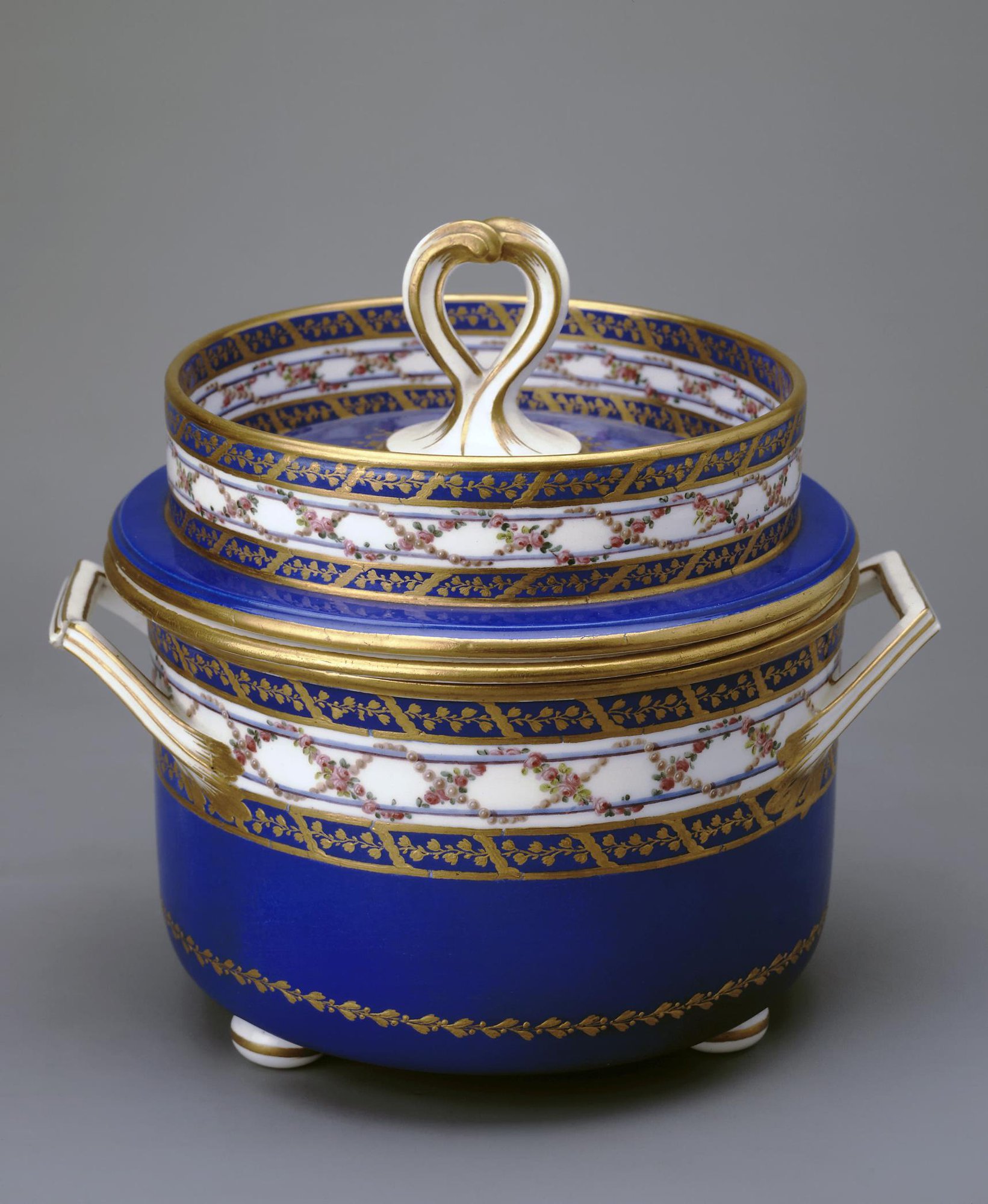
Artist: Jean-Baptiste Tandart l’aîné (painter)
Organization: Sèvres Porcelain Manufactory
Origin: France
Date: 1788
Complex: Blue Service
Material: soft-paste porcelain
Dimensions: height 12.5 cm; diameter 20.5 cm
Current Collection: The State Hermitage Museum
Inventory Number: ZF-16263
Hermitage ID: 352363
Rudanovsky Connection: Entered the Hermitage in 1919 from the collection of A. K. Rudanovsky.
A Sèvres monteith of 1788, its rim cut into a scalloped crown and its blue body encircled by a garland of roses.
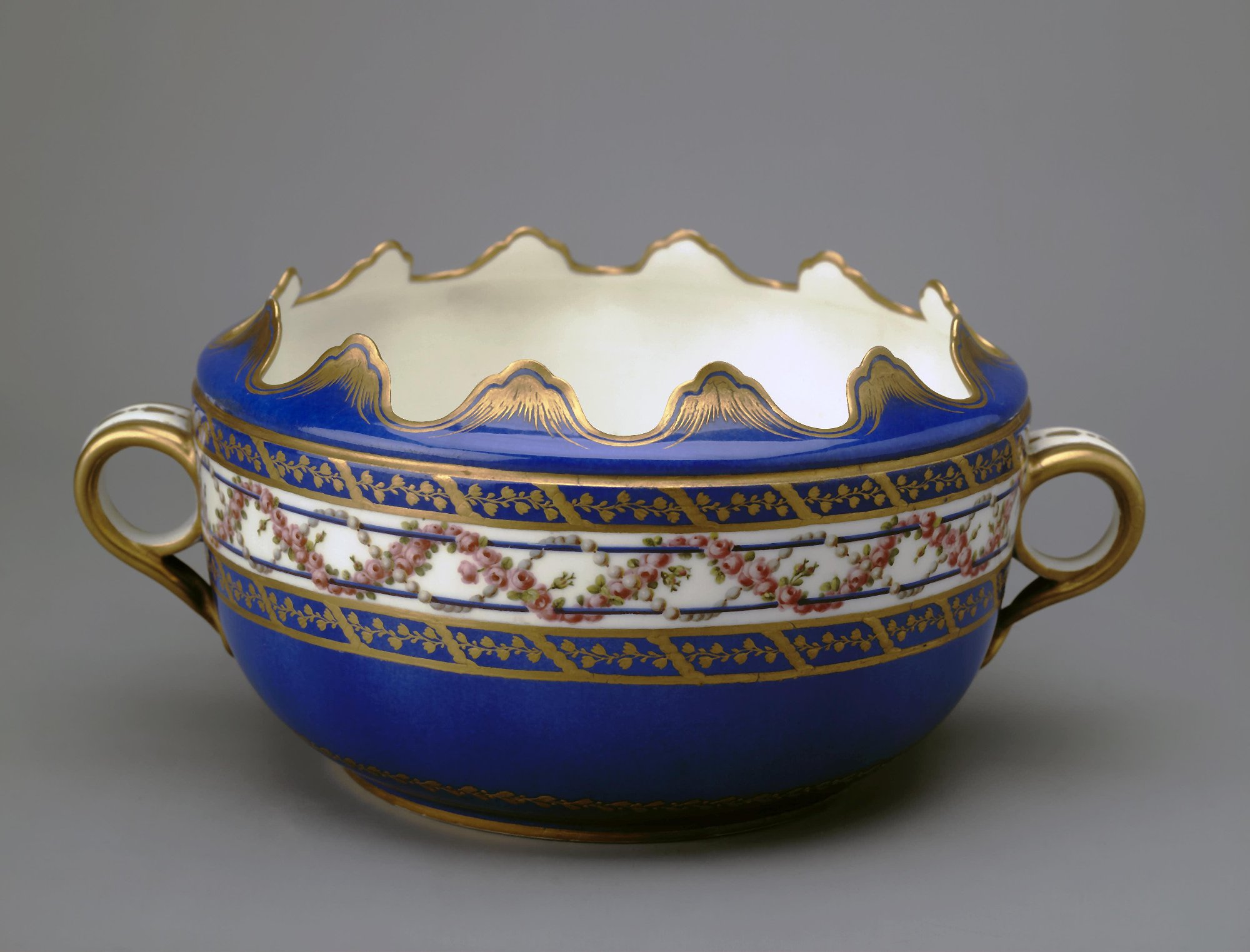
Round Monteith. The State Hermitage Museum.
The bowl entered the Hermitage in 1919 from the collection of A. K. Rudanovsky. It is not currently on permanent display.
It is a wide, deep bowl with two handles and a rim cut into a series of pointed waves — the shape that gives the monteith its name and its function.
The Object
The bowl is round, with a broad body and two loop handles.
The lower part is covered in a deep cobalt blue, with a gold band and a garland of small gold leaves near the base. Above, a white band carries a continuous garland of pink roses and green leaves, framed by blue and gold lines.
The rim is cut into a series of pointed scallops, each edged with gold, like the crest of a wave.
The Monteith
A monteith is a bowl for cooling wine glasses.
The scalloped rim allowed the stems of glasses to hang between the notches, with the bowls resting in the water below. The glasses were cooled, and the monteith was also used as a punch bowl.
The form was popular in the eighteenth century, in silver, porcelain and faience, and it was one of the most distinctive shapes of the dining table.
The Scalloped Rim
The rim is the monteith’s defining feature.
It is cut into a series of deep, pointed waves, each with a gold edge. The notches are designed to hold the stems of glasses, and the points are decorative as well as functional.
The scalloped rim gives the bowl a crown-like silhouette, and it catches the light in a series of small highlights.
The Blue Service
The monteith belongs to the Blue Service of 1788.
The service included cups, plates, trays and bowls, all decorated with the same blue ground, white band and rose garland. The monteith is one of its largest and most sculptural pieces.
The service was a luxury commission, and it would have been used for dessert, wine and coffee.
Tandart
The monteith is attributed to Jean-Baptiste Tandart l’aîné, a painter at Sèvres.
Tandart was a flower painter, and the garland of roses on the bowl is typical of his work. His mark on the underside identified the piece to the factory.
The attribution connects the object to a named painter, and it allows the decoration to be placed within the production of the service.
The Handles
The bowl has two loop handles.
They are painted with gold and blue, and they curve out from the body in a simple, functional shape. The handles allowed the heavy bowl to be lifted and carried.
They also give the object a symmetrical silhouette, balancing the scalloped rim and the round body.
The Garland
The garland of roses runs around the white band.
It is continuous, with roses, buds and leaves, and it is framed by blue lines and gold bands. The flowers are painted in soft pinks and greens, and they contrast with the deep blue of the ground.
The garland softens the geometry of the bowl and gives it a note of informality.
The Drinking
A monteith belongs to the ritual of drinking.
In the eighteenth century, wine was served from bottles, and glasses were cooled in a bowl of water and ice. The monteith held the water, and its notched rim held the glasses by their stems.
The bowl was also used for punch, and it stood at the centre of the table, surrounded by glasses and bottles.
The Gold
The gold on the monteith is applied in bands and leaves.
It frames the blue ground, outlines the scallops and forms a garland of small leaves near the base. The gold is fired and burnished, and it shines against the blue and white.
Gold is the most fragile part of the decoration, and on this bowl it is worn along the rim, where the object was handled.
The Shape
The shape of the monteith is generous and open.
It is wide enough to hold several glasses, deep enough to hold water, and its rim is cut into notches that hold the stems. The two handles make it possible to lift when full.
The shape is both practical and sculptural: a bowl crowned with waves, which reads as a piece of architecture as much as a vessel.
The Table
The monteith was made for a table.
It stood at the centre of the dessert or wine service, surrounded by glasses, bottles and dishes. Its blue and gold would have caught the candlelight, and its scalloped rim would have glittered.
That table is gone, but the bowl still carries its logic: a vessel designed for a social ritual, and decorated for the occasion.
The Collector
The monteith came to the Hermitage with the Rudanovsky collection.
Rudanovsky collected Sèvres porcelain alongside paintings, drawings, glass and miniatures, and the Blue Service is one of the most important groups in his collection.
The bowl is therefore a double document: of the Sèvres factory in 1788 and of a nineteenth-century Russian collector’s taste.
The Scallops
The scallops of the rim are cut with precision.
Each point is a small triangle of porcelain, edged with gold, and the notches between them are deep enough to hold a glass stem. The pattern is regular but not mechanical: the points vary slightly, as hand-cut forms always do.
The scallops give the bowl its crown, and they are the first thing the eye notices.
The Blue Ground
The blue ground is the bowl’s dominant colour.
It is applied as a wash over the glaze, fired and polished, and it covers the lower part of the body. The colour is deep and even, with a slight variation that comes from hand application.
Blue was the most expensive colour in the Sèvres palette, and its use here signals the quality of the service.
The Foot
The bowl stands on a small, gilded foot.
The foot raises the body from the table, gives it stability and provides a base for the gold band that frames the bottom. It is painted with gold and blue, and it is partly hidden by the curve of the body.
A small foot under a wide bowl is a classical proportion: it makes the object look lighter and more elegant than it really is, in fact.
Provenance
The monteith carries the inventory number ZF-16263 and entered the Hermitage in 1919 from the collection of A. K. Rudanovsky.
In the Hermitage
The monteith is preserved in the State Hermitage Museum in Saint Petersburg and is not on permanent display.
It is a rare and beautiful object, and it shows how a functional vessel — a bowl for cooling glasses — could be turned into a piece of sculpture, with a crown of scallops and a garland of roses.