Organization: Imperial Porcelain Manufactory, Vienna
Origin: Austria
Date: 1750–1755
Material: porcelain
Technique: painting
Dimensions: height 5.9 cm; diameter 6.2 cm
Current Collection: The State Hermitage Museum
Inventory Number: ZF-22699
Hermitage ID: 467327
Rudanovsky Connection: Entered the Hermitage in 1919 from the collection of A. K. Rudanovsky.
A small Viennese porcelain cream pot of 1750–1755, painted with a rose and other flowers.
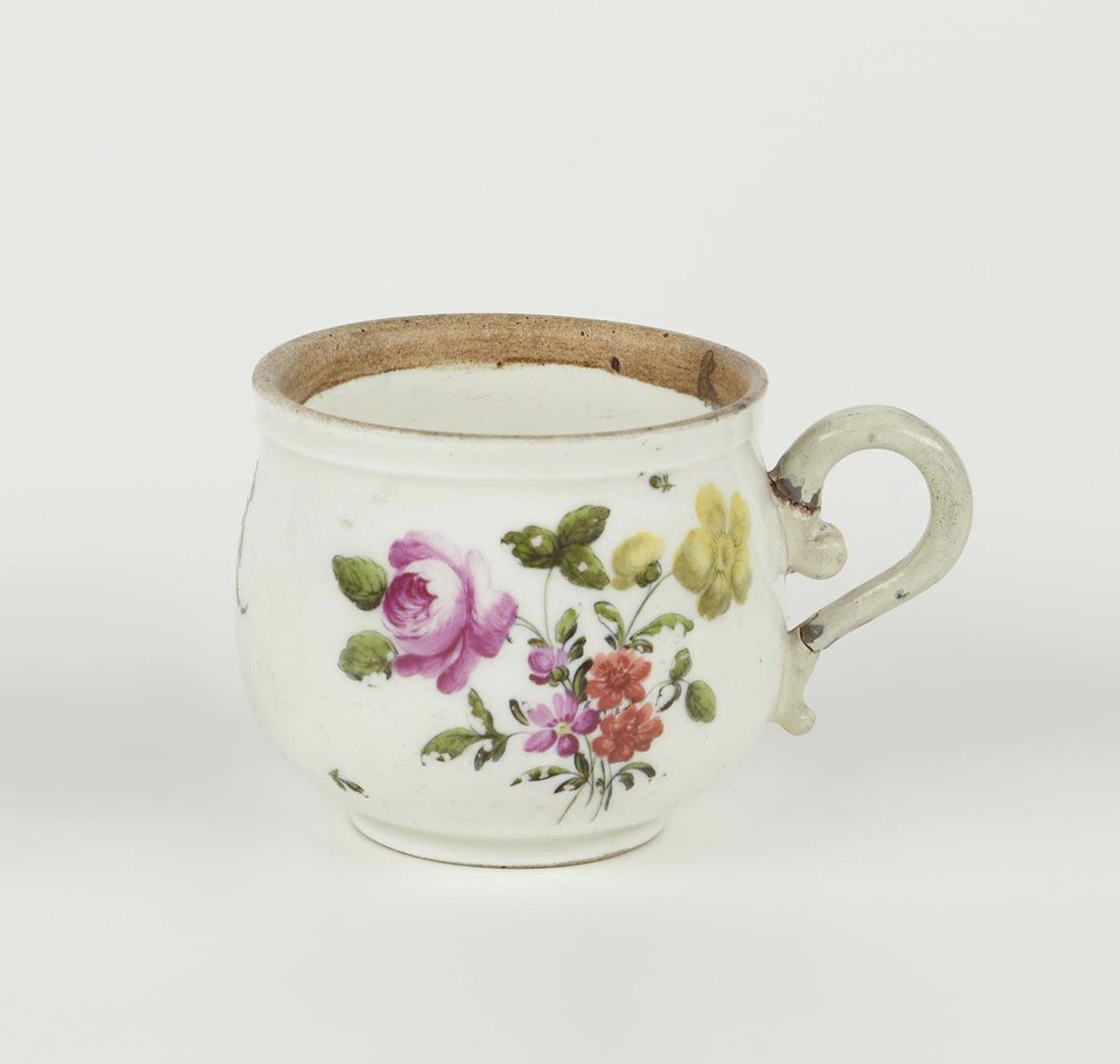
Pot-à-Crème. The State Hermitage Museum.
The pot entered the Hermitage in 1919, transferred through the Department for the Protection of Monuments of Art and Antiquities from the collection of A. K. Rudanovsky. It is not currently on permanent display.
It is a small vessel — 5.9 centimetres high — with a rounded body, a loop handle and a single large rose on the front.
The Object
The pot is round and slightly squat, with a flat base and a low rim.
Its handle is a simple loop, painted with a few strokes, and the rim is banded with a worn gold line. On the body, a large pink rose is flanked by smaller flowers and leaves.
The inside is white, and the surface is slightly uneven.
Cream
The pot is a pot à crème — a jug for cream.
Cream was served with coffee and tea, and the pot was part of the table service: it stood beside the coffee pot, the sugar bowl and the cups.
Cream pots were small, because cream was a luxury, and they were decorated to match the rest of the service.
The Pot
The pot’s shape is simple and practical.
It is round, with a low rim and a loop handle, and its size is just right for a small quantity of cream. The body is painted with a single large flower, which gives the object its focus.
The pot was made in a mould, and its handle was applied by hand before firing.
The Flowers
The flowers are the pot’s decoration.
A large pink rose dominates the front, with a smaller red flower beside it and green leaves. The painting is loose and confident, and the colours are warm.
Flower painting was a speciality of the Vienna factory, and roses were among its favourite subjects.
The Vienna Factory
The pot was made at the Imperial Porcelain Manufactory in Vienna.
The factory was founded in 1718 by Claudius Innocentius du Paquier, and it became an imperial manufactory in 1744. It was one of the earliest porcelain works in Europe, and its wares are characterised by rich colours and bold painting.
The factory’s products were collected by the Austrian court and nobility, and they were exported across Europe.
The 1750s
The pot was made in the 1750s.
At that time, the Vienna factory was developing its own style, influenced by Meissen but distinct in its palette and its forms. Its painters favoured large flowers, strong colours and simple shapes.
The pot belongs to that phase: a small object, painted with confidence and warmth.
The Condition
The pot is worn.
The gold on the rim is rubbed, and there are chips and stains on the surface. The painting is still legible, but the object shows its age.
The wear is a sign of use: the pot was handled, filled and poured, and its condition records its life.
The Rim
The rim of the pot is low and slightly flared.
It is banded with a worn gold line, and it is chipped in places. The rim is where the pot was filled and poured, and its wear is a sign of use.
Rims of this kind were painted with gold in the Vienna factory, and the gold has rubbed away over time.
The Handle
The handle is a simple loop.
It is painted with a few strokes, and it is attached to the body with a small scroll. The handle is practical: it allows the pot to be lifted and poured.
Handles of this kind were applied by hand before firing, and they are one of the signs of the pot’s manufacture.
The Base
The base of the pot is flat and unglazed.
It is a plain surface, with the marks of the kiln, and it is where the factory’s mark may have been painted. The base is the pot’s foundation, and it is the part that touches the table.
Unglazed bases are common in eighteenth-century porcelain, and they often carry the marks that identify the factory.
Coffee
The pot belongs to the coffee table.
Coffee was a fashionable drink in eighteenth-century Europe, and it was served from porcelain services. The cream pot, the sugar bowl, the coffee pot and the cups formed a set, and they were used together.
The coffee table was a social ritual, and its objects were designed to be seen as well as used.
The Collector
The pot came to the Hermitage with the Rudanovsky collection.
Rudanovsky collected European porcelain alongside paintings, drawings, glass and miniatures, and his collection included Viennese and German wares.
The pot is therefore a double document: of the Vienna factory in the 1750s and of a Russian collector’s taste.
The Painting
The painting is loose and confident.
The rose is painted with a few broad strokes, and its petals are shaded from pale pink to deep rose. The smaller flowers and the leaves are painted with the same freedom.
This style of flower painting is characteristic of the Vienna factory in the 1750s: bold, warm and slightly rustic.
The Shape
The pot is shaped like a small jug.
It has a rounded body, a narrow neck and a loop handle, and its form is designed for pouring. The shape is simple, and it is the vehicle for the flower.
Pots of this kind were made in sets, in several sizes, and they were part of the coffee and tea service.
The Gold
The gold on the pot is reduced to a few lines.
It edges the rim and the handle, and it is worn away in places. The gold was the last decoration applied, and it has not survived as well as the painting.
Its remains still give the pot a touch of luxury, and they show how the object was finished.
The Kiln
The pot was fired twice.
The first firing hardened the porcelain; the second fixed the painted decoration. Between the two, the pot was glazed and painted, and the second firing was the moment of risk: the colours could change, and the pot could crack.
The survival of the pot is a sign of the kiln’s skill and of the factory’s experience.
Provenance
The pot carries the inventory number ZF-22699. It entered the Hermitage in 1919, transferred through the Department for the Protection of Monuments of Art and Antiquities from the collection of A. K. Rudanovsky.
In the Hermitage
The pot is preserved in the State Hermitage Museum in Saint Petersburg and is not on permanent display.
It is a small, charming object, and it preserves a moment of the Viennese table: a rose, a handle and a pot for cream, painted in the 1750s.
It is a small pot, and it has survived more than two hundred and fifty years of use, travel and storage.
Its rose has outlasted the rose it was painted from.