Sculptor / attribution in historical record: François-Camille Duru
Object type: Sculpture / decorative art
Subject: Pygmalion and Galatea
Collection: The State Hermitage Museum
Historical Hermitage ID: 454007
Rudanovsky Connection: Listed in the historical A. K. Rudanovsky Collection records
Pygmalion and Galatea presents one of the most enduring stories in the history of European art: the moment when an artist’s creation crosses the boundary between sculpture and life.
The work was included in the historical A. K. Rudanovsky Collection records and linked there to the State Hermitage Museum in Saint Petersburg. The former Hermitage digital catalogue identified the object under record 454007.
In the surviving Rudanovsky record, the sculpture is associated with the name François-Camille Duru.
The Myth of Pygmalion
The story of Pygmalion comes from classical mythology and is best known through Ovid’s Metamorphoses.
Pygmalion is a sculptor who creates an image of an ideal woman. His work is so beautiful and appears so perfect that he falls in love with his own creation.
What begins as admiration for an artwork gradually becomes something deeper: Pygmalion treats the sculpture as though it were already alive.
He brings it gifts, dresses it and dreams that the figure before him might become a real woman.
During a festival dedicated to Venus, the goddess of love, Pygmalion asks that his wishes be fulfilled.
When he returns to the sculpture and touches it, the transformation begins.
The material that had once been cold and lifeless becomes warm beneath his hands. The statue begins to move and the woman Pygmalion created comes to life.
Later artistic tradition gave her the name Galatea.
The Moment of Transformation
For painters and sculptors, the story offered an irresistible subject.
It was not simply a love story. It was also a story about art itself.
Pygmalion achieves the impossible dream of the artist: the image he creates becomes indistinguishable from life.
For centuries, European artists had attempted to make marble appear soft, painted figures appear to breathe and motionless images seem capable of movement.
The myth of Pygmalion transformed that artistic ambition into a literal event.
Stone becomes flesh.
The artwork becomes a living being.
And the sculptor confronts his own creation as something that no longer belongs entirely to him.
Pygmalion in Eighteenth-Century Art
The subject became particularly popular in European art during the eighteenth century.
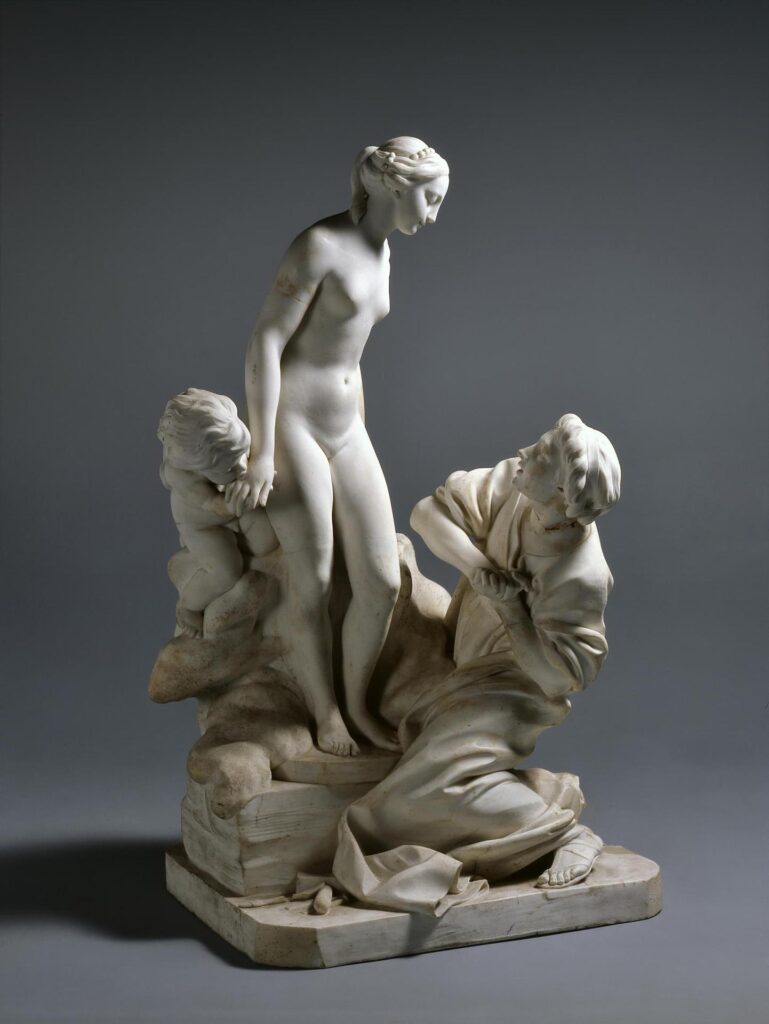
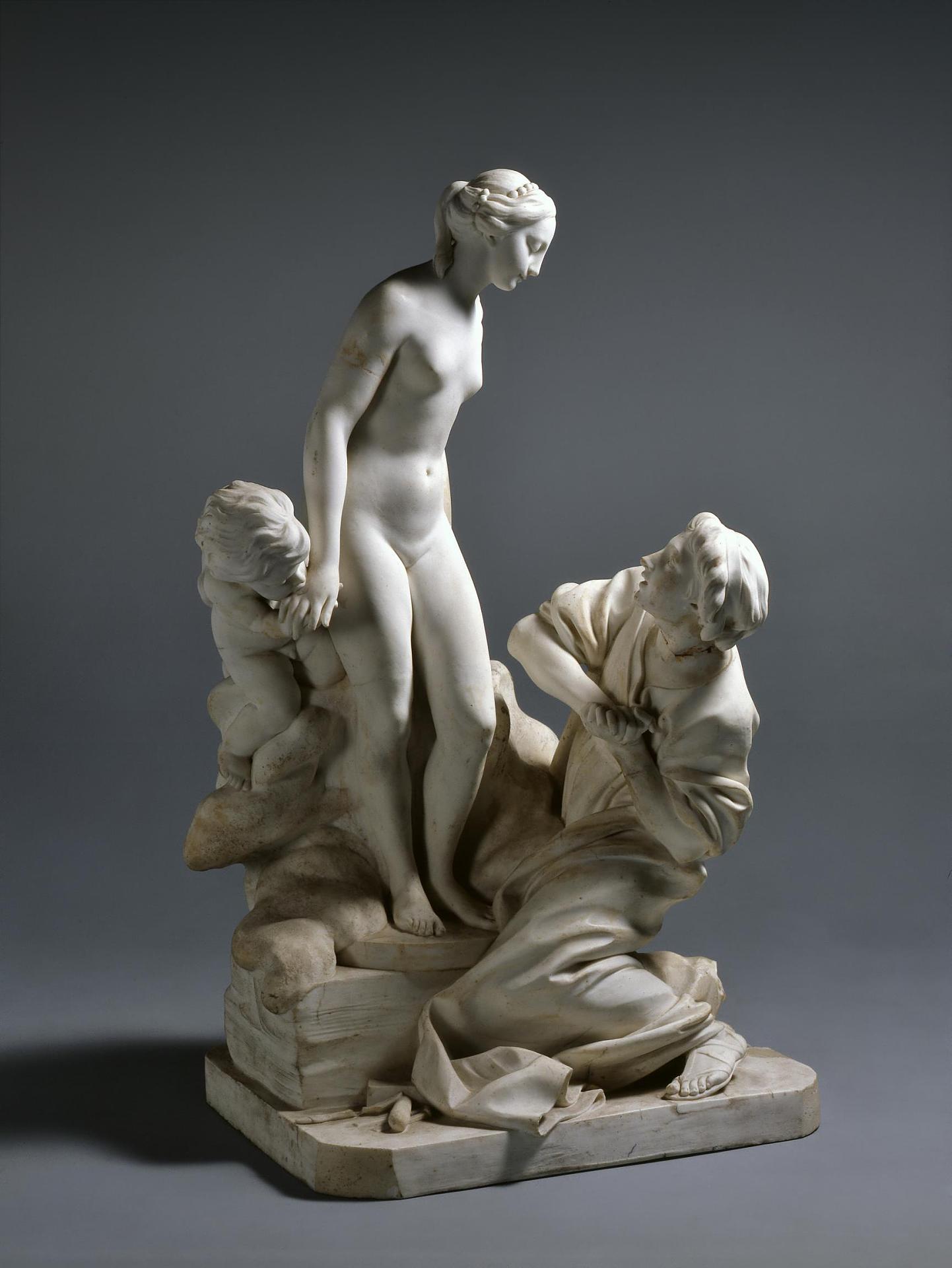
One of its most influential interpretations was created by the French sculptor Étienne-Maurice Falconet, whose marble Pygmalion and Galatea was exhibited at the Paris Salon in 1763.
Falconet chose the extraordinary instant when Galatea awakens.
Pygmalion kneels before the figure in astonishment while Cupid represents the divine power of love responsible for the transformation.
The composition became highly celebrated and was subsequently reproduced and adapted in other materials, particularly porcelain.
The Sèvres Manufactory produced versions of the group in biscuit porcelain, helping the composition circulate among European collectors. Surviving eighteenth-century examples demonstrate how widely the subject and Falconet’s interpretation were admired.
Sculpture and Porcelain
The eighteenth century witnessed an extraordinary development in European porcelain production.
Porcelain was no longer used only for vessels and tableware. Major manufactories employed sculptors and modellers to produce complex groups inspired by mythology, literature and contemporary life.
Unglazed biscuit porcelain was particularly suitable for sculpture.
Its pale, matte surface could resemble finely carved marble while allowing intricate compositions to be reproduced at a much smaller scale.
Mythological groups such as Pygmalion and Galatea therefore existed at the intersection of sculpture and decorative art.
They could translate compositions associated with monumental sculpture into intimate objects intended for palaces, private collections and sophisticated interiors.
The Artist and His Creation
Few mythological subjects speak so directly about the act of making art.
Pygmalion is simultaneously the protagonist of the story and an artist contemplating his own work.
His desire raises questions that have remained relevant throughout the history of art.
Can an artist create an image more perfect than reality?
What happens when the viewer begins to respond emotionally to something that is only an image?
And what separates a representation of life from life itself?
The myth offered eighteenth-century sculptors an especially clever challenge.
A sculptor creating Pygmalion and Galatea was carving or modelling a representation of another sculptor watching his sculpture become alive.
The material of the artwork therefore became part of the meaning of the story.
Galatea
Galatea represents the transformation at the centre of the composition.
At first she belongs entirely to the world of art: an ideal figure created by the sculptor.
But the intervention of Venus changes her status.
She becomes both artwork and living woman.
Artists could emphasise this transformation in different ways. Some represented Galatea almost completely awakened, while others concentrated on the precise instant at which the lifeless figure begins to respond to Pygmalion.
The story therefore allowed sculptors to explore movement, gesture and the human body while simultaneously demonstrating their mastery over the material from which the figure was made.
The Rudanovsky Record
Pygmalion and Galatea appears among the objects documented by the historical Rudanovsky Collection project.
The original record connected the work with François-Camille Duru and provided a direct link to the State Hermitage Museum’s former digital catalogue.
That museum link is no longer active.
Because the surviving Rudanovsky entry contains very little additional cataloguing information, the precise authorship, date, material and provenance of this particular object should not be reconstructed without further museum documentation.
The historical attribution is therefore preserved here as it appeared in the Rudanovsky record rather than expanded into details that cannot currently be verified.
What can be established is that the object belonged to the broader artistic tradition surrounding one of the eighteenth century’s most celebrated mythological sculptural subjects.
A Story About Art
The lasting fascination of Pygmalion and Galatea lies in its unusual relationship with art itself.
It is a myth about a sculptor told through sculpture.
The viewer sees an artificial figure representing an artificial figure becoming human.
The ancient story therefore becomes a meditation on artistic creation — on the desire to give permanence to beauty and, ultimately, to give life to something created by human hands.
That idea allowed the story of Pygmalion to survive far beyond antiquity.
It passed through Renaissance literature, eighteenth-century sculpture and porcelain, nineteenth-century painting, theatre and later popular culture.
Across these interpretations, the central moment remains unchanged:
the artist stands before his creation — and the creation comes alive.