Artist: Workshop of Desiderio da Settignano (c. 1430)
Origin: Italy, Florence
Date: second half of the 1450s
Material: terracotta
Technique: painting
Dimensions: 40 × 32 cm
Current Collection: The State Hermitage Museum
Inventory Number: N.sk-1175
Hermitage ID: 55515
Rudanovsky Connection: Entered the Hermitage in 1920 from the collection of A. K. Rudanovsky.
A Florentine painted terracotta relief of the Madonna and Child, from the workshop of Desiderio da Settignano, made in the 1450s.
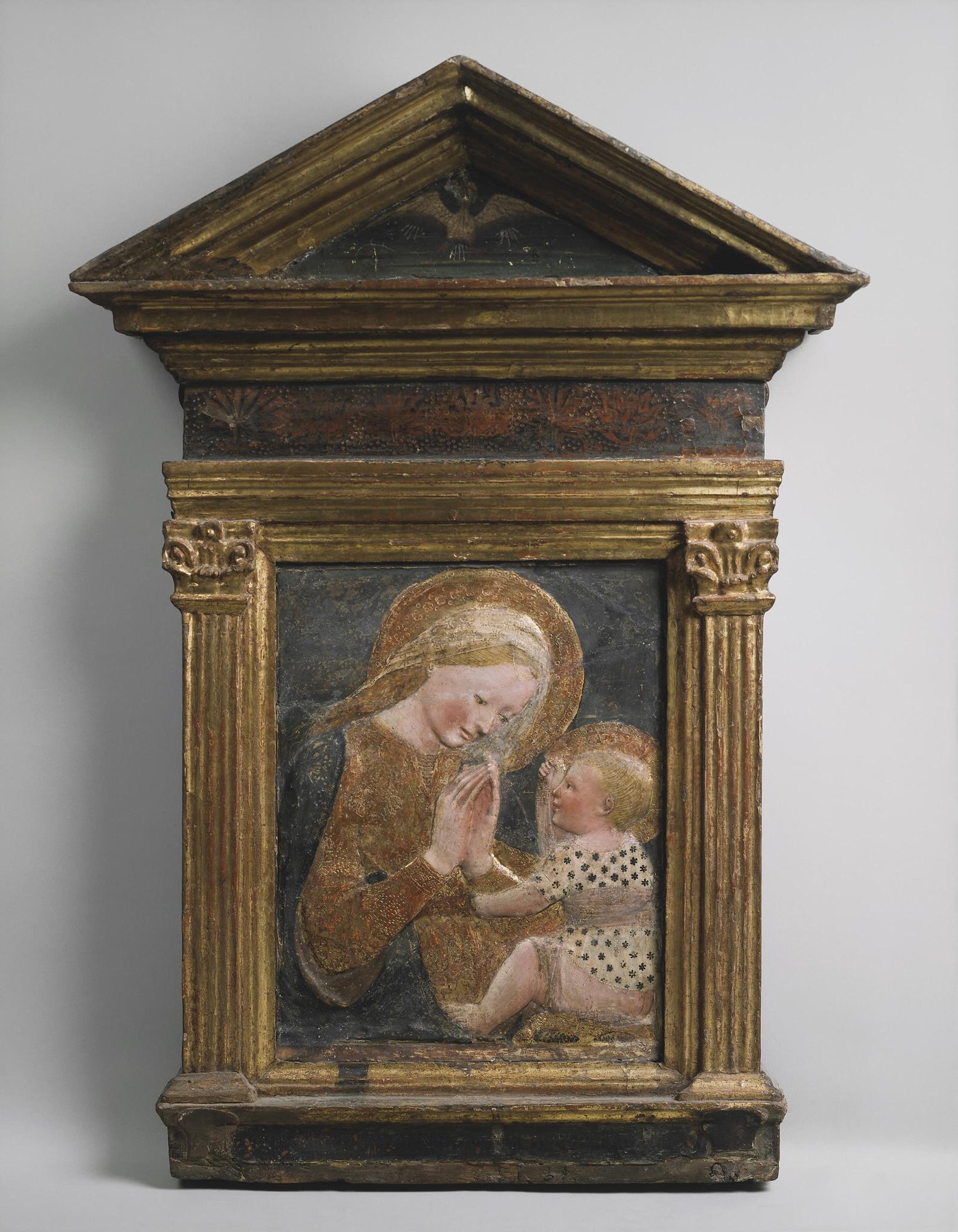
Relief: Madonna and Child. The State Hermitage Museum.
The relief entered the Hermitage in 1920 from the Rudanovsky family collection, through the State Museum Fund, and it was originally in the collection of A. K. Rudanovsky. It is not currently on permanent display.
It is a painted terracotta relief — 40 by 32 centimetres — set in an architectural frame, showing the Virgin adoring the Child.
The Object
The relief is a shallow panel, painted in colours, and it is set in a wooden frame.
The Virgin kneels at the left, her hands joined in prayer, her head bowed toward the Child. The Child sits on a cushion at the right, naked except for a dotted garment, and he raises one hand toward his mother.
The background is painted in dark gold, and the frame has a pediment, pilasters and a dove at the top.
The Madonna
The Virgin is the relief’s centre.
She kneels, her body turned toward the Child, her hands joined. Her hair falls in long waves over her shoulders, and her face is young and calm, with downcast eyes.
Her pose is one of adoration: she is not holding the Child, but praying to him, and the gesture turns the scene into an act of devotion.
The Child
The Christ Child sits on a cushion.
He is small and plump, and he wears a light garment marked with dark dots, a pattern that may represent embroidery or fur. His right hand is raised toward the Virgin, and his left rests on the cushion.
The Child is the object of the Virgin’s prayer, and his gesture — a blessing or a greeting — connects the two figures.
The Frame
The relief is set in an architectural frame.
It has a pediment at the top, pilasters at the sides and a base at the bottom, and it is painted in gold and dark tones. At the top, in the pediment, a dove is painted, the symbol of the Holy Spirit.
The frame turns the relief into a tabernacle: a small architectural structure for a devotional image, made to stand on an altar or a wall.
Desiderio
Desiderio da Settignano (c. 1430–1464) was a Florentine sculptor.
He was a pupil of Donatello, and he specialised in reliefs: marbles and terracottas of the Madonna and Child, portraits and children’s heads. His work is characterised by delicacy, softness and a tender naturalism.
The relief is attributed to his workshop, and it belongs to the large production of devotional reliefs that his studio supplied to Florentine homes and churches.
Terracotta
The relief is made of terracotta.
Terracotta is baked clay, and it was a cheap and versatile material: it could be moulded, carved and painted, and it allowed sculptors to produce multiple copies. It was used for reliefs, busts, statues and architectural ornament.
Many Renaissance sculptors worked in terracotta, and their reliefs were among the most popular devotional objects of the period.
The Polychromy
The relief is painted.
Terracotta reliefs were usually polychromed: the flesh was painted in flesh tones, the robes in colour, and the background in gold or blue. The paint gave the relief its realism and its brightness.
The polychromy here is partly preserved: the flesh, the hair, the garments and the gold background are still visible, though the colours have faded and darkened.
The Devotion
The relief is a devotional object.
It was made for a private house or a chapel, and it was intended to be prayed before. Its small size and its tender subject made it suitable for a domestic setting, where it could be placed on a table or a wall.
Images of the Madonna and Child were among the most common devotional objects of the Renaissance, and they were produced in large numbers for ordinary people.
The Cushion
The Child sits on a cushion.
It is a small, soft object, painted in pale colours, and it raises the Child to the Virgin’s eye level. The cushion is a domestic detail, and it makes the scene feel like a moment in a house.
Cushions appear in many Renaissance reliefs of the Madonna and Child: they are a practical support, and a sign of tenderness.
The Gold
The background is gold.
Gold leaf or gold paint was applied to the flat surface behind the figures, and it gives the relief a luminous, sacred ground. The gold is now dark and worn, but it still glows.
Gold grounds are characteristic of Italian devotional art: they suggest the heavenly world, and they make the figures stand out.
The Dove
A dove is painted in the pediment.
It is small and dark, with spread wings, and it hovers above the relief. The dove is the symbol of the Holy Spirit, and it completes the Trinity: the Father above, the Son in the Child, the Spirit in the dove.
The dove is a small detail, but it turns a domestic scene into a theological image.
Workshop Copies
The relief is a workshop production.
Desiderio’s studio, like other Florentine workshops, produced multiple copies of popular reliefs: they were moulded, cast and finished, and sold to private clients. The copies varied in quality and in paint.
This relief belongs to that production: a devotional image, made in series, and finished by hand.
The Hair
The Virgin’s hair falls in long waves.
It is painted in a pale gold, and it is modelled in soft ridges, and it frames her face and covers her shoulders. The hair is a sign of her youth and her beauty, and it is one of the relief’s most delicate passages.
In Florentine reliefs, hair was often treated with great attention: it is fine, it catches the light, and it must be modelled without heaviness.
The Pilasters
Two pilasters frame the relief.
They are painted in gold, with carved capitals, and they give the tabernacle its architectural structure. The pilasters turn the relief into a niche, and they frame the figures like a window.
Architecture and sculpture are combined in the tabernacle: the frame is part of the image, not a separate object.
Provenance
The relief carries the inventory number N.sk-1175. It entered the Hermitage in 1920 from the Rudanovsky family collection, through the State Museum Fund, and it was originally in the collection of A. K. Rudanovsky.
In the Hermitage
The relief is preserved in the State Hermitage Museum in Saint Petersburg and is not on permanent display.
It is a fine example of Florentine terracotta relief, and it preserves a moment of tenderness: a mother, a child and a painted frame, made for a Florentine house in the 1450s, and still glowing with its gold, on a shelf, in a store, in a city the sculptor never saw, and never imagined, in a country he never visited, and which had not yet been invented.