Artist: Giovanni Battista Silvestri (1796–1873)
Origin: Italy
Date: circa 1830
Material: paper
Technique: watercolour
Dimensions: 178 × 121 mm
Current Collection: The State Hermitage Museum
Inventory Number: OR-27458
Hermitage ID: 358415
Rudanovsky Connection: Entered the Hermitage in 1922 from the collection of A. K. Rudanovsky.
A watercolour view of the cathedral square in Florence, with Brunelleschi’s dome and Giotto’s campanile rising above a crowd of small figures, painted around 1830 by Giovanni Battista Silvestri.
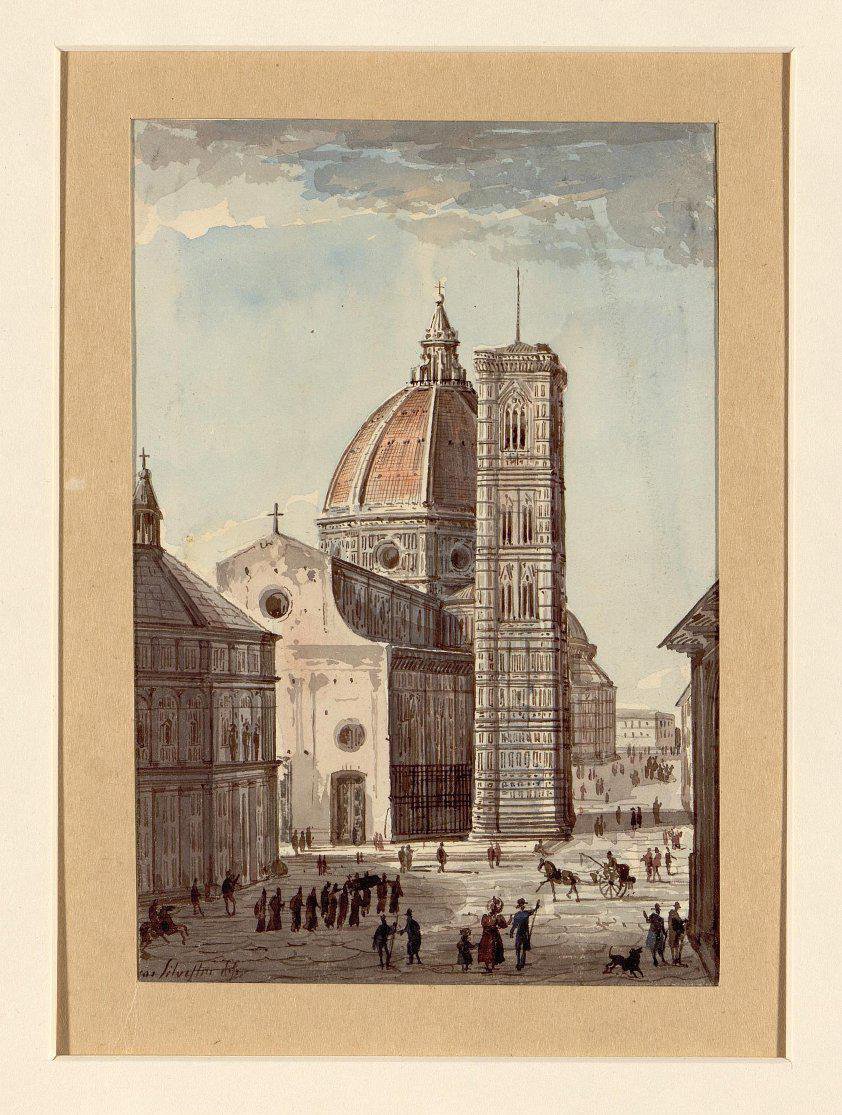
View of the Cathedral in Florence. The State Hermitage Museum.
The watercolour entered the Hermitage in 1922 from the collection of A. K. Rudanovsky. It is not currently on permanent display.
It is a small sheet, 17.8 by 12.1 centimetres, painted in delicate washes of blue, brown and rose, and it shows the heart of Florence as it looked in the early nineteenth century.
The Object
The composition is vertical: the cathedral rises in the centre, the campanile stands to its right, and the square opens in front.
The dome, with its red tiles and white ribs, dominates the upper part; below it, the white marble façade of the cathedral and the tall, slender campanile. In the foreground, small figures walk across the square; a carriage and a horse stand at the right.
The colours are soft: pale blue sky, warm stone, muted reds and greens.
The Duomo
The cathedral of Santa Maria del Fiore is the symbol of Florence.
It was begun in 1296, and its dome — the largest masonry dome in the world at the time — was completed by Filippo Brunelleschi in 1436. The campanile was designed by Giotto and built after his death.
The cathedral is a building of extraordinary size and complexity, and it has been painted and drawn by artists for centuries.
Brunelleschi’s Dome
The dome is the centre of the view.
It is a double shell of brick, built without centring, and its shape — a pointed octagon — has become one of the most recognisable silhouettes in Europe. The white ribs divide the red tiles into eight segments, and the lantern at the top completes the composition.
In the watercolour, the dome is painted with care: the red of the tiles, the white of the ribs, the grey of the lantern. The artist has understood its structure.
Giotto’s Campanile
The campanile stands to the right of the dome.
It is a slender tower of white marble, decorated with reliefs and coloured panels, and it rises higher than the dome. In the drawing, it is rendered with fine vertical lines, emphasising its height and its lightness.
The contrast between the rounded dome and the vertical campanile is one of the great architectural dialogues of the Renaissance, and the artist has made it the centre of his composition.
The Piazza
The square in front of the cathedral is filled with figures.
They are small, sketched in a few strokes: people walking, a carriage, a horse, a dog. They give scale to the buildings and life to the scene.
The figures are staffage — a standard element of the veduta — and they turn an architectural view into a picture of a city.
Silvestri
Giovanni Battista Silvestri (1796–1873) was an Italian architect and draughtsman.
He worked in Florence, where he was involved in architectural projects and in the documentation of the city’s monuments. His views of Florence are among his best-known works, and they combine archaeological care with picturesque effect.
Silvestri belongs to the tradition of the Italian vedutisti, the painters of city views who worked from the seventeenth century to the nineteenth.
Watercolour
Watercolour was the ideal medium for a view.
It allowed the artist to work quickly, to capture the light and the atmosphere, and to produce a finished sheet that could be sold to a traveller. The transparency of the medium suits the pale sky and the sunlit stone.
Silvestri’s handling is delicate: the washes are layered, the details are drawn with a fine brush, and the whole image has a soft, slightly faded tonality.
The Format
The drawing is small, and its vertical format is unusual for a city view.
Most vedute are horizontal, to accommodate the breadth of a square. This one is vertical, to accommodate the height of the dome and the campanile, and it makes the cathedral look even taller than it is.
The format is a deliberate choice, and it shapes the way we see the building.
The City View
The city view — the veduta — was one of the most popular genres of eighteenth- and nineteenth-century art.
Travellers on the Grand Tour bought views of the cities they visited; collectors assembled albums of them; and painters specialised in producing them for a ready market. Venice, Rome and Florence were the great subjects.
Silvestri’s view belongs to that tradition, but it is also a document: it records the appearance of the cathedral square at a particular moment, with its buildings, its crowds and its light.
The Crowd
The figures in the square are not incidental.
They give scale, movement and life to the architecture. Without them, the cathedral would be a monument; with them, it is a place where people live.
The crowd is painted in small touches of colour: dark coats, white dresses, a carriage, a horse. Each figure is a few strokes, but together they create the bustle of a city square.
Watercolour Paper
The drawing is painted on paper, which has yellowed with age.
Watercolour paper is sized to absorb the paint evenly, and it holds the washes on the surface. Over time, the paper can darken or become brittle, and the colours can fade.
The warm tone of this sheet is part of its beauty: it gives the watercolour the mellow, slightly nostalgic look of an old view.
The Lantern
At the top of the dome stands the lantern, designed by Brunelleschi.
It is a small, elegant structure of white marble, with columns and a conical roof, and it completes the dome both visually and structurally. In the watercolour, it is a tiny white shape against the sky, but it is essential to the silhouette.
The lantern is one of the details that make the dome recognisable, and its presence shows that the artist knew the building well.
The Marble
The cathedral is faced in white and green marble.
In the watercolour, the marble is painted in pale greys and creams, with touches of pink and green. The effect is of a building that glows in the sun, and it explains why the Florentines called their cathedral «the beautiful».
The marble facing is one of the defining features of Italian Gothic architecture, and the artist has taken care to render its colours and its patterns.
Provenance
The watercolour carries the inventory number OR-27458 and entered the Hermitage in 1922 from the collection of A. K. Rudanovsky.
In the Hermitage
The watercolour is preserved in the State Hermitage Museum in Saint Petersburg and is not on permanent display.
It is a small, precise, atmospheric record of Florence in the 1830s, and it shows how a city could be turned into a picture for the delight of a traveller or a collector.
It is a view, a souvenir and a small painting, all at once, and it still carries the light of Florence.