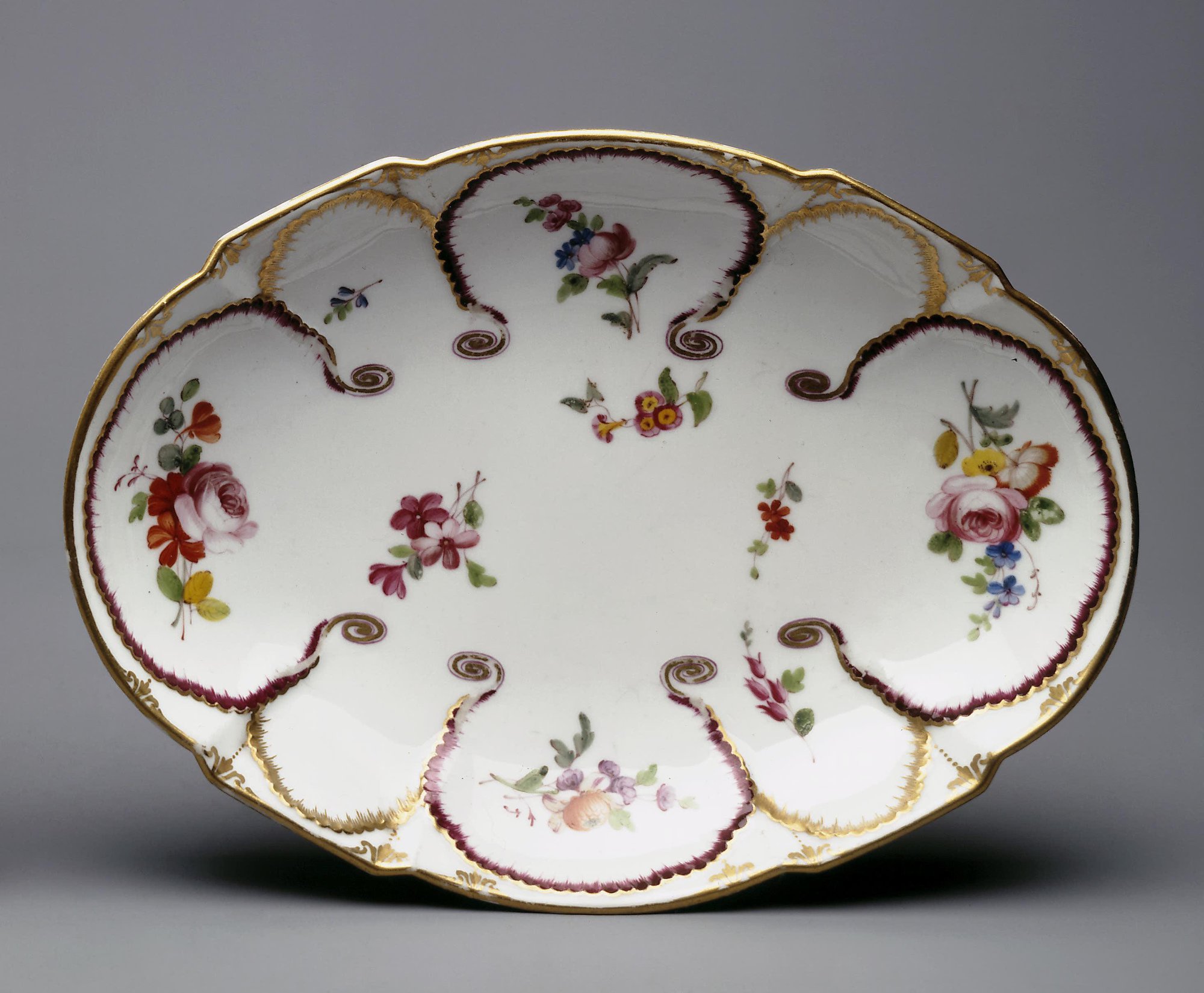
Artist: Antoine Buteux le jeune (painter)
Organization: Sèvres Porcelain Manufactory
Origin: France
Date: 1778
Complex: Service «Cabbage Leaves in Purple»
Material: hard-paste porcelain
Dimensions: diameter 23.1 cm
Current Collection: The State Hermitage Museum
Inventory Number: ZF-16225
Hermitage ID: 352358
Rudanovsky Connection: Entered the Hermitage in 1919 from the collection of A. K. Rudanovsky.
A round salad bowl from a Sèvres service of 1778, painted with scattered flowers inside reserves shaped like cabbage leaves and edged in purple.
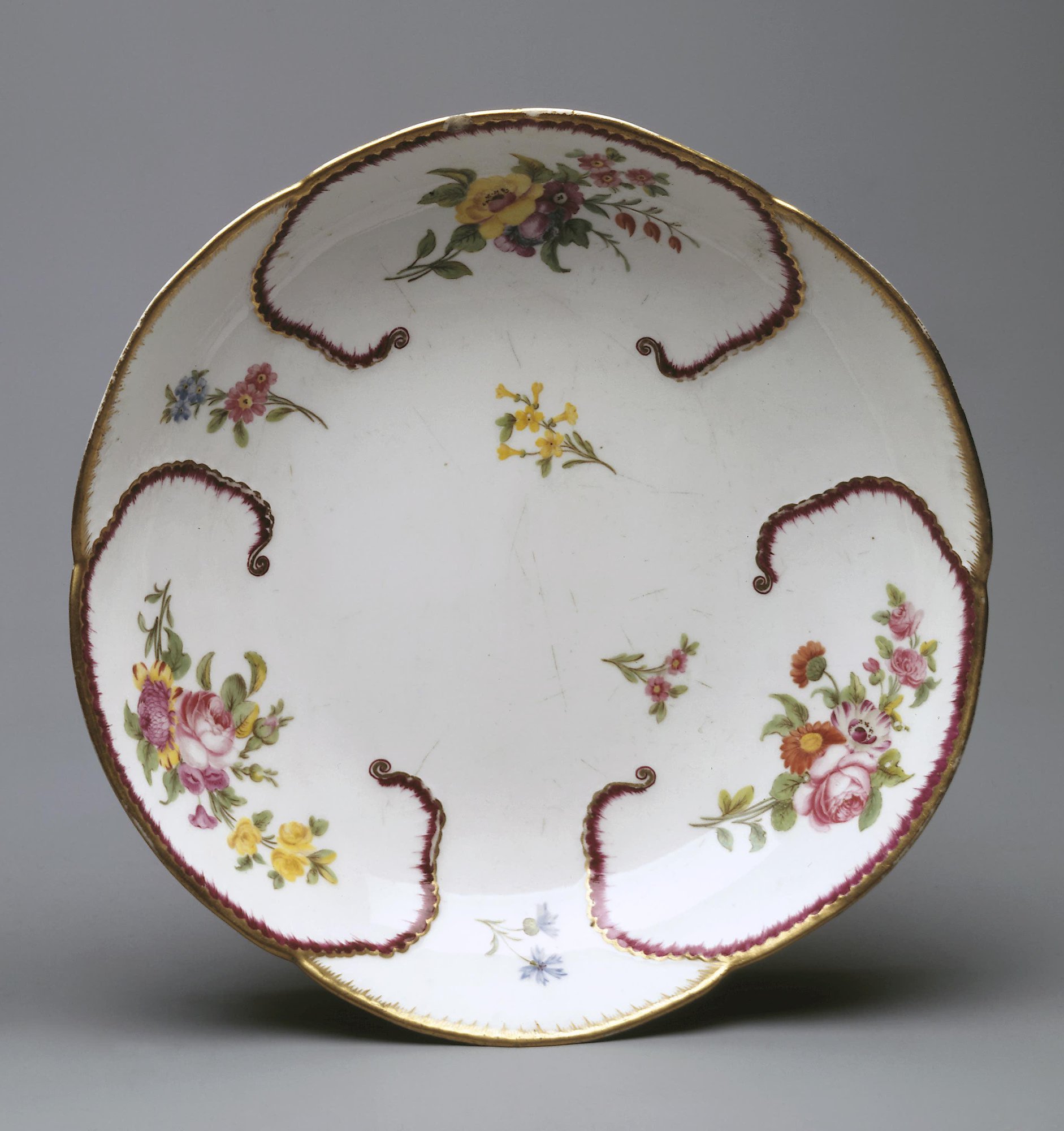
Round Salad Bowl. The State Hermitage Museum.
The bowl entered the Hermitage in 1919 from the collection of A. K. Rudanovsky. It is not currently on permanent display.
It is a wide, shallow bowl, white and gold, with a decoration that looks at first like scattered flowers and only gradually resolves into a pattern of scalloped reserves.
The Object
The bowl has a broad, gently curving sides and a gilded rim.
The decoration is organised around four large reserves, shaped like the lobes of a leaf, each outlined with a purple scalloped edge and a gold line. Inside the reserves, bouquets of garden flowers are painted: roses, pansies, auriculas, bluebells and small yellow blossoms.
Between the reserves, scattered flowers float on the white ground, giving the design a lightness that the formal leaf shapes might otherwise lack.
Cabbage Leaves in Purple
The service is recorded as «Cabbage Leaves in Purple», and the name describes the decoration exactly.
The reserves are shaped like the leaves of a cabbage, with scalloped edges that curl at the tips. The purple edging defines the leaf and separates it from the white ground, and the gold line gives it a metallic finish.
The pattern was one of several «leaf» designs used at Sèvres in the 1770s and 1780s. It allowed the painter to combine a formal structure with the informal scatter of flowers that was fashionable at the time.
Sèvres in 1778
By 1778, the Sèvres manufactory was at the height of its reputation.
It had been a royal manufactory since the 1750s, and it supplied the court, the nobility and the international market with porcelain of extraordinary quality. Its painters were among the most skilled in Europe, and its gilders were famous for their precision.
The year 1778 belongs to the period when Sèvres was beginning to use hard-paste porcelain, made with kaolin discovered near Limoges, alongside its traditional soft-paste.
The Painter
The bowl is attributed to Antoine Buteux le jeune, one of the painters working at Sèvres in the 1770s.
Sèvres painters specialised: some painted figures, some landscapes, some flowers, some birds. Buteux was a flower painter, and the bouquets on this bowl are typical of his work: precise, colourful and slightly stylised.
The painter’s mark on the underside of the bowl would have identified him to the factory, and it allows the modern scholar to reconstruct the division of labour within the workshop.
Salad
A salad bowl is a specific object.
It is wider and shallower than a soup bowl, with a broad rim that allows the salad to be tossed and served. In a dinner service, it belongs to the second course, with the roasts and the vegetables.
The size of this bowl — 23 centimetres across — suggests a service for a substantial table, where salad was served as a separate dish rather than as a garnish.
The Gold
The gold on the bowl is applied with care.
The rim is gilded, and the reserves are outlined with a fine gold line that follows the scalloped edge. The gold is fired and burnished, so that it shines against the white porcelain.
Gilding was one of the most expensive stages of porcelain production, and it was usually done by a specialist rather than by the painter. The combination of gold and purple is a mark of the quality of the service.
The Flowers
The flowers are the liveliest part of the design.
They are painted in a naturalistic style, with careful attention to the petals, the leaves and the shading. The colours are soft but varied: pink, crimson, yellow, blue and violet.
The bouquets are not botanical illustrations. They are decorative arrangements, composed to fill the reserves and to please the eye, and they belong to the tradition of flower painting that flourished in France in the eighteenth century.
Hard Paste
The bowl is made of hard-paste porcelain, a material Sèvres had only recently adopted.
Hard paste is made with kaolin, a white clay that allows the porcelain to be fired at a higher temperature and produces a harder, more durable body. Kaolin was discovered near Limoges in 1768, and Sèvres began to use it in the 1770s.
The change was significant. Hard paste is closer to Chinese porcelain, and it allowed the factory to make larger pieces and to compete with the imported wares that had dominated the European market.
The Sèvres Mark
On the underside of the bowl there would be the factory mark.
Sèvres pieces are marked with the interlaced Ls of the royal cipher, usually with a date letter in the centre and the painter’s mark beside it. These marks are the factory’s archive, and they allow each piece to be dated and attributed.
The mark is also a guarantee of origin. In the eighteenth century, Sèvres porcelain was widely imitated, and the mark was a way of distinguishing the genuine article from its rivals.
Dessert
The bowl belongs to the dessert course.
In an eighteenth-century dinner, dessert was a separate service, with fruit, sweets, biscuits and preserves arranged on the table in elaborate patterns. Porcelain played a central role: bowls, trays, compotiers and plates were set out in symmetrical arrangements.
A salad bowl might seem an odd piece for dessert, but the term covers a range of shallow bowls used for fruit and compotes as well as salads.
The Service Dispersed
The service is now dispersed.
Like most large eighteenth-century services, it was divided among heirs, sold at auction or broken up over time. Individual pieces entered museums and private collections, and the service as a whole survives only in inventories and photographs.
The Hermitage has several pieces from the same service, which allows a partial reconstruction of its appearance.
The Cabbage Leaf Pattern
The cabbage-leaf pattern was one of several naturalistic designs used at Sèvres in the 1770s.
It replaced the earlier fashion for dense, symmetrical ornament with something lighter and more organic: leaves, flowers and ribbons arranged in a loose, natural way. The pattern was painted in several colourways, of which the purple version is the one recorded here.
The name is a modern convenience. In the eighteenth century, the service would have been described by its decoration or by the name of its buyer, and the «cabbage leaves» are simply the most recognisable feature of the design.
Provenance
The bowl carries the inventory number ZF-16225 and entered the Hermitage in 1919 from the collection of A. K. Rudanovsky.
In the Hermitage
The bowl is preserved in the State Hermitage Museum in Saint Petersburg and is not on permanent display.
It is one piece of a large service, dispersed among museums and private collections. Seen alone, it is a beautiful object; seen as part of the service, it is a document of the taste and organisation of the Sèvres manufactory in the late eighteenth century.