Origin: Russia (?)
Date: 19th century
Material: porcelain
Technique: polychrome overglaze painting, gilding
Dimensions: height 9.4 cm; base 14.6 × 8 cm
Current Collection: The State Hermitage Museum
Inventory Number: ERF-3439
Hermitage ID: 909353
Rudanovsky Connection: Entered the Hermitage in 1919 from the collection of A. K. Rudanovsky.
A porcelain group of two dogs attacking a boar, made in Russia in the nineteenth century.
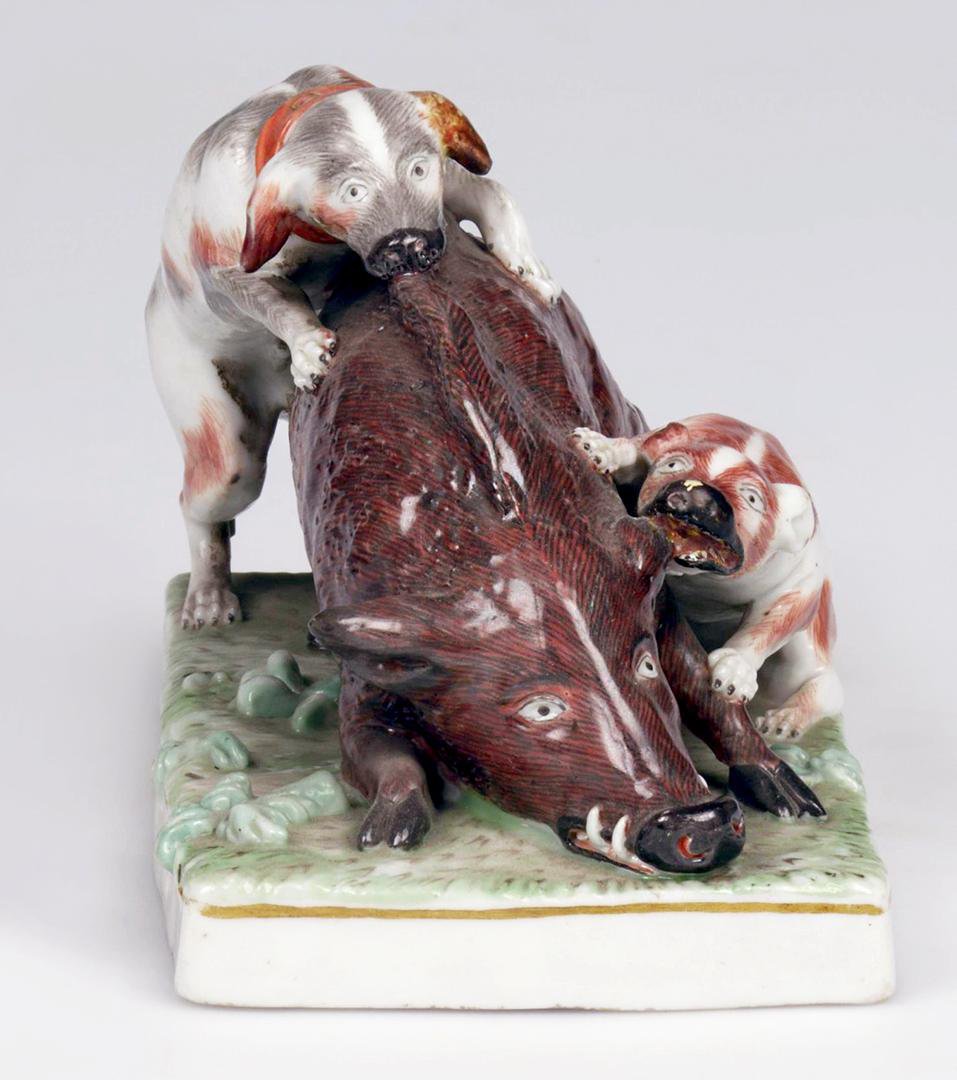
Sculptural Group: Two Dogs Attacking a Boar. The State Hermitage Museum.
The group entered the Hermitage in 1919 from the collection of A. K. Rudanovsky. It is not currently on permanent display.
It is a small sculpture — nine centimetres high — of a boar brought down by two hunting dogs, mounted on a rectangular base painted as a grassy bank.
The Object
The boar lies on its side, its head turned toward the viewer, its tusks visible. One dog stands over it, its jaws at the boar’s neck; the other grips the boar’s flank, its body twisted with effort.
The animals are painted in naturalistic colours: the boar a dark reddish-brown, the dogs white with grey and red markings. The base is green and brown, with tufts of grass and a gilded edge.
The Hunt
The subject is a hunting scene.
Hunting was one of the great aristocratic pastimes of the eighteenth and nineteenth centuries, and it provided artists with dramatic subjects: horses, dogs, boars, stags, the moment of the kill.
Porcelain groups of hunting animals were popular in the eighteenth century, and they were produced by factories across Europe, from Meissen to Vienna and St Petersburg.
Animal Sculpture
Animal sculpture is a genre of its own.
It requires the artist to observe anatomy, movement and character, and to translate them into a material that is difficult to model and to fire. The best animal figures combine naturalism with decorative effect.
This group belongs to that tradition: the animals are observed, but they are also arranged for effect, in a composition that is dramatic and legible from several angles.
The Dogs
The dogs are the most dynamic part of the group.
One stands over the boar, its body taut, its head lowered. The other grips the flank, its paws braced, its mouth open. Their poses are carefully contrasted: one vertical, one diagonal.
The dogs are painted with attention to breed: white bodies, grey and red patches, small ears, powerful jaws. They are hunting dogs, not pets.
The Boar
The boar is the still centre of the group.
It lies on its side, its legs stiff, its head turned up. The tusks are visible, and the eye is painted with a dark pupil. The body is modelled with rough texture, suggesting bristles.
The boar’s stillness contrasts with the dogs’ movement, and it gives the composition its drama: the moment after the kill.
The Base
The base is a rectangular slab, painted as a grassy bank.
It is green and brown, with tufts of grass and a gilded edge. The base raises the group and provides a ground for the animals, and its colour connects the sculpture to the natural world.
The gilded edge is a decorative touch that lifts the object from the naturalistic to the ornamental.
Russia
The group is recorded as made in Russia, with a question mark.
Russian porcelain factories, including Gardner and the Imperial factory, produced animal groups in the eighteenth and nineteenth centuries, often after Western models. The style of this group is close to German and Austrian models, and it may have been made in Russia from a foreign mould.
The uncertainty is typical of nineteenth-century porcelain, where models circulated widely and factories copied one another.
The Model
The group was made from a mould.
The animals were modelled separately and assembled before firing, and the base was cast as a single piece. The painting was applied after firing, and the group was fired again at a low temperature.
The complexity of the assembly — two dogs, a boar and a base — made this a demanding object to produce.
The Moment
The group captures a single moment: the instant after the kill.
The boar is down, the dogs are still gripping, the struggle is over but the tension remains. It is a snapshot, like a hunting print, and it invites the viewer to imagine the chase that preceded it.
This narrative concentration is typical of animal groups: they are not portraits of animals but scenes of action, frozen at their most dramatic point.
The Base and the Grass
The base is painted as a grassy bank.
Green and brown washes suggest earth and turf, and small tufts of grass are modelled or painted along the edges. The base is not a neutral plinth: it is a piece of landscape, and it places the animals in a natural setting.
The gilded edge is a decorative frame that separates the natural scene from the table.
Animal Groups
Animal groups were a popular genre in eighteenth- and nineteenth-century porcelain.
They ranged from single animals — dogs, horses, birds — to complex scenes of hunting and combat. The best examples combine anatomical observation with dramatic composition.
This group belongs to the more ambitious end of the genre: two dogs and a boar, arranged in a composition that can be read from several angles.
The Painting
The painting is naturalistic but restrained.
The boar’s coat is dark reddish-brown, with lighter highlights on the bristles; the dogs are white with grey and red patches; the base is green and brown. The colours are applied as enamels and fired.
The effect is lively but not garish: the painter has respected the animals’ colours and used them to model the forms.
Scale
At 9.4 centimetres high, the group is small.
It was made for a table or a cabinet, not for a pedestal, and its size invites close looking. The drama of the scene is compressed into a space smaller than a hand.
That compression is part of the object’s power: a violent scene, rendered in delicate porcelain, at the scale of a paperweight.
The Boar’s Head
The boar’s head is the emotional centre of the group.
It is turned toward the viewer, the eyes open, the tusks visible, the snout lifted. The expression is not frightened but stunned, and it gives the animal a strange dignity in defeat.
Modelling an animal’s head in porcelain is difficult: the forms are small, the details must survive firing, and the expression must be readable at a glance. The head of this boar is one of the finest passages in the group.
Provenance
The group carries the inventory number ERF-3439 and entered the Hermitage in 1919 from the collection of A. K. Rudanovsky.
In the Hermitage
The group is preserved in the State Hermitage Museum in Saint Petersburg and is not on permanent display.
It is a small, vigorous sculpture, and it captures a moment of violence with the delicacy of porcelain — an object that is at once a hunting scene, an animal study and a piece of decorative art.
For all its small size, it has the momentum of a much larger work and a much older story: the dogs pull, the boar yields, and the eye is drawn around the group as if around a small, furious monument.