Organization: Gardner Porcelain Factory
Origin: Russia, Moscow Governorate, Verbilki Village
Date: late 18th century
Material: porcelain
Technique: polychrome overglaze painting, gilding
Dimensions: height 18.9 cm; base 8.8 × 9.3 cm
Current Collection: The State Hermitage Museum
Inventory Number: ERF-3819
Hermitage ID: 909363
Rudanovsky Connection: Entered the Hermitage in 1919 from the collection of A. K. Rudanovsky.
A Gardner porcelain group of Venus with Cupid and two doves, made in Russia at the end of the eighteenth century.
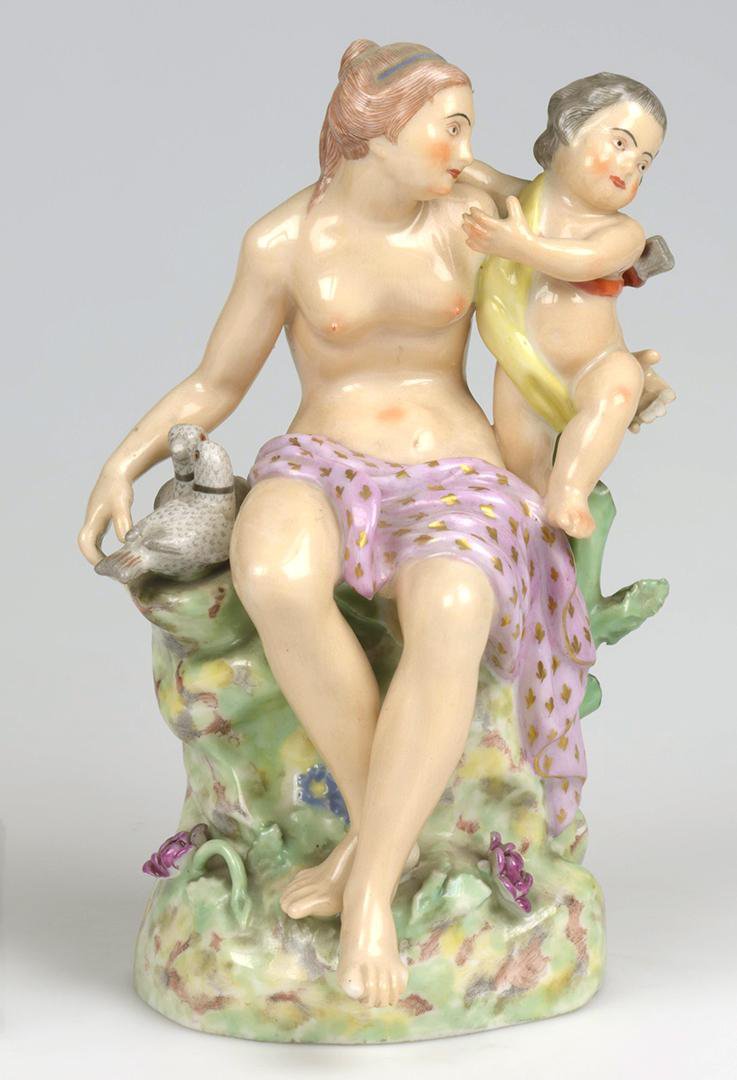
Sculptural Group: Venus with Cupid and Two Doves. The State Hermitage Museum.
The group entered the Hermitage in 1919 from the collection of A. K. Rudanovsky. It is not currently on permanent display.
It shows a seated woman — Venus — with a child — Cupid — standing beside her, and two doves at her feet, all modelled in white porcelain and painted in soft colours.
The Object
Venus sits on a rocky base, her body turned slightly, her head inclined toward Cupid.
She is nude to the waist, with a pale pink drapery over her lap, painted with small gold flowers. Her hair is gathered in a knot, and her skin is modelled with care: the breasts, the arms and the legs are softly rounded.
Cupid stands beside her, a plump child with a red band across his chest, his arms raised toward her. At her feet, a dove sits on the rock, and another is implied by the pair.
Venus
Venus is the Roman goddess of love and beauty.
In eighteenth-century art, she was a favourite subject: her nude body allowed artists to display their skill in modelling, and her mythology provided a repertoire of charming scenes.
This Venus is not a classical statue but a porcelain figure: her proportions are softened, her pose is relaxed, and her expression is gentle rather than majestic.
Cupid
Cupid is Venus’s son, the god of desire.
Here he is a small child, standing beside his mother and reaching toward her. His body is plump and soft, with dimpled arms and legs, and his face is round and smiling.
The relationship between mother and child is the emotional centre of the group: it turns a mythological subject into a tender domestic scene.
The Doves
Doves are the birds of Venus.
They were sacred to her in antiquity, and they appear in her iconography as symbols of love and tenderness. Here one dove sits on the rock beside her, its body modelled in soft grey and white.
The second dove may have been part of the original group, or it may be lost. The pair of birds would have completed the composition and reinforced the symbolism.
Gardner
The group was made at the Gardner factory near Moscow.
Gardner produced figures and groups after Western models, and this one is based on a European prototype — probably a Meissen or Sèvres model of Venus and Cupid.
The Russian version adapts the model to local taste: the colours are softer, the modelling is simplified, and the group is mounted on a rocky base.
The Classical Model
The group belongs to the neoclassical taste of the late eighteenth century.
Classical mythology provided subjects that were both elevated and charming, and porcelain factories produced them in great numbers. Venus, Cupid, Apollo and the muses were standard figures in every factory’s repertoire.
The model was probably derived from a marble or a bronze, translated into porcelain and adapted to the scale of a table ornament.
The Base
The base is a rocky mound, painted with green, brown and pink.
It is modelled with stones and plants, and it provides a natural setting for the figures. The rock is a common base for porcelain groups: it suggests a landscape and gives the figures a ground.
The base is also practical: it supports the figures and unifies the composition.
Polychrome
The painting is soft and restrained.
Venus’s skin is left in the white of the porcelain, lightly tinted; her drapery is pale pink with gold flowers; Cupid’s band is red; the dove is grey and white. The rock is painted in muted greens and browns.
The palette is limited, and the effect is gentle — a quality that distinguishes Gardner’s best figures.
The Group
The group is a composition of two figures and a bird.
Venus sits, Cupid stands, the dove rests. The three elements are arranged in a triangle, with Venus at the centre and the others at her sides.
The composition is simple and effective, and it allows the group to be read from several angles.
The Drapery
The pink drapery over Venus’s lap is the group’s colour accent.
It is painted with small gold flowers and falls in soft folds over her legs, covering the junction between the figure and the rock. The drapery is modelled, not painted flat: the folds are visible in the porcelain.
Drapery is one of the tests of a porcelain modeller: it must suggest cloth without being too thin, which would warp or break in the kiln.
The Rock
The rock on which Venus sits is painted with greens, browns and touches of pink.
It is modelled with stones and plants, and it provides a natural seat for the goddess. The rock is a common base for classical figures: it suggests a landscape and gives the nude figure a setting.
The colour of the rock contrasts with the pale flesh, and it makes the figure appear brighter.
The Model after Antiquity
The group is based on a classical model, filtered through European porcelain.
Venus and Cupid were standard subjects in every factory’s repertoire, derived from antique statues, Renaissance paintings and earlier porcelain groups. The pose — Venus seated, Cupid standing — is one of the oldest in the iconography of the goddess.
The Russian version simplifies the model and softens its classical severity.
The Group in the Interior
The group was made for an interior.
It stood on a table or a cabinet, among other porcelain and decorative objects, and it was admired for its modelling and its tenderness. The subject — mother and child — made it suitable for a drawing room or a boudoir.
At 18.9 centimetres, it is large enough to be a centrepiece and small enough to be held.
The Surface
The surface of the porcelain is smooth and glossy.
The glaze pools in the folds of the drapery and the modelling of the rock, and it gives the figure a soft, luminous quality. The flesh is left almost unpainted, relying on the warm white of the porcelain.
This restraint is characteristic of the best Gardner figures: the modelling carries the expression, and the colour supports it.
Provenance
The group carries the inventory number ERF-3819 and entered the Hermitage in 1919 from the collection of A. K. Rudanovsky.
In the Hermitage
The group is preserved in the State Hermitage Museum in Saint Petersburg and is not on permanent display.
It is a fine example of Gardner porcelain, and it shows how a classical subject could be turned into a tender, domestic image — Venus and Cupid, mother and child, in white porcelain and soft colours.
It is also a small image of happiness, made to stand on a table and to be looked at with a quiet, uncomplicated pleasure, for a moment or two.