Artist: Workshop of Severo da Ravenna (Severo di Domenico Calzetta, before 1538)
Origin: Italy
Date: 16th century
Material: bronze, deep-brown patina, traces of black lacquer
Dimensions: height 9 cm; length 11 cm
Current Collection: The State Hermitage Museum
Inventory Number: N.sk-1173
Hermitage ID: 55506
Rudanovsky Connection: Entered the Hermitage in 1920 from the collection of A. K. Rudanovsky.
A small bronze sea monster of the sixteenth century from the workshop of Severo da Ravenna, cast with a shell cup at its tail.
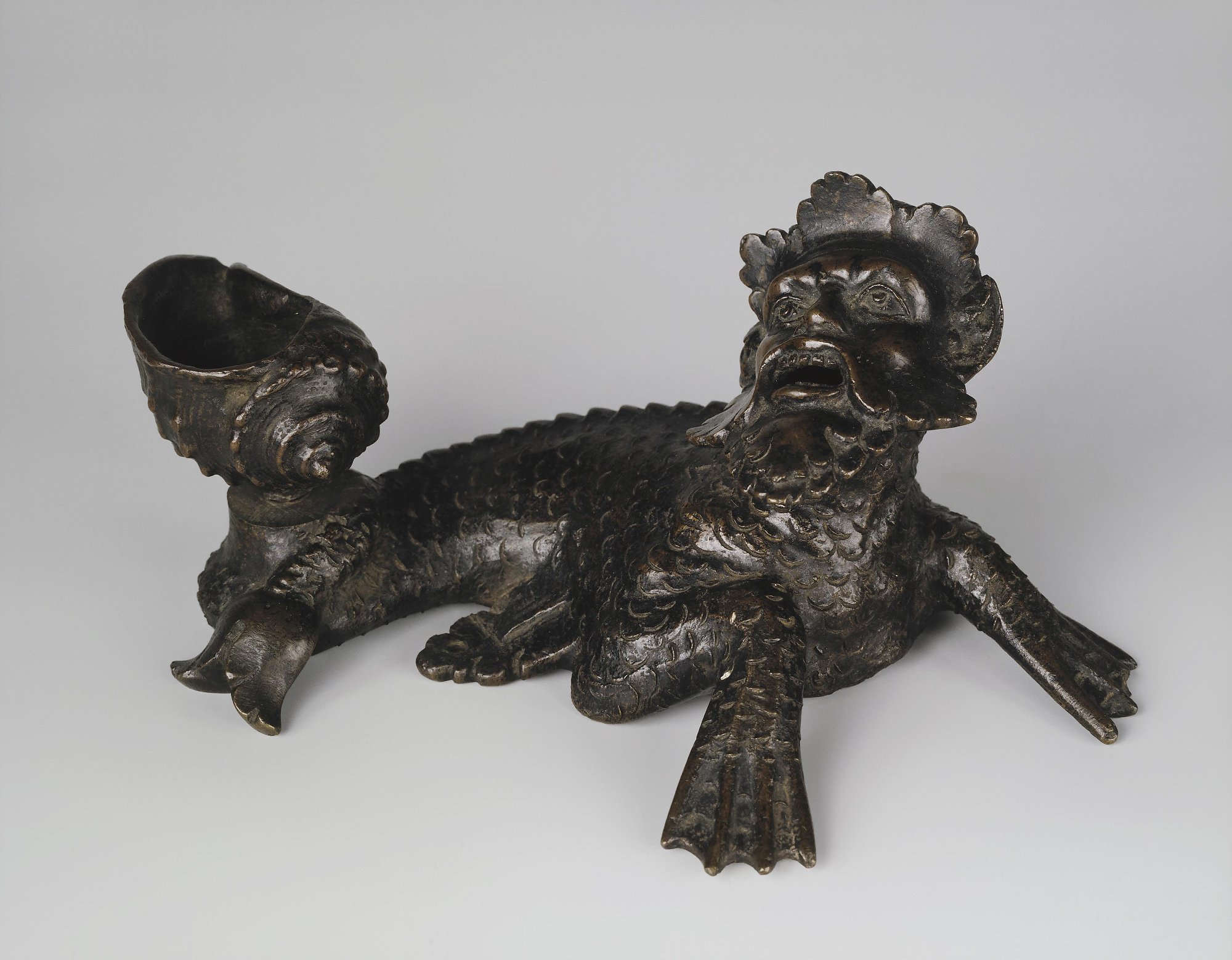
Sea Monster. The State Hermitage Museum.
The object entered the Hermitage in 1920, handed over from the State Museum Fund and originally in the collection of A. K. Rudanovsky. It is not currently on permanent display.
It is a small bronze — nine centimetres high, eleven long — in the form of a grotesque creature, with an open mouth and a shell-shaped cup held at its tail.
The Object
The creature lies on the ground, its body covered in scales.
It has a human face, with a beard and an open mouth, and a crest of shells or leaves around its head. Its body is long and fish-like, and its tail curls up behind it, holding a shell cup.
The bronze is dark brown, with a deep patina and traces of black lacquer, and it is cast in a single piece.
The Monster
The monster is a hybrid.
It has a human face, a fish’s body and the crest of a sea creature, and it belongs to the world of grotesques: the imaginary beings that populated the art of the Renaissance, from the margins of manuscripts to the grottoes of gardens.
Sea monsters were a favourite subject of Paduan bronzes, and they were used for inkwells, lamps, candlesticks and ornaments.
The Shell
The shell cup is the object’s functional part.
It is a scallop shell, held at the end of the tail, and it is open at the top. It may have held ink, oil or water, or it may have been a small lamp.
The shell is also a symbol: it is the attribute of Venus, and it connects the monster to the sea and to the classical world.
Severo da Ravenna
Severo da Ravenna (Severo di Domenico Calzetta, before 1538) was a Paduan sculptor.
He specialised in small bronzes: satyrs, animals, monsters, inkwells, candlesticks and mythological figures. His workshop produced a large number of bronzetti, and his style is characterised by lively modelling and a taste for the grotesque.
His work belongs to the Paduan tradition of bronze casting, which was one of the great schools of Renaissance sculpture.
Padua
Padua was a centre of bronze casting in the Renaissance.
The city’s workshops produced small bronzes for collectors, scholars and churches, and they were famous for their skill in casting and finishing. The bronzetti were valued for their invention and their craftsmanship.
This monster belongs to that production: a small, witty object, made for a collector’s study.
The Bronze
The object is cast in bronze.
Bronze is an alloy of copper and tin, and it was used for small sculpture because it is durable, it takes fine detail and it can be finished with a patina. The casting of a complex form like this one required a skilled foundry.
The surface is dark, with a warm brown patina, and traces of black lacquer remain in the recesses.
The Patina
The patina is part of the object.
It is the dark, slightly green-brown surface that bronze develops with age, and it protects the metal and gives it its colour. The patina here is deep and even, and it makes the scales and the face legible.
Collectors valued patina as a sign of age and quality, and they often preferred a dark, uniform surface.
The Function
The object is a functional bronze.
It was probably an inkwell, a lamp or a container for oil, and its grotesque form was a decorative addition to a useful object. Such objects stood on desks, tables and shelves, and they were used every day.
The combination of function and fantasy is characteristic of Renaissance bronzes: they are useful objects, and they are also small sculptures.
The Scales
The body is covered in scales.
They are cast in relief, in overlapping rows, and they give the surface a texture that catches the light. The scales run from the neck to the tail, and they make the creature look like a fish or a reptile.
Modelling scales in a small bronze is a test of the founder’s skill: they must be crisp, and they must survive the casting.
The Face
The face is the object’s most curious feature.
It is human: a broad face, a beard, an open mouth, wide eyes. And yet it is surrounded by a crest of shells and leaves, and it sits on a fish’s body.
The mixture of human and animal is the essence of the grotesque, and it gives the object its unsettling, comic character.
The Collector’s Study
The monster was made for a collector’s study.
Small bronzes were displayed on desks, shelves and cabinets, among books, medals and antiquities. They were handled, discussed and admired, and they were a sign of the owner’s taste.
The object was meant to be picked up and examined: its small size, its detail and its wit all invite close looking.
Casting
The object was cast in bronze, probably by the lost-wax method.
In lost-wax casting, a model is covered in wax, then in clay; the wax is melted out, and the molten bronze is poured into the space. The result is a single, detailed cast.
Casting a complex form like this one required skill, and the finishing — the chasing and the patina — was done by hand.
The Tail
The tail curls up behind the body.
It is long and scaly, and it ends in the shell cup, which it holds above the ground. The tail is the object’s structural support as well as its most elegant line.
A tail that rises into a cup is a brilliant invention: it turns the animal into an object, and it gives the bronze its balance.
The Crest
A crest of shells or leaves rises around the head.
It is carved with curled edges, and it frames the face like a crown. The crest is a classical motif, and it connects the monster to the sea, to Neptune and to the world of marine deities.
The crest also gives the head its height, and it makes the face the centre of the object.
Provenance
The object carries the inventory number N.sk-1173. It entered the Hermitage in 1920, handed over from the State Museum Fund, and it was originally in the collection of A. K. Rudanovsky.
In the Hermitage
The object is preserved in the State Hermitage Museum in Saint Petersburg and is not on permanent display.
It is a small, witty bronze, and it preserves a world of grotesques and collectors: a monster, a shell and a dark patina, in the space of a hand, on a desk, in a study, five hundred years ago, among medals, shells, coins and other small monsters, in a cabinet of curiosities, where everything was strange and small, and where a monster with an open mouth was a perfectly reasonable thing to own.