Organization: Meissen Porcelain Manufactory
Origin: Germany (Saxony), Meissen
Date: 1766–1768
Complex: Hunting Service
Material: porcelain
Technique: polychrome overglaze painting, gilding
Dimensions: height 3.2 cm; length 23.9 cm; width 16.3 cm
Current Collection: The State Hermitage Museum
Inventory Number: ZF-18719
Hermitage ID: 427167
Rudanovsky Connection: Entered the Hermitage in 1919; previously in the A.S. Dolgorukov collection
A Meissen porcelain tray of 1766–1768 in the form of a leaf, painted with a family of deer.
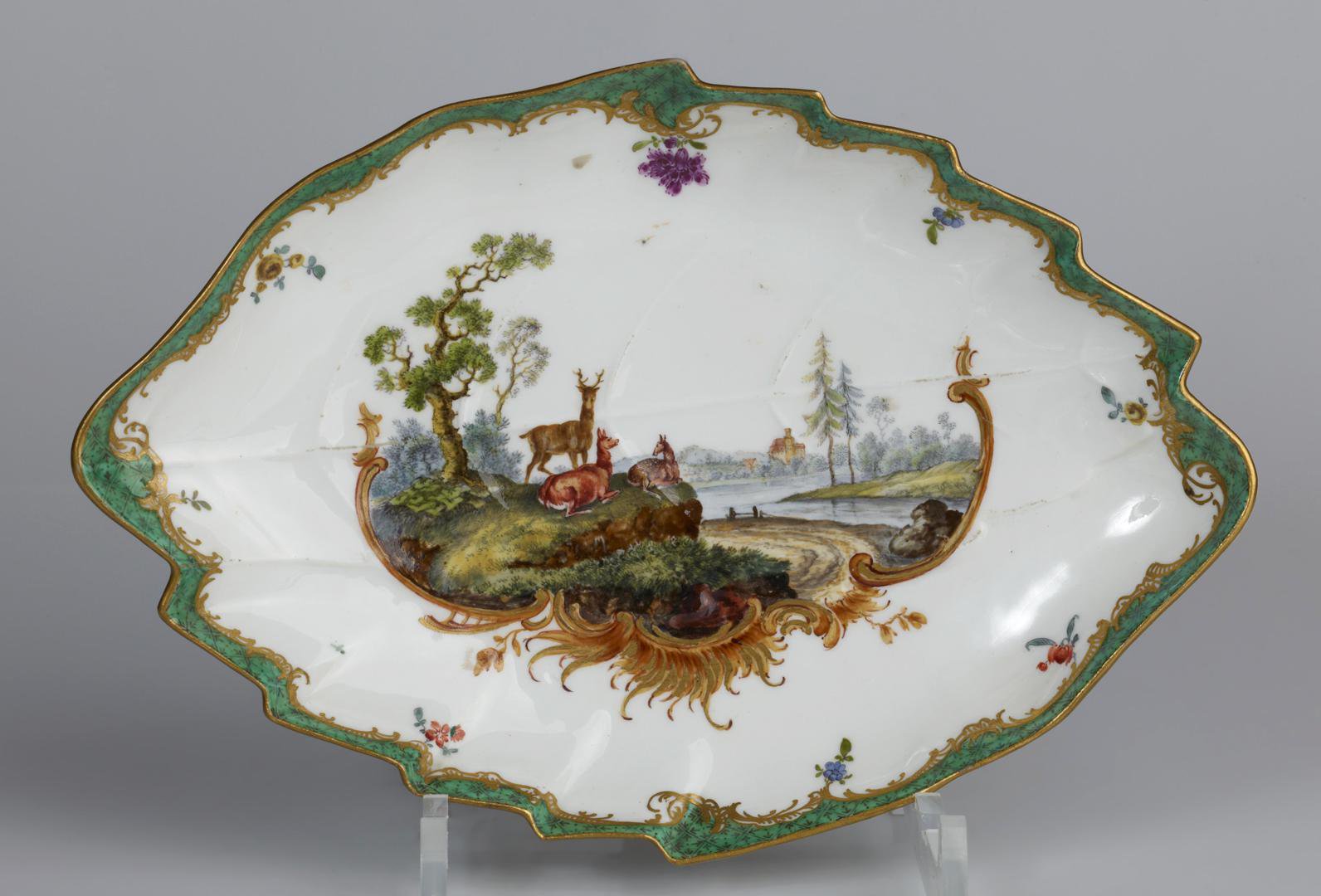
Tray in the Form of a Leaf Depicting a Deer Family. The State Hermitage Museum.
The tray entered the Hermitage in 1919, transferred from the Office for the Preservation of Monuments of Art and Antiquity. The record notes that it was previously in the A. S. Dolgorukov collection.
It is a shallow tray — 23.9 centimetres long — shaped like a leaf, with a green border and a painted group of deer.
The Object
The tray is leaf-shaped, with a wavy, lobed outline and a shallow well.
Its border is green, painted with a fine diaper pattern, and it is edged with gold scrolls and small flowers. In the centre, a gold cartouche frames a landscape with three deer.
The surface is white, and the painting is delicate: trees, a river, a distant house and the animals.
The Leaf
The leaf shape is the tray’s form.
It is cut with lobes and points, like a large leaf, and it is bordered with a green band. The shape was made in a mould, and it is one of the service’s most inventive forms.
Leaf-shaped dishes were popular in the eighteenth century: they brought the garden to the table, and they allowed the painter to compose a scene within an irregular frame.
The Deer
The deer are the tray’s subject.
A stag stands at the left, his head raised, and two does rest on the ground beside him. They are painted in soft browns, with white markings, and they are grouped on a grassy bank.
Deer are the classic quarry of the hunt, and their presence turns the tray into a hunting picture. The family group — stag, does — gives the scene a peaceful, almost domestic character.
The Cartouche
The cartouche is a gold frame.
It is painted with scrolls and leaves, and it surrounds the deer like a window. Its shape is irregular, and it follows the forms of the landscape.
Cartouches of this kind are a feature of the service: they frame each scene and separate it from the white ground.
The Border
The border is green.
It is painted with a diaper pattern of small stars, and it is edged with gold scrolls and small flower sprays. Its colour contrasts with the white ground and the brown deer.
Borders of this kind are characteristic of the «Hunting Service», and they unite its many pieces.
The Hunting Service
The tray belongs to the Meissen «Hunting Service».
The service was made in 1766–1768, and it was decorated with hunting scenes after paintings and prints. It was one of the most ambitious services of the eighteenth century, and it was made for the Russian court.
Its pieces include plates, dishes, tureens, candlesticks and leaf-shaped trays, all painted with scenes of the chase.
The Provenance Note
The tray’s record is unusual.
Unlike most of the works in this group, it does not mention the Rudanovsky collection: it names the Dolgorukov collection instead. The two collections were both in Petrograd, and objects could pass between them, but the record is what it is.
This is worth stating plainly: not every object in this group came through the same hands, and the labels are not always the same.
The White Ground
The white ground is the tray’s space.
It is the colour of the porcelain, glazed and smooth, and it gives the painting its emptiness. The white of the tray is warm, and it makes the green border and the brown deer stand out.
In the «Hunting Service», white plays the same role throughout: it is the sky, the field and the paper of the picture.
The Gold
The gold is applied in scrolls and lines.
It edges the border, frames the cartouche and covers the small rococo ornaments. It was applied over the glaze, fired and burnished, and it is the most expensive part of the decoration.
The gold gives the tray its richness, and it frames the deer.
The Trees
The trees are painted in soft greens.
They rise behind the deer, and they give the scene its depth. Their foliage is described in masses, and their trunks are painted with a few strokes.
Trees of this kind are a convention of landscape painting: they frame the scene and suggest the woods.
The River
A river runs through the middle distance.
It is painted in pale greys and blues, and it reflects the sky. On its bank, a small house and trees are visible.
The river gives the scene its depth, and it opens the composition toward the horizon.
The Table
The tray was made for a table.
It held sweetmeats, fruit or small dishes, and it was part of the dessert service. Its leaf shape made it a decorative object as much as a useful one.
That table is gone, but the tray still carries its logic: a leaf of porcelain, holding something sweet.
The Deer’s Antlers
The stag’s antlers are painted with care.
They rise from his head in branching lines, and they are painted in pale brown. They give the animal its dignity, and they identify him as a stag rather than a hind.
Antlers are a test of a porcelain painter’s skill: they are thin, branching and easy to lose in the background.
The House
A small house stands in the distance.
It is white, with a red roof, and it is surrounded by trees. It gives the landscape a human note, and it suggests a village or an estate.
A house in the distance is a common device in landscape painting: it gives the scene a scale and a story.
The Cartouche’s Scrolls
The cartouche is a work of gold scrolls.
Its frame is made of C-scrolls and leaves, and they curl around the deer like a rococo border. The scrolls are painted with a fine brush, and they are shaded to look three-dimensional.
Scrolls of this kind are the signature of the rococo: they are ornamental, asymmetrical and full of movement.
The Piece’s Number
The tray carries an inventory number, ZF-18719.
Numbers of this kind were given by the museum, and they identify the object in the collection. They are the modern equivalent of the old owners’ marks.
The number is a small trace of the object’s life after the table: it is a museum object now.
Provenance
The tray carries the inventory number ZF-18719. It entered the Hermitage in 1919, transferred from the Office for the Preservation of Monuments of Art and Antiquity, and it was previously in the A. S. Dolgorukov collection.
In the Hermitage
The tray is preserved in the State Hermitage Museum in Saint Petersburg and is not on permanent display.
It is a fine example of Meissen porcelain, and it preserves a scene of peace in a service of the chase: a stag, two does and a green leaf of porcelain.