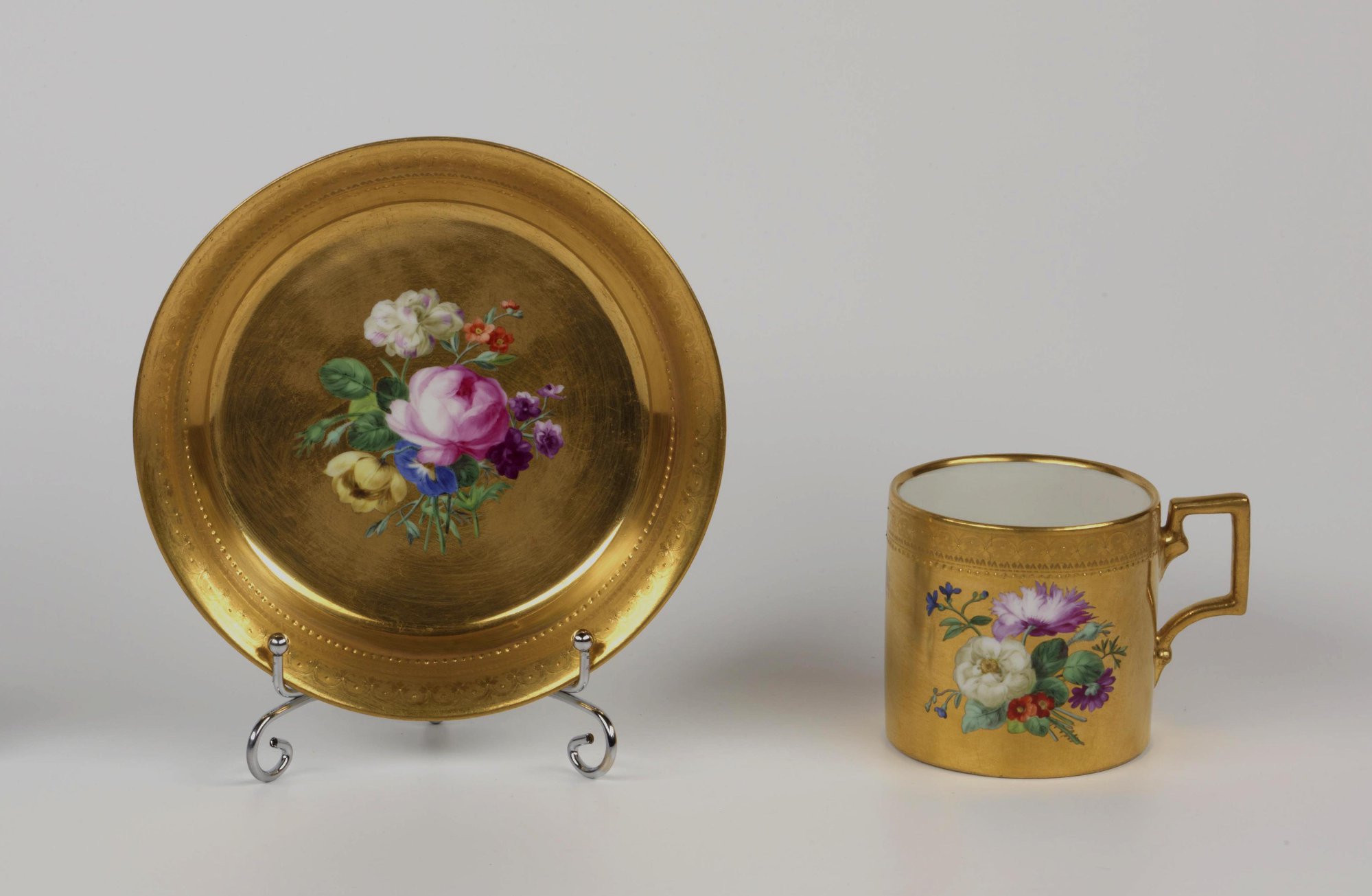
Organization: Imperial Porcelain Manufactory, Vienna
Origin: Austria, Vienna
Date: late 18th – early 19th century
Complex: Breakfast Service (Déjeuner)
Material: porcelain
Technique: gilding, polychrome painting
Dimensions: length 31 cm; width 23 cm
Current Collection: The State Hermitage Museum
Inventory Number: ZF-17054
Hermitage ID: 352437
Rudanovsky Connection: Entered the Hermitage in 1919 from the collection of A. K. Rudanovsky.
A Viennese porcelain tray of the late eighteenth or early nineteenth century, from a breakfast service.
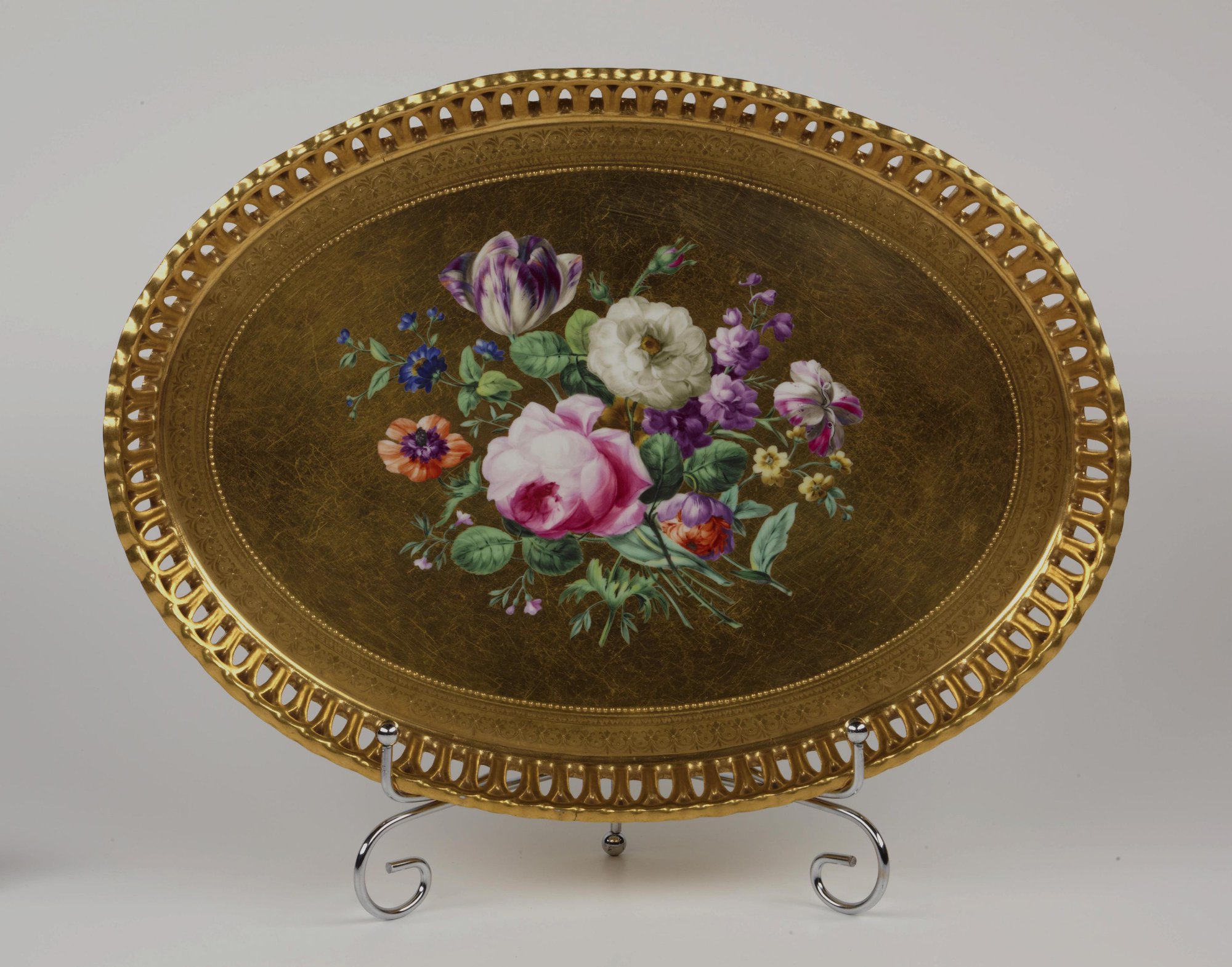
Tray, Breakfast Service (ZF-17054). The State Hermitage Museum.
The tray entered the Hermitage in 1919, transferred through the Branch for the Protection of Monuments of Art and Antiquities from the collection of A. K. Rudanovsky. It is not currently on permanent display.
It is an oval tray — 31 by 23 centimetres — with a pierced gold gallery and a central bouquet of flowers.
The Object
The tray is oval, with a flat centre and a raised, pierced rim.
The rim is gilded, and it is cut with a pattern of arches and slots — a gallery, designed to keep the cups and the plates in place. The centre is painted with a dense bouquet of flowers on a brown-gold ground.
The tray is part of a breakfast service, a déjeuner, and it was made to carry the cups, the pot and the plates of a small meal.
The Déjeuner
A déjeuner is a breakfast or a small meal service.
It was a set of porcelain for one or two people: a tray, a teapot or coffee pot, cups, a sugar bowl, a milk jug and plates. It was used for a private meal, served in a bedroom, a boudoir or a garden pavilion.
Déjeuners were popular in the eighteenth and nineteenth centuries, and they were made by the great European factories.
The Gallery
The gallery is the tray’s most distinctive feature.
It is a pierced rim, cut with a repeating pattern of arches, and it is gilded. Its function was practical: it kept the cups and the plates from sliding off the tray.
The gallery is also decorative: it gives the tray a crown of gold, and it catches the light.
The Bouquet
The bouquet is the tray’s centre.
It is a dense arrangement of flowers: a pink rose, a striped tulip, a white flower, blue convolvulus and smaller blossoms, with green leaves. The flowers are painted with care, and their colours are strong.
The bouquet is the tray’s decoration, and it is also its subject: a garden, painted on a tray for a breakfast.
The Gold Ground
The ground is brown-gold.
It is a dark, warm colour, painted with fine lines that suggest a texture, and it makes the flowers stand out. The gold ground is a feature of Viennese porcelain of the period.
A dark ground is a deliberate choice: it gives the bouquet depth, and it makes the tray look rich and luxurious.
Vienna
The tray was made in Vienna.
The Imperial Porcelain Manufactory of Vienna was one of the earliest in Europe, and it produced services, figures and decorative objects. In the late eighteenth and early nineteenth centuries, it was known for its rich grounds, its flower painting and its gilding.
The tray belongs to that production, and it shows the Viennese taste for colour and ornament.
The Service
The tray is part of a service.
The other pieces — cups, pot, plates — are not preserved with it, or they are catalogued separately. Together, they formed a déjeuner, a small world of porcelain for a private meal.
A service is a system: each piece is designed to match the others, and the tray is its stage.
The Cups
The tray was made for cups.
A déjeuner included two cups and saucers, a pot, a sugar bowl and a milk jug, and the tray carried them all. The cups stood on the tray, and the gallery kept them in place.
The cups that went with this tray are not preserved with it, but the tray still suggests them: a small, complete breakfast, carried in on porcelain.
The Rim
The rim of the tray is raised and gilded.
It is a thin band of gold, and it frames the painted centre like a picture frame. The rim is the tray’s edge, and it is where the object is most handled.
Gilded rims of this kind are a feature of Viennese porcelain, and they give the tray its finish.
The Tulip
A striped tulip stands at the top of the bouquet.
It is painted in white and purple, with a fine pattern of stripes, and it is one of the most striking flowers in the composition. Tulips were a luxury flower in the eighteenth century.
The tulip gives the bouquet its height and its colour accent, and it balances the rose at the centre.
The Table
The tray was made for a table.
It stood at the centre of a breakfast, surrounded by cups and plates, and it was the stage for the meal. Its gold and flowers would have caught the morning light.
That table is gone, but the tray still carries its logic: a small platform for a private ceremony.
The Collector
The tray came to the Hermitage with the Rudanovsky collection.
Rudanovsky collected European porcelain alongside paintings, drawings, glass and miniatures, and his collection included Viennese services and decorative objects.
The tray is therefore a double document: of Vienna in the late eighteenth century and of a Russian collector’s taste.
The Gold
The gold is the tray’s frame.
It covers the gallery, the rim and the lines around the centre, and it is the most expensive part of the decoration. It was applied last, and it is the first to wear.
The gold gives the tray its richness, and it makes the brown ground glow.
The Painting
The painting is dense and precise.
The bouquet is built from many small strokes: petals, leaves, stems, buds. The painter has modelled each flower, and the result is a bouquet that seems to have been gathered, not painted.
The painting is the work of a specialist, and it is the tray’s chief ornament.
The Brown Ground
The ground is brown, with a golden sheen.
It is painted in thin layers, with fine lines that suggest a texture, and it is darker at the edges and lighter toward the centre. The ground gives the bouquet its depth, and it makes the flowers appear to float.
A dark ground is a deliberate choice: it concentrates attention on the flowers, and it gives the tray a rich, luxurious look.
Provenance
The tray carries the inventory number ZF-17054. It entered the Hermitage in 1919, transferred through the Branch for the Protection of Monuments of Art and Antiquities from the collection of A. K. Rudanovsky.
In the Hermitage
The tray is preserved in the State Hermitage Museum in Saint Petersburg and is not on permanent display.
It is a fine example of Viennese porcelain, and it preserves a small ceremony: a tray, a bouquet and a breakfast, painted two centuries ago.
The tray is a small painting with a practical edge, and it has carried its flowers through two centuries without dropping a petal.
It is a tray, and it is also a garden, and it has outlasted the breakfast it was made for.