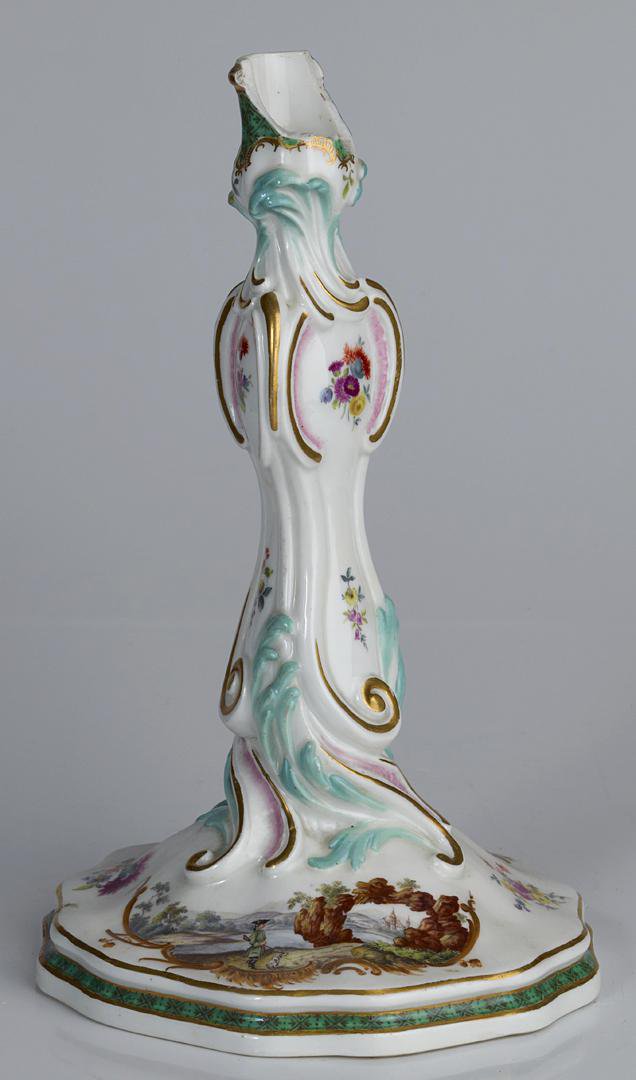
Organization: Meissen Porcelain Manufactory
Origin: Germany (Saxony), Meissen
Date: 1766–1768
Complex: Hunting Service
Material: porcelain
Technique: polychrome overglaze painting, gilding
Dimensions: diameter 22.6 cm
Current Collection: The State Hermitage Museum
Inventory Number: ZF-18710
Hermitage ID: 427166
Rudanovsky Connection: Entered the Hermitage in 1919; previously in the A.S. Dolgorukov collection
A Meissen soup plate of 1766–1768 from the «Hunting Service», painted with a huntsman on horseback.
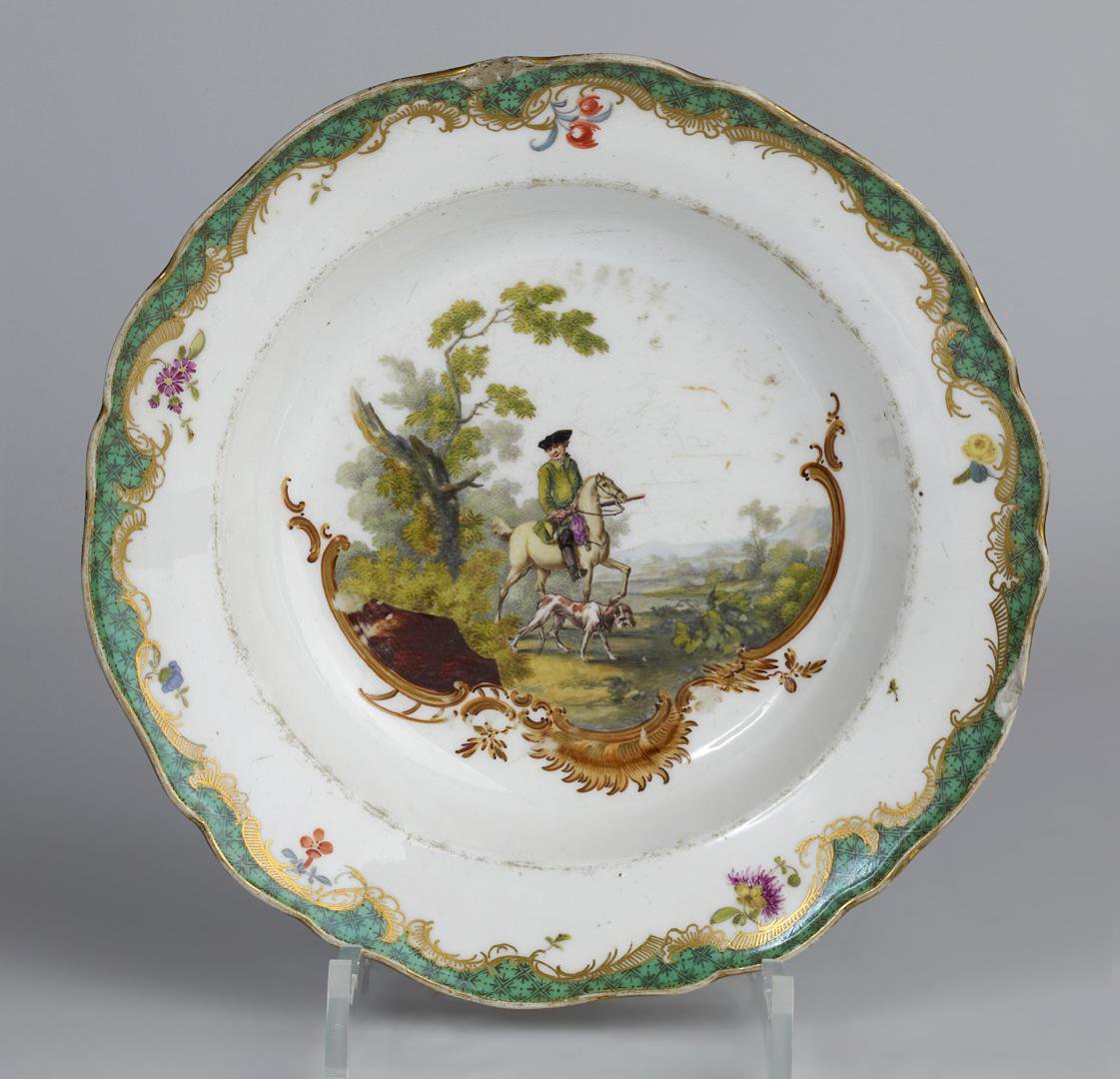
Soup Plate Depicting a Huntsman with his Dog. The State Hermitage Museum.
The plate entered the Hermitage in 1919, transferred from the Office for the Preservation of Monuments of Art and Antiquity. The record notes that it was previously in the A. S. Dolgorukov collection.
It is a round soup plate — 22.6 centimetres across — with a green border and a painted huntsman in the centre.
The Object
The plate is round, with a wide rim, a shallow well and a scalloped edge.
Its rim is green, painted with a diaper pattern and edged with gold scrolls and flowers. In the centre, a gold cartouche frames a huntsman on a white horse, with a dog beside him.
The painting is delicate, and the colours are soft: greens, browns, whites and greys.
The Huntsman
The huntsman is the plate’s subject.
He sits on a white horse, dressed in a green coat and a black hat, and he holds a whip or a hunting crop. His face is turned toward the viewer, and his pose is calm and elegant.
He is a gentleman of leisure, not a working hunter: his dress, his horse and his pose belong to the world of the eighteenth-century nobility.
The Horse
The horse is white.
It stands still, its head turned, its legs planted, and it is painted with care: the mane, the tail, the hooves. Its whiteness makes it the plate’s brightest element.
Horses were a favourite subject of porcelain painters, and they were a sign of status: a gentleman on a good horse was an image of wealth and leisure.
The Dog
A dog stands beside the horse.
It is white with brown spots, and it looks up at the rider. It is a hunting dog, and its presence completes the scene.
The dog gives the plate its narrative: the huntsman is resting, and the dog is waiting.
The Cartouche
The cartouche is a gold frame.
It is painted with scrolls and leaves, and it surrounds the huntsman like a window. Its shape is irregular, and it follows the landscape.
Cartouches of this kind are a feature of the service: they frame each scene and separate it from the white ground.
The Border
The border is green.
It is painted with a diaper pattern of small stars, and it is edged with gold scrolls and small flower sprays. Its colour contrasts with the white ground and the brown landscape.
The border is one of the signs of the service, and it unites its many pieces.
The Service
The plate belongs to the Meissen «Hunting Service».
The service was made in 1766–1768, and it was decorated with hunting scenes after paintings and prints. It was one of the most ambitious services of the eighteenth century.
Its pieces include plates, dishes, tureens, candlesticks and leaf-shaped trays, all painted with scenes of the chase.
The Provenance Note
The plate’s record is unusual.
Unlike most of the works in this group, it does not mention the Rudanovsky collection: it names the Dolgorukov collection instead. The two collections were both in Petrograd, and objects could pass between them, but the record is what it is.
This is worth stating plainly: not every object in this group came through the same hands.
The Economy of the Scene
The scene is economical.
A rider, a horse, a dog, a few trees and a slope: that is all. Yet the picture is complete, and it tells a story of leisure and the chase.
Economy of this kind is a feature of the service: the painters trusted a few figures and a large white ground.
The Trees
The trees are painted in soft greens.
A large tree rises behind the horse, and a smaller one stands at the right. Their foliage is described in masses, and their trunks are painted with a few strokes.
Trees of this kind frame the scene and give it depth, and they connect the rider to the landscape.
The Land
The land is a soft, rolling landscape.
It is painted in greens and browns, with a distant hill and a pale sky. The ground under the horse is grassy, and the horizon is low.
Landscapes of this kind are a convention of hunting scenes: they provide a setting without distracting from the action.
The Gold
The gold is applied in scrolls and lines.
It edges the rim, frames the cartouche and covers the small rococo ornaments. It was applied over the glaze, fired and burnished.
The gold gives the plate its richness, and it frames the huntsman.
The Table
The plate was made for a table.
It was a soup plate, and it stood at the place of a guest at a grand dinner. Its hunting scene would have been admired between courses.
That table is gone, but the plate still carries its function: a vessel for soup, and a picture for the interval.
The Whip
The huntsman holds a whip or a crop.
It is a thin, dark line in his hand, and it curves slightly. It is the attribute of the rider, and it completes his costume.
A whip is a small detail, but it turns the seated figure into a man on horseback, ready to move.
The Hat
The huntsman wears a black hat.
It is a tricorn or a round hat, and it sits low on his head. Its dark colour contrasts with the white horse and the green coat.
Hats of this kind are a feature of eighteenth-century costume, and they are painted with a few strokes.
The White Horse’s Harness
The horse wears a bridle and a saddle.
They are painted in brown and red, with gold details, and they are visible under the rider. The harness gives the horse its function, and it adds a note of colour to the white body.
Details of this kind are what make a painted animal convincing, and the painter does not neglect them.
The Piece’s Number
The plate carries an inventory number, ZF-18710.
Numbers of this kind were given by the museum, and they identify the object in the collection. They are the modern equivalent of the old owners’ marks.
The number is a small trace of the object’s life after the table: it is a museum object now.
Provenance
The plate carries the inventory number ZF-18710. It entered the Hermitage in 1919, transferred from the Office for the Preservation of Monuments of Art and Antiquity, and it was previously in the A. S. Dolgorukov collection.
In the Hermitage
The plate is preserved in the State Hermitage Museum in Saint Petersburg and is not on permanent display.
It is a fine example of Meissen porcelain, and it preserves a hunting scene: a rider, a white horse and a dog, painted on a soup plate more than two centuries ago.
It is a plate, and it is a small painting, and it has kept its rider and his white horse for more than two centuries.