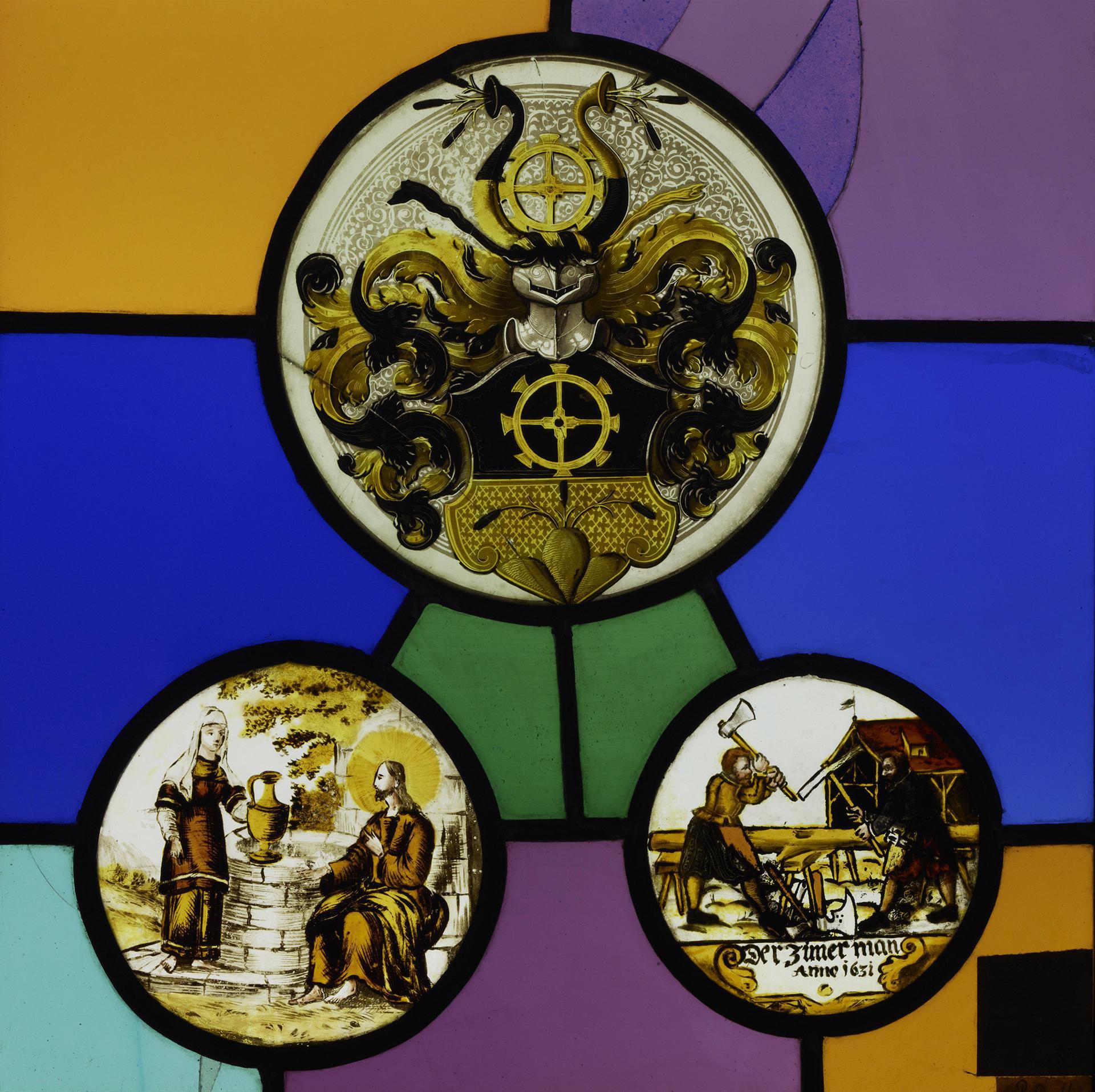
Artist: Anonymous master
Origin: Switzerland
Date: 1692
Material: coloured and clear glass, lead
Technique: silver stain, overglaze painting
Dimensions: 33.5 × 23 cm
Current Collection: The State Hermitage Museum
Inventory Number: V-204
Hermitage ID: 134670
Rudanovsky Connection: Entered the Hermitage in 1919 from the collection of A. K. Rudanovsky.
A Swiss stained-glass panel of 1692, painted with a standard-bearer in armour holding a red banner, flanked by two saints.
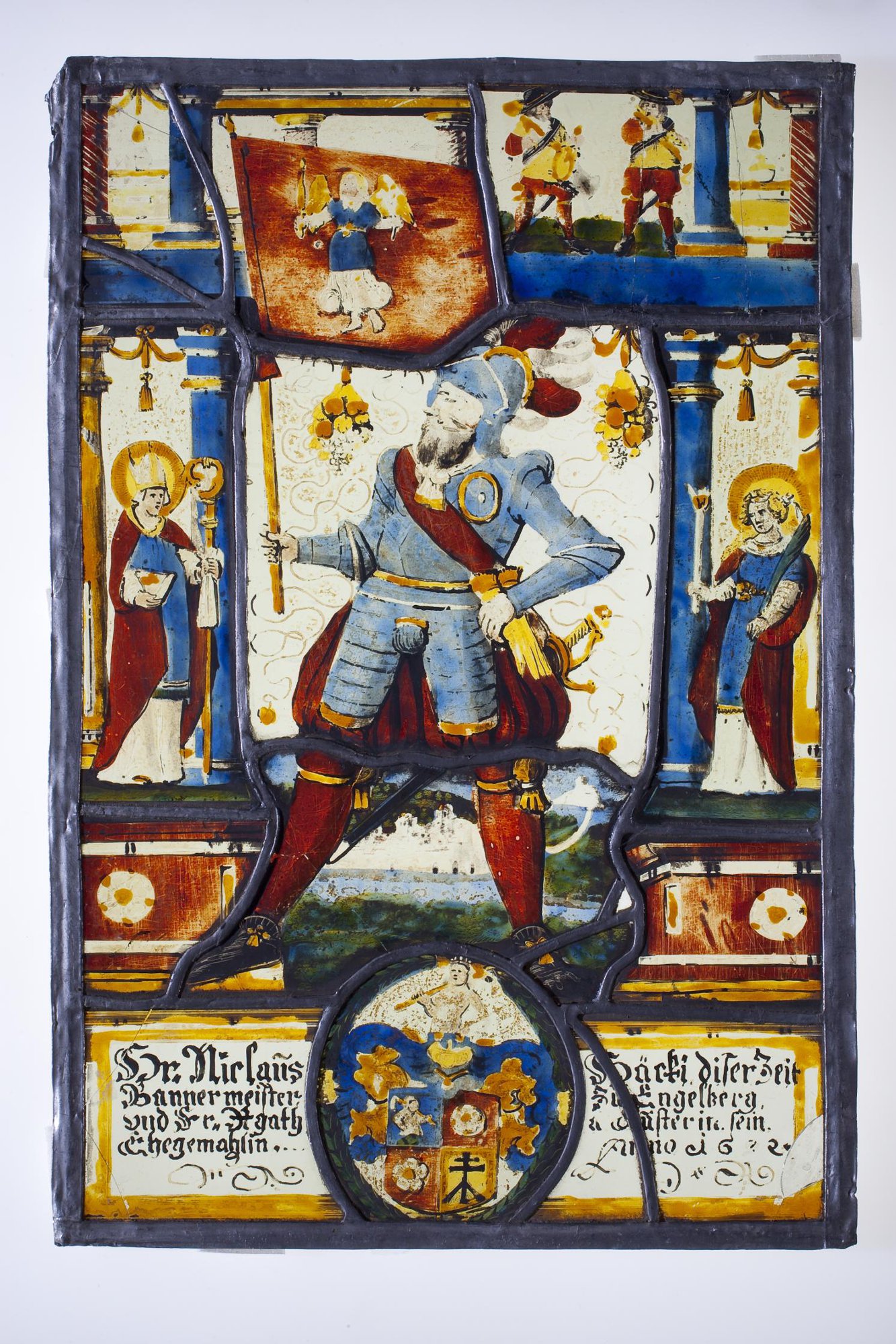
Stained Glass Bannerman from Engelberg. The State Hermitage Museum.
The panel entered the Hermitage in 1919 from the collection of A. K. Rudanovsky. It is not currently on permanent display.
It is a vertical panel, 33.5 by 23 centimetres, with an architectural frame, a central figure, two side figures and a coat of arms at the bottom.
The Object
The panel is framed by painted columns, cornices and a tiled floor, in grey, blue and gold.
In the centre stands a bearded man in armour, holding a red banner with a white figure — a child or an angel — on it. To his left and right, two saints stand under small canopies: one in a red cloak with a crozier, one in a blue cloak with a sword.
At the bottom, a roundel with a coat of arms, and an inscription in black lettering on a yellow band.
The Bannerman
The central figure is a standard-bearer — a Bannerträger.
He wears plate armour, a blue sash and a helmet with a plume, and he holds the banner staff in one hand, the fabric in the other. His pose is confident, almost swaggering, and his gaze is directed at the viewer.
The standard-bearer was a figure of civic and military pride in Swiss art: he represented the town, the canton or the family that commissioned the panel.
The Banner
The banner is red, with a white figure in the centre.
The figure is difficult to identify: it may be a child, an angel or a heraldic charge. The banner is the bannerman’s attribute, and it carries the identity of the group he represents.
In Swiss panels, banners often bear the arms of the canton or the town, and they are painted with care as the emblem of collective identity.
The Saints
The two saints flank the bannerman.
The one on the left wears a red cloak and holds a crozier — a bishop or an abbot. The one on the right wears a blue cloak and holds a sword — a martyr or a warrior saint.
They are the patron saints of the donor, the town or the church, and their presence turns the panel into an act of devotion as well as a display of status.
Engelberg
The inscription names Engelberg, a town and monastery in central Switzerland.
Engelberg was a Benedictine abbey founded in the twelfth century, and it was a centre of art and learning in the region. The panel may have been made for the abbey, the town hall or a family connected with the monastery.
The place name anchors the object in a specific landscape and community.
The Arms
The coat of arms at the bottom belongs to the donor.
It is painted in a roundel, with a helmet and mantling, and it is surrounded by a wreath. The arms identify the family — probably the Bannermeister family named in the inscription.
Heraldry is the panel’s documentary core: it records the donor’s identity and status, and it allows the object to be connected to a specific person.
The Inscription
The inscription is painted on a yellow band at the bottom.
It names Hr. Niclaus Bannermeister and Fr. Agatha, his wife, and it records the place and date: Engelberg, Anno 1692.
The text is in German black letter, and it is partly legible. It is the panel’s archive, and it turns a decorative object into a historical document.
Silver Stain
The panel is painted with silver stain and overglaze painting.
Silver stain produces the yellows and golds — the armour, the halos, the architectural details — while overglaze painting draws the faces, the draperies and the heraldry.
The combination gives the panel its rich, luminous colour, and it is one of the great techniques of Swiss glass painting.
The Architecture
The panel is framed by painted architecture.
Columns, cornices, a tiled floor and a canopy create a shallow stage for the figures. The architecture is drawn in perspective, in grey, blue and gold, and it gives the scene depth and dignity.
This framing device is common in Swiss panels of the seventeenth century, and it connects the glass painting to the traditions of Renaissance perspective.
The Canopies
The two saints stand under small canopies.
The canopies are painted in gold and blue, with tassels and fringes, and they mark the saints as figures of honour. They also create a rhythm across the panel: bannerman in the centre, saints at the sides, each under his or her own canopy.
Canopies of this kind are a standard element of religious painting, and they give the panel a ceremonial character.
Glass and Church
The panel was probably made for a church or a monastery.
Stained glass was one of the great arts of the medieval and early modern church: it told stories, honoured saints and filled the interior with coloured light. Even after the Reformation, panels continued to be donated to churches and chapels.
The panel’s saints, its banner and its inscription all point to a religious context, and to a donor who wanted to be remembered in glass.
The Panel in a Window
The panel was set into a window, and it was seen in daylight.
The lead cames held it in place, the stone tracery framed it, and the light passed through the glass, making the colours glow. In a museum, the panel is lit artificially, but the glass still holds the memory of that light.
The Bannerman’s Sword
The bannerman carries a sword at his side.
The sword is a sign of his military role: the standard-bearer was a soldier, and he carried the banner into battle or into procession. In the panel, the sword is painted with gold and silver, and it hangs from a belt at his waist.
The combination of banner and sword is the image of civic and military honour, and it gives the figure his authority.
Provenance
The panel carries the inventory number V-204 and entered the Hermitage in 1919 from the collection of A. K. Rudanovsky.
In the Hermitage
The panel is preserved in the State Hermitage Museum in Saint Petersburg and is not on permanent display.
It is a fine example of Swiss stained glass of the late seventeenth century, and it preserves, in glass and lead, the memory of a family, a town and a year.
In the panel, the bannerman stands as he stood in life: armoured, confident, holding the colours of his community above his head. The glass has kept him there, in blue and red and gold, for more than three hundred years — longer than the banner he holds, longer than the town he served.
He is a small figure in a small panel, but he stands for a whole community: its faith, its pride and its memory. In a window, he would have been seen every day, by people who knew his name.