Origin: Switzerland
Date: 1631
Material: glass, lead
Dimensions: 34.5 × 33.2 cm
Current Collection: The State Hermitage Museum
Inventory Number: V-209
Hermitage ID: 134675
Rudanovsky Connection: Entered the Hermitage in 1919 from the collection of A. K. Rudanovsky.
A Swiss stained-glass panel of 1631 with three roundels: a coat of arms above, Christ and the Samaritan woman at the lower left, and two carpenters at the lower right.
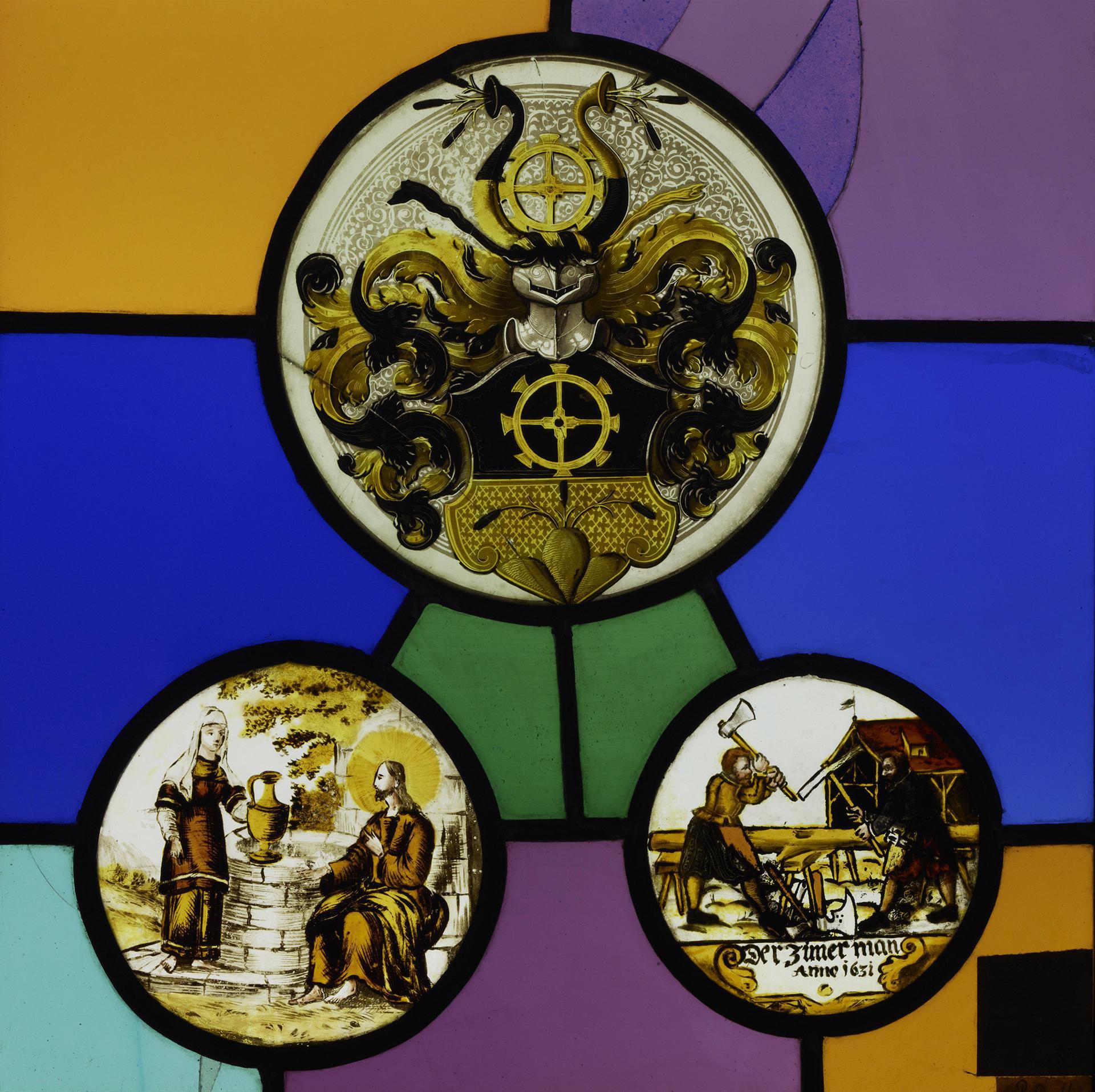
Stained Glass of Three Round Glasses: Shield with the Coat-of-Arms, Christ and the Samaritan Woman, Two Carpenters. The State Hermitage Museum.
The panel entered the Hermitage in 1919 from the collection of A. K. Rudanovsky. It is not currently on permanent display.
It is a square panel, 34.5 by 33.2 centimetres, composed of three painted roundels set into a ground of coloured glass.
The Object
The panel is built as a composition of circles.
At the top, a large roundel contains a coat of arms with a wheel; below, two smaller roundels sit side by side. Between them, the ground is made of blue, yellow, purple and green glass, cut into geometric shapes.
The painting is in black and brown, with yellow highlights, and the roundels are bordered by lead cames.
The Three Roundels
The three roundels are the panel’s three subjects.
The upper one is heraldic: a coat of arms with a wheel, a helmet and mantling. The lower left is biblical: Christ seated at a well, speaking to the Samaritan woman. The lower right is a scene of labour: two carpenters at work.
The combination is typical of Swiss panels, where heraldry, devotion and daily life are brought together in a single object.
The Arms
The coat of arms at the top belongs to the donor.
It shows a wheel — the symbol of a miller, a wagoner or a guild — on a shield, with a helmet, mantling and a crest. The wheel is a speaking emblem: it identifies the family or the trade by a single, legible sign.
Heraldry in Swiss panels is often professional as well as familial: the arms may refer to a guild, a town or a craft.
Christ and the Woman
The lower left roundel shows Christ and the Samaritan woman.
Christ sits beside a well, his hand raised, and the woman stands before him with a jar. The scene is painted in brown and yellow, with a tree and a landscape behind.
The subject — the conversation at the well — is one of the most popular in Christian art, and it was a favourite of stained-glass donors because it spoke of faith, welcome and eternal life.
The Carpenters
The lower right roundel shows two carpenters at work.
One stands on a beam, holding an axe; the other bends over a piece of timber. A house is under construction behind them, and the inscription below reads Der Zimmerman — «the carpenter».
The scene is a genre picture: a snapshot of work, with tools, wood and a building site.
The Guild
The carpenters’ roundel suggests a guild connection.
Many Swiss panels were commissioned by guilds, and they showed the tools and activities of the trade. A carpenter’s panel would have been donated by the carpenters’ guild or by a master carpenter.
The combination of the arms, the biblical scene and the workshop scene is characteristic: the panel presents the donor’s trade, faith and status at once.
1631
The date 1631 places the panel in the seventeenth century.
At that time, Swiss stained glass was flourishing: the Reformation had reduced church commissions, but civic and private panels multiplied. Guilds, families and town councils commissioned windows for town halls, guild houses and churches.
The panel belongs to that civic tradition, and it records the identity of a group rather than of an individual.
Silver Stain
The panel is painted with silver stain and overglaze painting.
Silver stain gives the yellows — the wheel, the halos, the wood — while overglaze painting draws the faces, the draperies and the details. The colours are applied to clear glass and fired, so that they fuse with the surface.
The technique is one of the glories of Swiss glass painting, and it gives the panel its warm, luminous quality.
The Ground
The ground is a mosaic of coloured glass.
Blue, yellow, purple and green pieces are cut into geometric shapes and assembled around the roundels. The colours are the colour of the glass itself, and they glow with a saturated intensity.
The lead lines separate the colours and draw the outlines, and the whole surface becomes a pattern of light and dark.
The Well
The well in the biblical roundel is a stone structure with a wooden beam.
It is painted in brown and grey, and it serves as a seat for Christ and as a stage for the conversation. In the Gospel, the well is Jacob’s well, a place of memory and prophecy.
The painter gives the well a simple, legible form, and it anchors the two figures in the landscape.
Tools and Work
The carpenters’ roundel is a picture of work.
The tools — axe, adze, rule — are painted with care, and the timber, the beam and the house under construction are all described. The scene is not idealized: it shows labour, dust and effort.
This interest in work is characteristic of seventeenth-century art, where genre scenes and trades became subjects in their own right.
The Panel in a Window
The panel was made for a window.
It was set into a larger window, in a guild hall or a church, and it was seen in daylight. The three roundels told three stories at once: the family, the faith and the trade.
In a museum, the panel is isolated, but its three subjects still speak together.
The Wheel
The wheel in the coat of arms is the panel’s heraldic key.
It is painted in gold on a dark shield, with a helmet above and mantling around. The wheel could refer to a miller, a cartwright, a wheelwright or a guild of carters; without the inscription, its exact meaning is uncertain.
Heraldic signs of this kind are often professional: they identify the donor’s trade as well as his family. The wheel is a simple, legible emblem, and it runs through the whole panel as its visual signature.
Provenance
The panel carries the inventory number V-209 and entered the Hermitage in 1919 from the collection of A. K. Rudanovsky.
In the Hermitage
The panel is preserved in the State Hermitage Museum in Saint Petersburg and is not on permanent display.
It is a compact, legible object, and it brings together three worlds — heraldry, scripture and work — in a single square of glass, lead and paint.
Each roundel tells a story: who the donor was, what he believed and how he earned his living. In a window, those three stories were read together, in the light of day, by anyone who looked up.
That is the genius of the panel: it is a self-portrait of a whole life, compressed into three circles of glass.
A coat of arms, a gospel scene and a workshop: together they say who a man was, what he believed and what he did — and they say it in glass, which has kept them bright, legible and quiet for four long centuries and more.