Artist: Anonymous master
Origin: Switzerland
Date: 1604
Material: coloured and clear glass, lead
Technique: silver stain, overglaze painting
Dimensions: 34 × 23 cm
Current Collection: The State Hermitage Museum
Inventory Number: V-207
Hermitage ID: 134673
Rudanovsky Connection: Entered the Hermitage in 1919 from the collection of A. K. Rudanovsky.
A Swiss stained-glass panel of 1604, made for Father Peter Schmid, with God the Father above, saints at the sides and a coat of arms with a bishop’s mitre below.
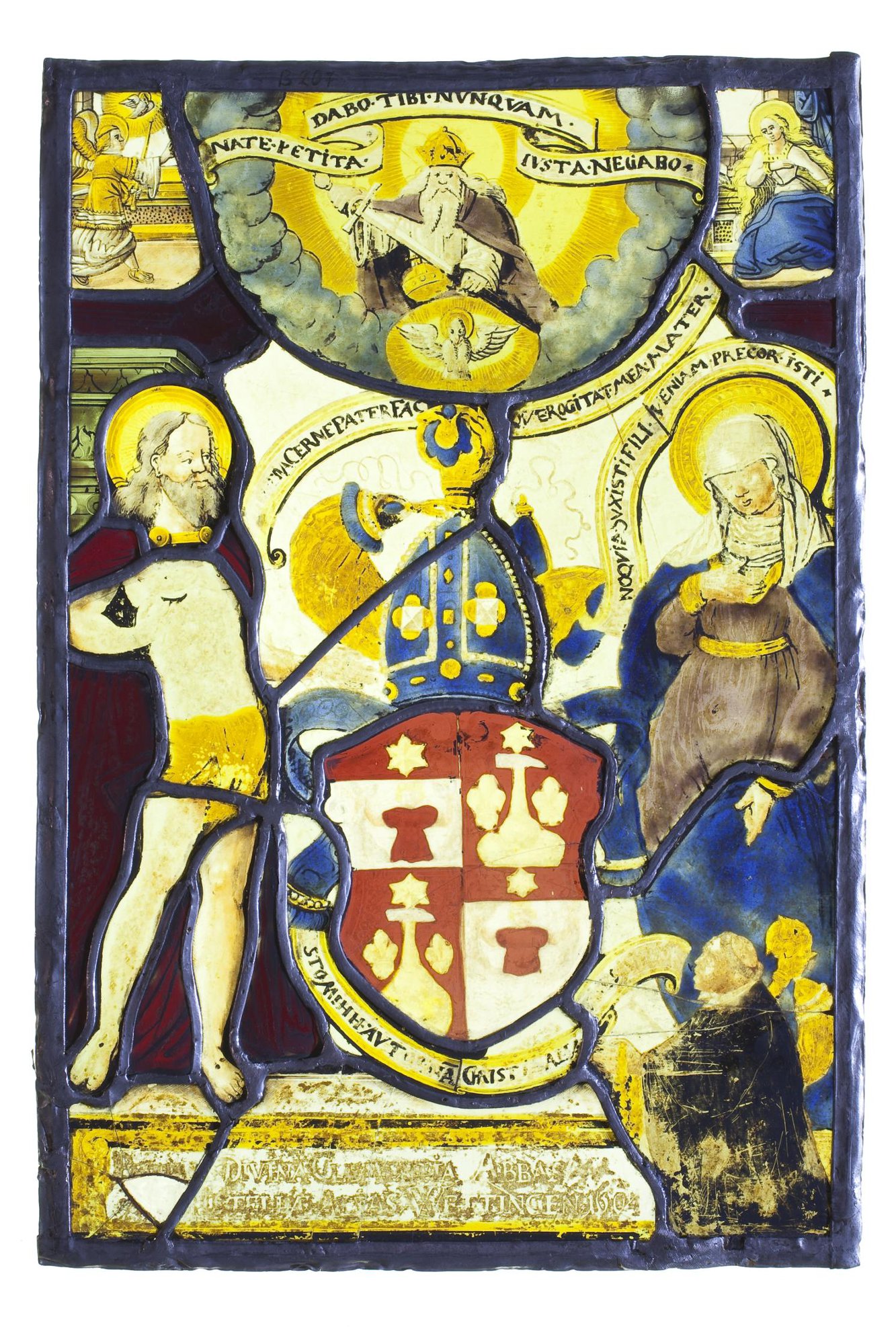
Stained Glass from father Peter Schmid. The State Hermitage Museum.
The panel entered the Hermitage in 1919 from the collection of A. K. Rudanovsky. It is not currently on permanent display.
It is a vertical panel, crowded with figures, inscriptions and heraldry — a devotional object made for a monastery or a church.
The Object
At the top, God the Father appears in a mandorla of clouds, holding a crucifix and a dove.
Below, on the left, a bearded saint stands with his hands behind his back, arrows in his body — St Sebastian. On the right, a woman in a veil holds a small tower — probably St Barbara.
At the bottom, a large coat of arms with a mitre and a crosier, and a small kneeling figure in a dark habit, the donor. Bands of inscription run through the composition.
God the Father
God the Father is the panel’s summit.
He is shown as an old man with a white beard, wearing a crown and a cloak, holding the crucifix and the dove of the Holy Spirit. The three persons of the Trinity are thus present in a single image.
The mandorla of clouds and the golden background give him a celestial setting, and the inscriptions around him are words of scripture.
The Trinity
The image is a Trinity.
The Father holds the Son on the cross, and the dove represents the Holy Spirit. This composition — the «Throne of Grace» — was one of the most common in medieval and Renaissance art.
It presents the mystery of the Trinity in a single, legible image, and it was especially favoured in devotional panels.
The Saints
Two saints flank the composition.
St Sebastian, on the left, is shown naked except for a loincloth, his body pierced by arrows. He was a plague saint, invoked against epidemics, and he was one of the most popular intercessors of the period.
The female saint on the right holds a tower. She is probably St Barbara, a martyr invoked against sudden death, and her tower is her attribute.
The Arms and Mitre
The coat of arms at the bottom is the panel’s heraldic centre.
It is a quartered shield with a mitre above and a crosier behind — the insignia of an abbot or a bishop. The arms identify the donor’s office as well as his family.
The mitre and crosier are painted in blue and gold, and they stand out against the red and white of the shield.
The Abbot
The donor is a small figure at the lower right.
He kneels in a dark habit, his hands raised in prayer, and he is shown in profile. He is the «Father Peter Schmid» of the title — an abbot, priest or monk who commissioned the panel.
The small figure is a signature: it records the donor’s presence, humility and devotion.
1604
The date 1604 places the panel after the Reformation.
In Switzerland, the Reformation had transformed religious art: churches were stripped of images, and stained glass moved from churches to town halls and private houses. Panels like this one were made for Catholic institutions or for families that remained loyal to the old faith.
The panel’s Catholic imagery — the Trinity, the saints, the abbot — belongs to that confessional world.
The Inscription
The panel is covered with inscriptions.
Bands of text run around the figures and below the arms: Latin phrases, the names of the donors and the date. They are painted in black letter and are partly legible.
Inscriptions of this kind are the panel’s archive: they identify the donors, the saints and the occasion, and they allow the object to be dated.
Silver Stain
The panel is painted with silver stain and overglaze painting.
Silver stain gives the yellows — the clouds, the halos, the mitre — while overglaze painting draws the faces, the draperies and the inscriptions.
The combination produces a dense, glowing surface, in which the figures seem to emerge from the glass.
The Mandorla
God the Father appears in a mandorla of clouds.
The mandorla — an almond-shaped halo — is a medieval symbol of divine glory. Here it is formed by clouds, painted in grey and gold, and it surrounds the figure like a window into heaven.
The mandorla is the panel’s visual summit: it draws the eye upward. and it frames the Trinity at the centre of the composition.
The Donor
The donor is the panel’s human centre.
He kneels in a dark habit, his hands raised, his face in profile. He is small, humble and slightly awkward, and he is placed at the edge of the composition, as if he did not want to intrude.
This is the standard pose of the donor in religious art: present but subordinate, praying but not claiming attention.
The Confession
The panel is a Catholic object.
Its imagery — the Trinity, the saints, the abbot, the mitre — belongs to the old faith, and it was made at a time when Switzerland was divided between Catholic and Protestant cantons.
A panel like this was a statement of confessional identity as well as a work of art, and it was commissioned by someone who wanted to affirm his faith in glass.
The Panel in a Window
The panel was set into a window.
It was seen in daylight, in a church or a chapel, and it was read as a devotional image: the Trinity above, the saints at the sides, the donor below.
In a museum, the panel is isolated and lit artificially, but the glass still carries the memory of the light for which it was made.
The Tower
The tower held by the female saint is her attribute.
In the legend of St Barbara, her father shut her in a tower to keep her from the world; the tower became her symbol, and she is always shown with it. She was invoked against lightning and sudden death.
The tower in the panel is small and painted in gold and brown, but it is enough to identify the saint and to connect her to her story.
Provenance
The panel carries the inventory number V-207 and entered the Hermitage in 1919 from the collection of A. K. Rudanovsky.
In the Hermitage
The panel is preserved in the State Hermitage Museum in Saint Petersburg and is not on permanent display.
It is a compact devotional object, and it preserves, in glass and lead, the faith, the heraldry and the memory of a Swiss abbot.
It is also a document of a divided Europe: a Catholic image, made in a Protestant century, for a man who wanted his faith in his window, in glass that would last longer than he would — and it has, for more than four centuries.