Origin: Switzerland
Date: 1727
Material: glass, lead
Dimensions: 33.2 × 29 cm
Current Collection: The State Hermitage Museum
Inventory Number: V-205
Hermitage ID: 134671
Rudanovsky Connection: Entered the Hermitage in 1919 from the collection of A. K. Rudanovsky.
A Swiss stained-glass panel of 1727, painted with two coats of arms — one in a roundel, one on a shield — against a ground of coloured glass.
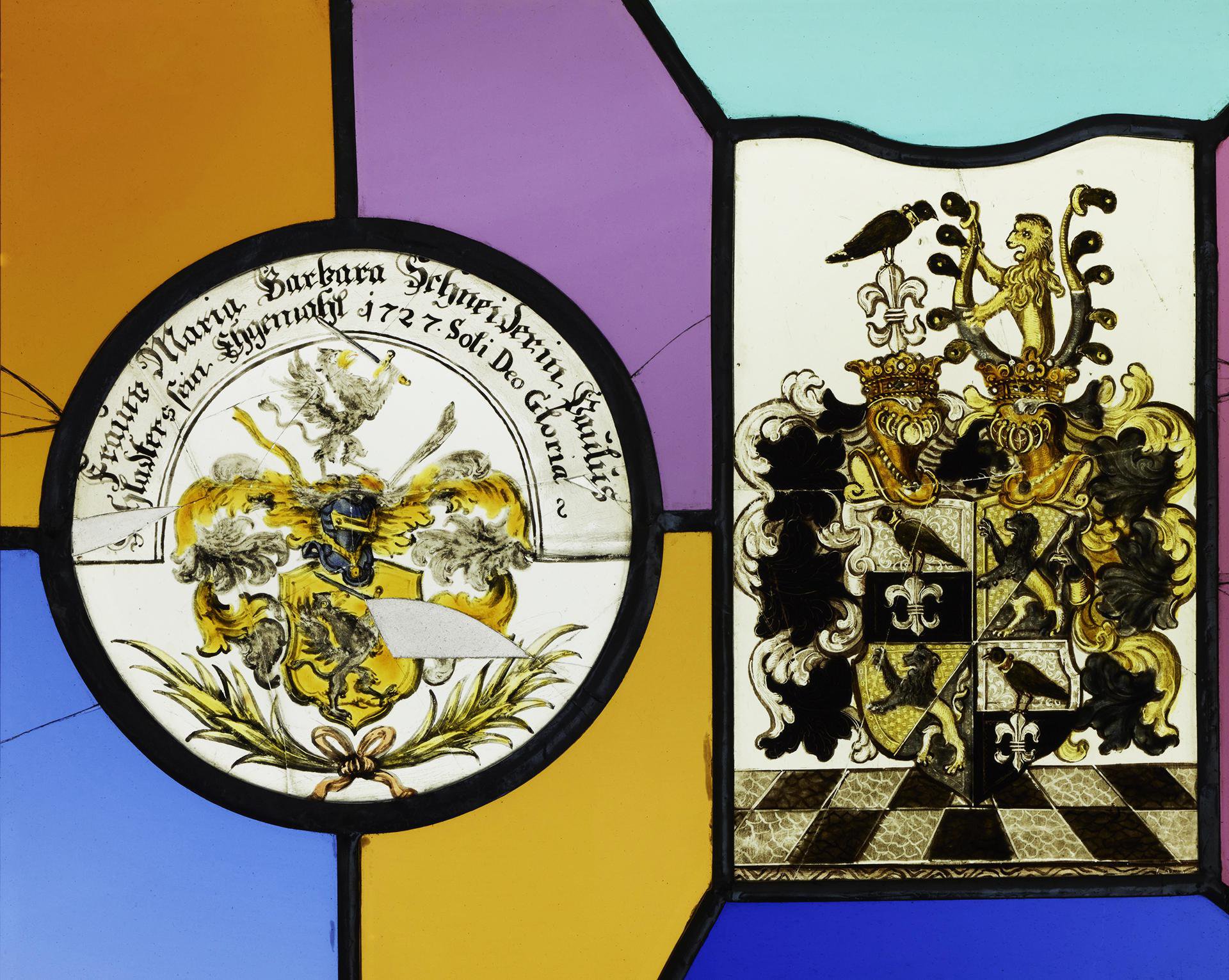
Stained Glass of Two Glasses Depicting the Coat-of-Arms. The State Hermitage Museum.
The panel entered the Hermitage in 1919 from the collection of A. K. Rudanovsky. It is not currently on permanent display.
It is a panel of coloured glass, assembled in a patchwork of yellow, purple, blue and turquoise, with two painted coats of arms at the centre.
The Object
The panel is almost square, 33 by 29 centimetres.
Its ground is made of large pieces of coloured glass — yellow, purple, blue, turquoise — held together by lead cames. At the centre, two painted panels: on the left, a roundel with an inscription and a coat of arms; on the right, a shield with a larger and more elaborate achievement.
The painting is in black and brown, with yellow and white highlights, and the glass is clear where the arms are painted.
Two Glasses
The title describes the panel as «two glasses» — two painted panes set into a single window.
The left pane is a roundel: a circular cartouche with an inscription around its edge and a coat of arms in the centre. The right pane is a shield: a large, shaped panel with a full heraldic achievement — shield, helmet, mantling and crest.
The two panes may commemorate a marriage, a partnership or two branches of a family.
The Schneider Arms
The inscription names the donors.
It reads, in German: Frau Maria Barbara Schneiderin, gebohrne … 1727 — «Mrs Maria Barbara Schneider, née … 1727». The text is partly legible, and it identifies the panel as a donation by a woman of the Schneider family.
The arms in the roundel and on the shield belong to the family and to its alliances.
The Roundel
The roundel is the smaller of the two painted panes.
It contains a shield with a lion, surrounded by mantling and surmounted by a helmet with a crest. Around the edge, the inscription curves in a circle.
Roundels were a common form in Swiss stained glass of the eighteenth century: they were cheaper than full panels and could be inserted into existing windows.
The Shield
The shield is the larger pane.
It shows a full achievement: a quartered shield with lions, a fleur-de-lis and birds; two helmets with crowns; rich mantling in black and gold; and crests above.
The heraldry is complex, and it would have been read by contemporaries as a genealogy — a record of the family’s alliances and claims.
The Inscription
The inscription is the panel’s document.
It records the donor, the date and often a motto or a religious phrase. In this panel, the text is in German black letter, painted in brown on the clear glass.
Inscriptions of this kind are essential for dating and provenance, and they turn a decorative object into a historical record.
1727
The date places the panel in the eighteenth century.
By 1727, the great age of Swiss stained glass was over: the Reformation had reduced the demand for church windows, and the tradition survived mainly in secular panels — coats of arms for town halls, guilds and private houses.
The panel belongs to that later phase: a heraldic object, made for a family, in a tradition that was already becoming antiquarian.
Swiss Glass in the Eighteenth Century
Swiss stained glass of the eighteenth century was a conservative art.
The techniques — silver stain, overglaze painting, lead cames — had changed little since the sixteenth century, and the forms — roundels, shields, coats of arms — were traditional.
The panels were made by workshops in Zurich, Bern, Lucerne and other cities, and they were collected by patrician families and civic institutions.
Silver Stain
The yellow of the panel is silver stain.
Silver stain is a compound of silver, applied to the glass and fired, which produces a range of yellows and golds. It was used for the mantling, the crowns and the highlights of the arms.
The stain is one of the most characteristic techniques of European stained glass, and its warm colour is one of the pleasures of the panel.
The Ground
The ground of the panel is a patchwork of coloured glass.
Yellow, purple, blue and turquoise pieces are cut into irregular shapes and assembled around the painted panes. The colours are not painted: they are the colour of the glass itself, and they glow with a saturated, jewel-like intensity.
This use of coloured glass as a ground is characteristic of Swiss panels, where the lead lines and the bright colours create a mosaic effect.
The Lead
The lead cames are the panel’s skeleton.
They hold the pieces together, separate the colours and draw the outlines of the painted scenes. In a window, the lead is structural; in a museum, it is also graphic, and its dark lines are part of the image.
The lead has oxidized over time, and its surface is dull and slightly crusty. It is one of the signs of age in old glass.
Heraldry
Heraldry was a language that everyone could read.
A coat of arms identified a family, a town or a guild, and its elements — the shield, the helmet, the mantling, the crest — followed strict rules. In a window, heraldry was a signature and a statement of status.
This panel’s heraldry is complex, and it would have been read by contemporaries as a genealogy, a record of alliances and claims.
The Panel in a Window
The panel was made for a window.
It was set into a larger window, in a church, a town hall or a private house, and it was seen in daylight. The coloured glass glowed, the lead drew the outlines, and the arms announced the donor.
In a museum, the panel is isolated and lit artificially, but the glass still carries the memory of the window it once filled.
The Date
The date 1727 is painted into the inscription.
It places the panel at the end of the great tradition of Swiss stained glass, when the art had become heraldic and commemorative rather than religious. The panels of this period were often made for private houses and family chapels.
The date is also a guarantee of authenticity: it allows the panel to be placed precisely in the history of Swiss glass painting.
Provenance
The panel carries the inventory number V-205 and entered the Hermitage in 1919 from the collection of A. K. Rudanovsky.
In the Hermitage
The panel is preserved in the State Hermitage Museum in Saint Petersburg and is not on permanent display.
It is a heraldic document in glass, and it preserves the memory of a family, a marriage and a year — a small window into the social history of eighteenth-century Switzerland, and into the pride of a family that wanted to be remembered by name, in glass, by those who came after.
That is what a window was for: to be seen, read and remembered.